
8 Weight Loss Peptides Researchers Compare in 2026
Weight loss peptides compared across 8 dose-specific 2026 benchmarks: tirzepatide, semaglutide, liraglutide efficacy data, stopping rules, and research-use-only sourcing.
📋 Table of Contents
Researchers comparing weight loss peptides in 2026 should anchor their review on tirzepatide, semaglutide, and liraglutide because the sourced obesity trials provide the clearest dose-specific and endpoint-specific benchmarks. Tirzepatide shows the highest efficacy signal at 20.9% average body-weight loss after a 36-week open-label lead-in, while semaglutide 2.4 mg produced 14.9% mean loss at week 68 in STEP 1. The comparison depends on molecule, dose, population, and time point rather than any single ranking.
Key takeaways
- Tirzepatide, semaglutide, and liraglutide lead the 2026 comparison set for weight loss peptides based on the sourced obesity trials.
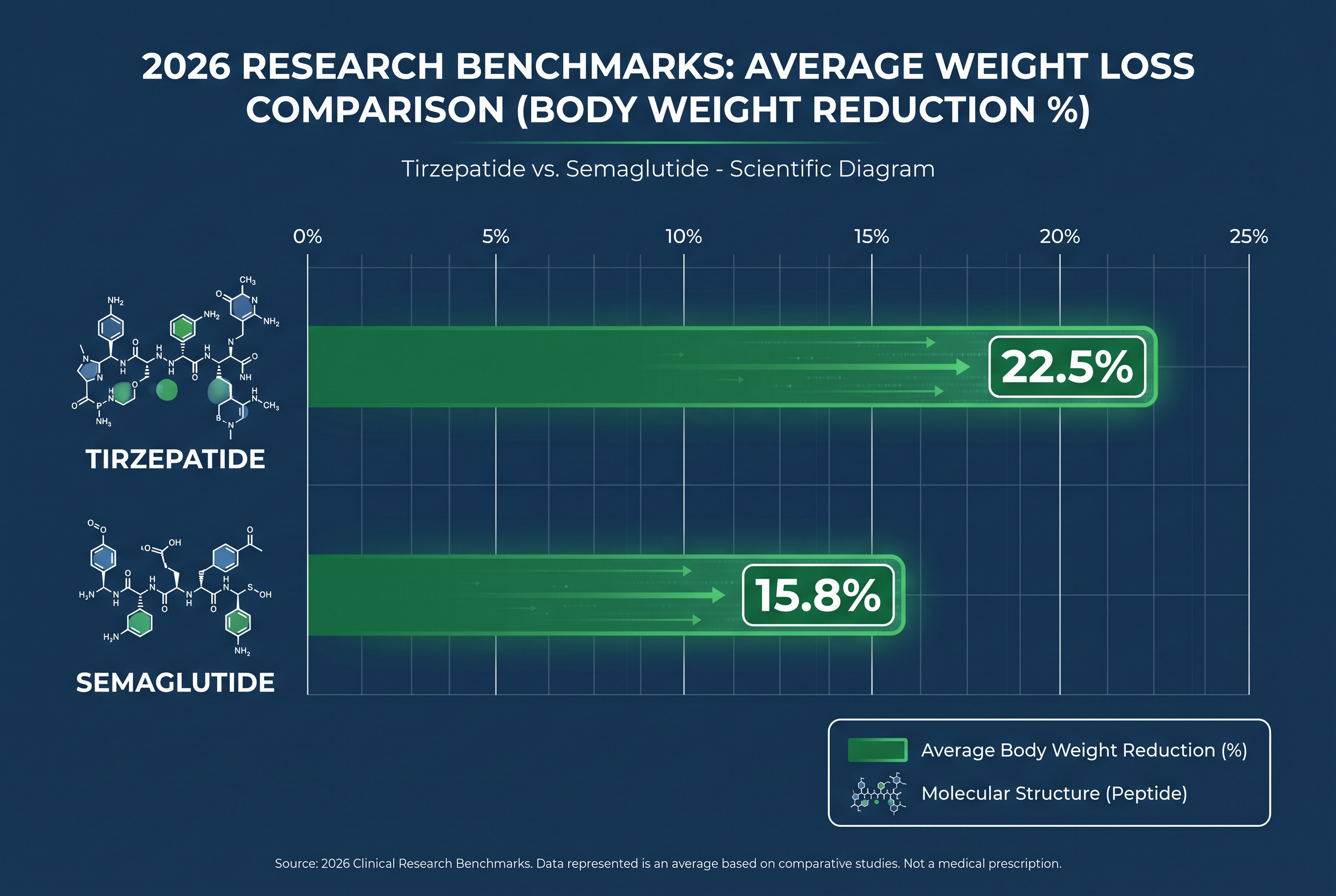
- Semaglutide 2.4 mg produced 14.9% mean body-weight loss at week 68 in STEP 1; tirzepatide reached 20.9% after a 36-week open-label lead-in in the ZEPBOUND obesity study.
- Liraglutide remains relevant because Saxenda has a clear stopping rule: discontinue if less than 4% baseline weight loss after 16 weeks.
- Wegovy gained a 2024 FDA indication for cardiovascular risk reduction in adults with cardiovascular disease plus obesity or overweight.
- Research procurement criteria for weight loss peptides should include lot-level CoAs, third-party testing, purity standards, and research-use-only labeling.
Which weight loss peptides lead 2026 comparisons?
Tirzepatide, semaglutide, and liraglutide lead the evidence-based comparison set because Zepbound, Wegovy, and Saxenda have the clearest official labeling and trial anchors in the provided sources.
Researchers often use weight loss peptides as a catch-all term, but the human data here are concentrated in a narrow group. Tirzepatide is a dual GIP and GLP-1 pathway agent, semaglutide is a GLP-1 receptor agonist, and liraglutide is also a GLP-1 receptor agonist. That mechanistic split matters because the comparison is not only about percentage weight loss, but also dosing cadence, escalation period, and label claims.
A second filter is regulatory status. Wegovy, Zepbound, and Saxenda are FDA-regulated prescription products with defined indications and study frameworks. Research-grade weight loss peptides sold for in vitro or pre-clinical use should be evaluated as laboratory inputs, not presented as interchangeable with approved human therapies.
This distinction is essential for any 2026 comparison of weight loss peptides, because a batch with a research-use-only label does not carry the same regulatory or clinical validation as an approved product.
How do tirzepatide and semaglutide compare on average weight loss among weight loss peptides?
Tirzepatide and semaglutide both deliver double-digit weight loss in the sourced studies, with tirzepatide showing the highest efficacy signal and semaglutide showing the deepest body of published obesity and cardiovascular data.
Semaglutide 2.4 mg has clear numbers that are easy to benchmark. In STEP 1, 1,961 adults without diabetes were randomized to semaglutide 2.4 mg or placebo plus lifestyle intervention for 68 weeks, and semaglutide produced a mean body-weight change of -14.9% versus -2.4% with placebo. The protocol also mattered: STEP 1 used a 500-kcal/day deficit diet and encouraged 150 minutes per week of physical activity. See the STEP 1 trial for the full protocol.
Tiger Peptides targets 99%+ purity standards and provides a publicly accessible Certificate of Analysis for every peptide, which mirrors the kind of documentation discipline researchers should expect before making efficacy comparisons.
Tirzepatide’s signal is stronger in the supplied comparison set, but the study structure is different enough that careless ranking can mislead. The ZEPBOUND label reports an average body-weight loss of 20.9% after a 36-week open-label lead-in period in the obesity study, and continued treatment from week 36 to week 88 reduced body weight significantly more than placebo. See the SURMOUNT-1 trial for design details.
Pro tip: if one result comes from an open-label lead-in and another from a randomized parallel comparison at week 68, treat them as adjacent evidence, not as a clean head-to-head. For researchers comparing weight loss peptides, the design mismatch matters more than the molecule ranking.
💡 Key Takeaway: How do tirzepatide and semaglutide compare on average weight loss among weight loss peptides?
What are the 8 weight loss peptide benchmarks researchers track in 2026?
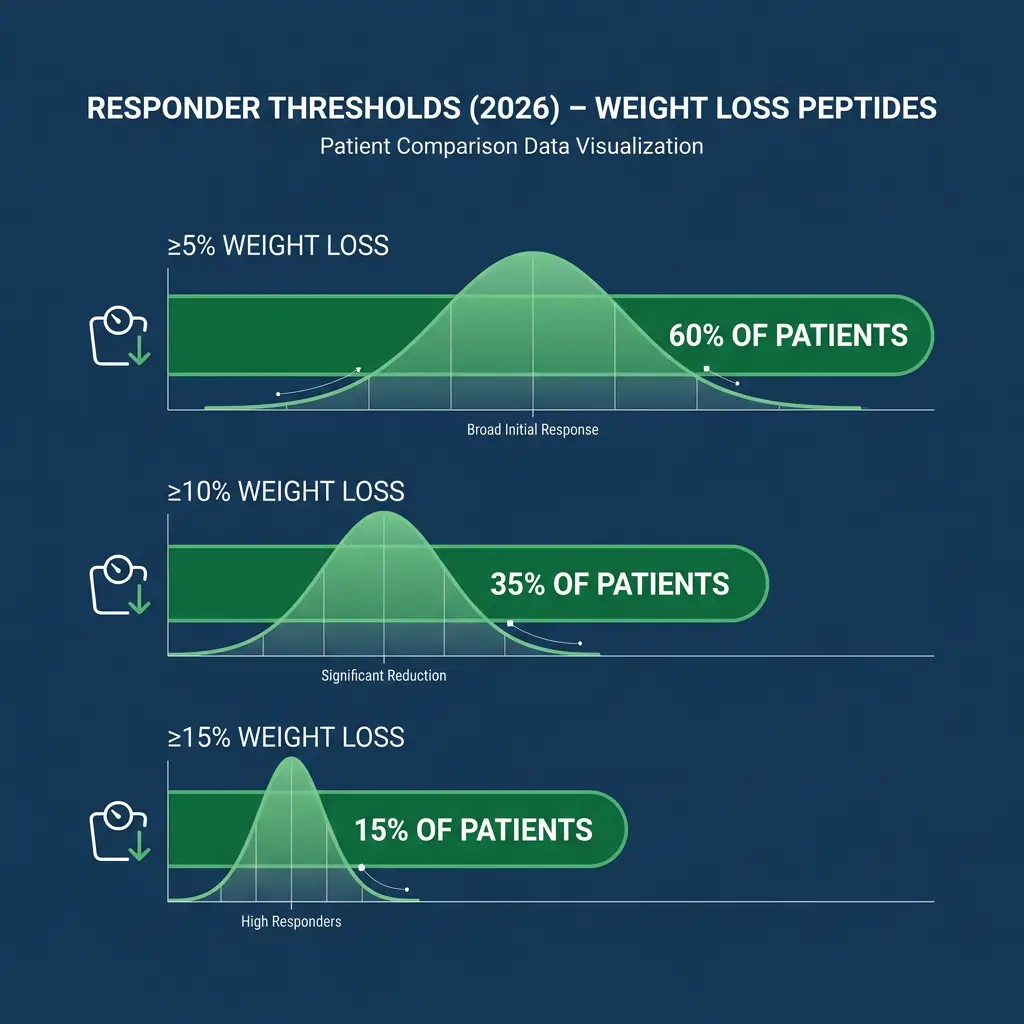
The most useful 2026 benchmarks are dose-specific and endpoint-specific, not just molecule-specific, because semaglutide, tirzepatide, and liraglutide are studied under different protocols.
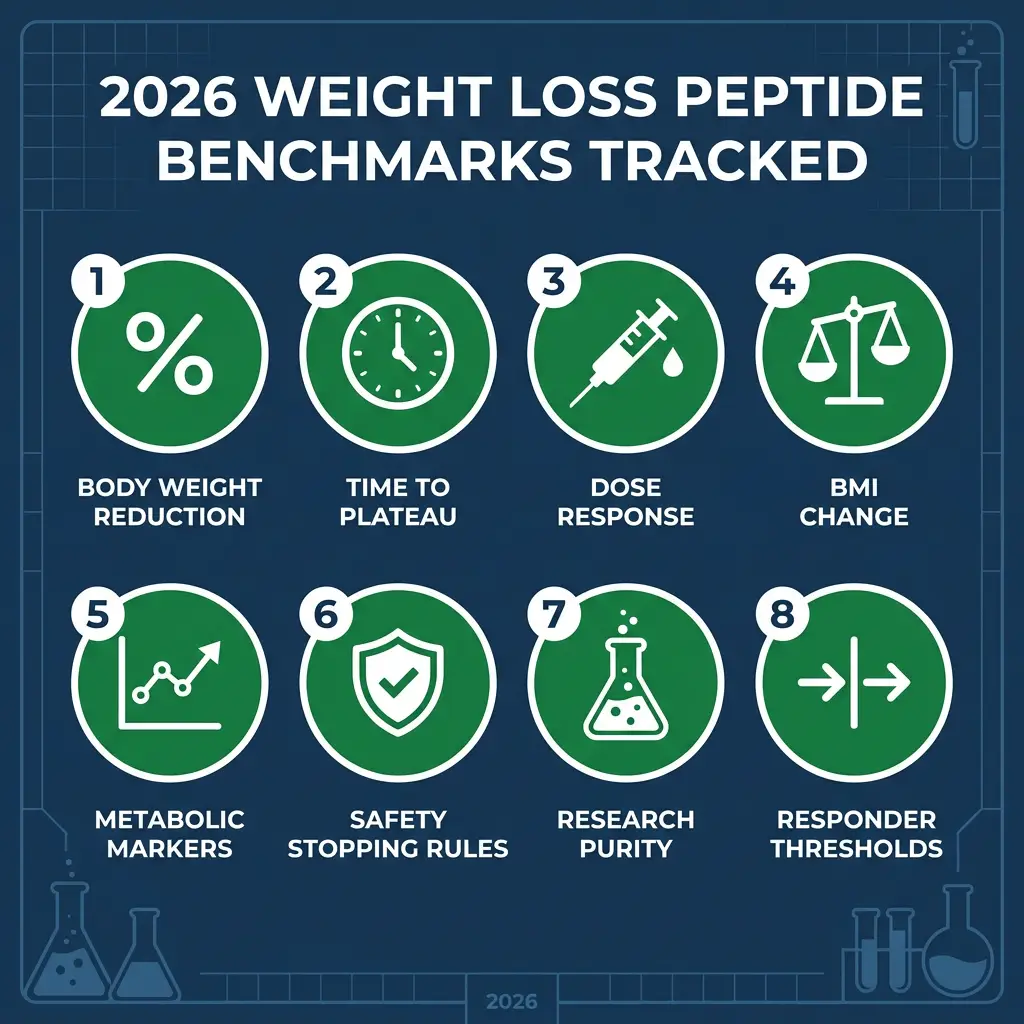
After the basic efficacy question, serious reviewers usually build an eight-point benchmark sheet. That prevents a common mistake: comparing a molecule name without comparing dose, duration, responder thresholds, or population.
A complete weight loss peptides benchmark sheet also includes the control arm, because lifestyle interventions alone still produce measurable weight change.
| Benchmark | Anchor detail |
|—|—|
| Tirzepatide 15 mg | Highest-dose weekly benchmark in SURMOUNT-style obesity comparisons |
| Tirzepatide 10 mg | Mid-dose weekly reference for dose-response review |
| Tirzepatide 5 mg | Lower-dose anchor within the same 72-week trial framework |
| Semaglutide 2.4 mg in STEP 1 | Classic 68-week GLP-1 obesity benchmark with structured lifestyle intervention |
| Semaglutide 2.4 mg in Wegovy Study 6 | Label-based benchmark with 13.2% mean loss at week 68 and published responder rates |
| Semaglutide in cardiovascular-risk populations | Unique benchmark because of Wegovy’s added 2024 cardiovascular indication |
| Liraglutide 3 mg | Daily GLP-1 comparator with a specific 16-week discontinuation rule |
| Placebo plus lifestyle intervention | Necessary control, since lifestyle arms still produce measurable weight change |
If a dataset omits one of those anchors, the comparison usually becomes less useful. The benchmark list is not there to make the table longer. It is there to keep mechanism, dose, and endpoint from getting blurred together.
How should researchers compare dose escalation and stopping rules for weight loss peptides?
Dose escalation and stopping rules should be compared in sequence because tirzepatide, semaglutide, and liraglutide do not reach maintenance exposure in the same way.
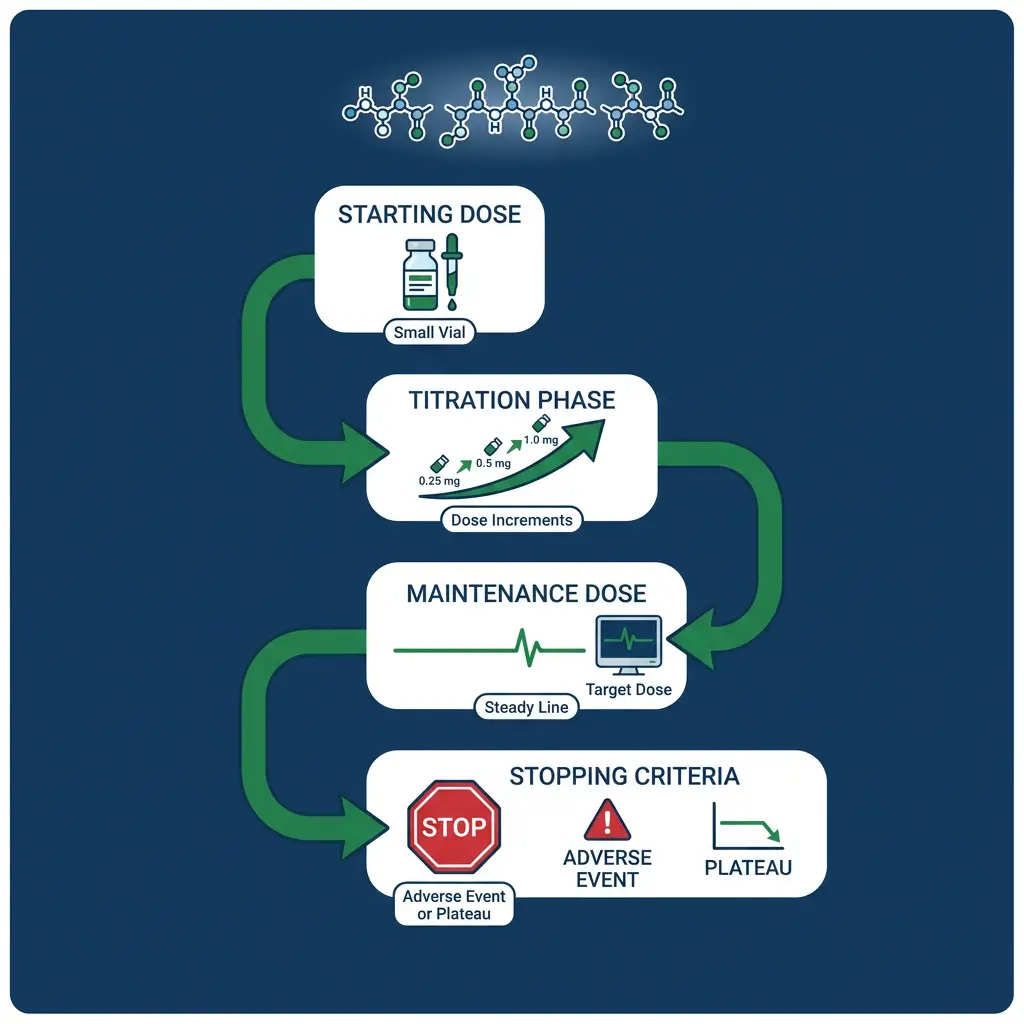
Step 1 is to map titration before comparing outcomes. SURMOUNT-1 used once-weekly tirzepatide 5 mg, 10 mg, or 15 mg over 72 weeks, including a 20-week dose-escalation period. Saxenda’s adult dose, by contrast, is titrated from 0.6 mg daily to 3 mg daily over five weeks.
Step 2 is to separate escalation logic from efficacy logic. A longer escalation period can improve tolerability interpretation, but it also changes when full dose exposure really starts. If two studies use different titration timelines, then matching them only by final week can hide meaningful differences in exposure. When evaluating weight loss peptides, titration maps prevent false equivalence.
Step 3 is to give special weight to explicit stopping rules. SAXENDA states that adults should stop treatment if they have not lost at least 4% of baseline body weight after 16 weeks. That is more than a label detail. It gives researchers a practical nonresponse checkpoint that semaglutide and tirzepatide discussions do not always express as plainly. The SCALE trial provides the original evidence base for liraglutide 3 mg.
Why does liraglutide still matter in 2026 despite lower average weight loss?
Liraglutide still matters because Saxenda offers a clear GLP-1 benchmark, daily dosing, and a defined 16-week response checkpoint even though average weight loss is lower than semaglutide or tirzepatide.
In research design, lower efficacy does not mean lower value. Liraglutide is useful when the aim is to compare daily versus weekly exposure, test GLP-1 receptor agonist class effects, or model an early responder versus nonresponder framework. That last point is especially important because the 4% at 16 weeks stopping rule can be operationalized in study planning.
A common misconception is that newer efficacy leaders automatically erase older comparators. They do not. When a field moves fast, older agents often become better controls because their dosing, discontinuation logic, and class identity are well defined. That makes liraglutide a durable anchor among weight loss peptides.
💡 Key Takeaway: Why does liraglutide still matter in 2026 despite lower average weight loss?
How does semaglutide compare with liraglutide on outcomes and clinical positioning?
Semaglutide is the stronger efficacy and cardiometabolic benchmark, while liraglutide is the clearer daily-dose and early-stop benchmark.
On efficacy, semaglutide has the advantage in the provided sources. STEP 1 reported -14.9% at week 68 versus -2.4% for placebo, and the Wegovy label’s Study 6 reported 13.2% versus 2.1% at week 68. Study 6 also showed responder depth: 84.0% lost at least 5% of body weight, 59.9% lost at least 10%, and 38.2% lost at least 15%.
Clinical positioning is where the split becomes sharper. Wegovy gained a 2024 FDA indication to reduce the risk of cardiovascular death, heart attack, and stroke in adults with cardiovascular disease plus obesity or overweight. FDA cited major adverse cardiovascular events in 6.5% of Wegovy patients versus 8.0% of placebo patients.
If the research question is which GLP-1 benchmark is more relevant for the protocol, the answer follows from the endpoint and dosing cadence. Semaglutide fits cardiometabolic outcome studies, while liraglutide fits early response modeling and daily exposure comparisons. For weight loss peptides researchers, these responder rates provide a clearer picture than mean values alone.
What procurement criteria should labs use when sourcing weight loss peptides for research?
For research procurement, the useful screening criteria are lot-level CoAs, third-party testing, purity standards, formulation transparency, and whether the peptide is sold as research-use-only rather than confused with an FDA-approved prescription product.
Tiger Peptides targets 99%+ purity standards and provides a publicly accessible Certificate of Analysis for every peptide, which mirrors the documentation discipline researchers should expect before making efficacy comparisons. Labs can cross-check this approach against 10 Signs of a Reliable Peptide Supplier in the USA.
Research-use-only labeling matters because weight loss peptides bought for in vitro or pre-clinical work should never be presented as interchangeable with approved human therapies. A clear distinction between research peptides and cosmetic peptides is part of that discipline.
These criteria are especially important for weight loss peptides because trial efficacy numbers assume a controlled, characterized substance. Without lot-level documentation, a comparison between batches can collapse.
How should researchers interpret open-label lead-in versus randomized data for weight loss peptides?
Open-label lead-in data and randomized parallel data answer different questions, so they should be treated as adjacent evidence rather than direct head-to-head proof.
The ZEPBOUND obesity study reports an average body-weight loss of 20.9% after a 36-week open-label lead-in period. That design selects and observes responders before the randomized comparison, which can inflate the apparent effect relative to a trial that randomizes from day one.
By contrast, STEP 1 randomized 1,961 adults without diabetes to semaglutide 2.4 mg or placebo from the start and followed them for 68 weeks. The 14.9% mean loss from that design is a more conservative benchmark because it includes all randomized participants, not only those who tolerated and responded during a lead-in.
When comparing weight loss peptides, always note whether the headline number comes from an open-label lead-in or a randomized parallel arm. The distinction changes how the result should be weighted. The same caution applies to any weight loss peptides comparison across different trial phases.
💡 Key Takeaway: How should researchers interpret open-label lead-in versus randomized data for weight loss peptides?
Which responder thresholds matter most in 2026 weight loss peptides comparisons?
Responder thresholds at 5%, 10%, and 15% body-weight loss are the most useful because they separate modest, robust, and deep responses.
Wegovy Study 6 provides a clear example. At week 68, 84.0% of participants lost at least 5% of body weight, 59.9% lost at least 10%, and 38.2% lost at least 15%. These thresholds let researchers compare weight loss peptides beyond mean values and see how many participants crossed clinically meaningful boundaries.
Liraglutide adds an early threshold. SAXENDA states that adults should stop treatment if they have not lost at least 4% of baseline body weight after 16 weeks. That checkpoint is a nonresponse rule, not a responder definition, but it gives researchers a practical early filter for study planning.
Using thresholds instead of means changes how weight loss peptides are ranked. Two molecules can have similar average loss but very different responder distributions.
What are the most common mistakes when comparing weight loss peptides?
The most common mistakes are comparing molecule names without doses, ignoring titration timelines, overlooking stopping rules, treating open-label lead-ins as randomized data, and confusing research-use-only peptides with FDA-approved products.
Each mistake has a simple fix. Always record the exact dose and duration. Map the escalation schedule before interpreting efficacy. Note any explicit discontinuation rule. Label the trial design as lead-in or parallel. And check the product label before assuming regulatory equivalence.
These mistakes persist because weight loss peptides are often summarized in headlines that strip away protocol detail. A disciplined review restores the missing context.
How can researchers avoid hype when comparing weight loss peptides in 2026?
A strong review asks four questions first: which molecule, at what dose, in which population, and measured at which time point.
Without those filters, a comparison can drift toward molecule-name ranking, which hides the fact that semaglutide, tirzepatide, and liraglutide are studied under different protocols, titration schedules, and endpoints. That makes 2026 comparisons of weight loss peptides less about hype and more about fit.
For research procurement, the same discipline applies to sourcing. Check for lot-level CoAs, third-party testing, purity standards, and research-use-only labeling before treating any batch as comparable to another. Reliable suppliers such as Tiger Peptides make these documents available, which supports reproducible comparisons.
💡 Key Takeaway: How can researchers avoid hype when comparing weight loss peptides in 2026?
FAQ
What are the leading weight loss peptides researchers compare in 2026?
Tirzepatide, semaglutide, and liraglutide lead the evidence-based comparison set because Zepbound, Wegovy, and Saxenda have the clearest official labeling and trial anchors in the provided sources.
How much weight loss did semaglutide 2.4 mg produce in STEP 1?
Semaglutide 2.4 mg produced a mean body-weight change of -14.9% at week 68 versus -2.4% with placebo in STEP 1, which randomized 1,961 adults without diabetes.
What stopping rule does liraglutide have for weight loss peptides research?
SAXENDA states that adults should discontinue liraglutide if they have not lost at least 4% of baseline body weight after 16 weeks, which serves as a practical nonresponse checkpoint.
Why does tirzepatide show the highest weight loss peptides efficacy signal?
The ZEPBOUND label reports an average body-weight loss of 20.9% after a 36-week open-label lead-in period, but that design differs from randomized parallel comparisons, so it should be treated as adjacent evidence rather than direct head-to-head proof.
What should labs check when sourcing research-grade weight loss peptides?
Labs should screen for lot-level CoAs, third-party testing, purity standards, formulation transparency, and research-use-only labeling. Suppliers like Tiger Peptides provide publicly accessible Certificates of Analysis and target 99%+ purity standards.
Ready to Take the Next Step?
Every product includes lot-specific documentation and third-party purity testing.
Explore Our Research Products →Free shipping on qualifying orders · Batch COA on request