
10 Signs of a Reliable Peptide Supplier in the USA
Identify reliable peptide suppliers in the usa with 10 proven signs, batch CoAs, third-party testing, and supplier qualification. Research use only.
📋 Table of Contents
Need to identify reliable peptide suppliers in the usa? The clearest answer: a supplier is reliable when it provides batch-level certificates of analysis tied to the exact lot you buy, verifiable third-party testing, and clear research-use-only (RUO) labeling that aligns with FDA and USP supplier qualification expectations in the usa. This proven guide covers 10 signs, batch CoAs, third-party testing, and supplier qualification.
Key takeaways
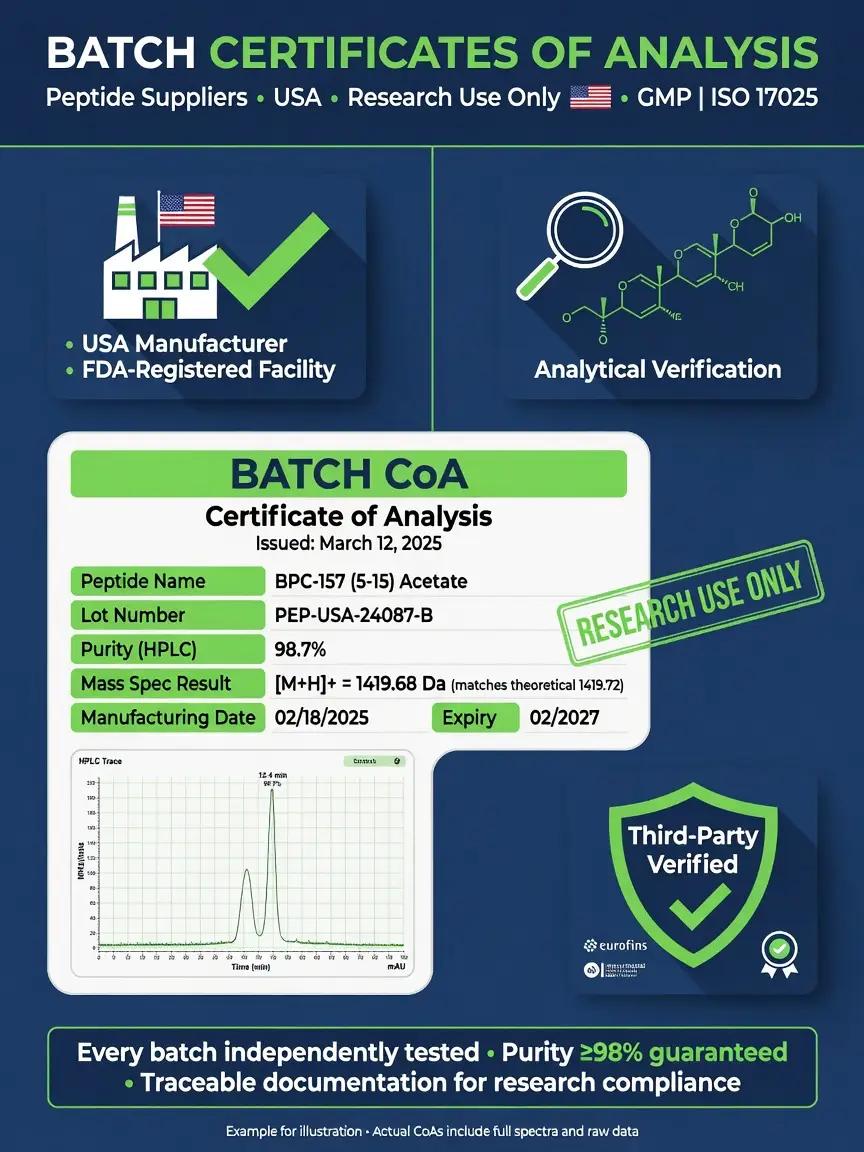
- A batch-level certificate of analysis tied to the exact lot you buy is the clearest first filter for peptide suppliers in the usa.
- FDA and USP supplier qualification requires at least one specific identity test and validation of supplier results at appropriate intervals.
- Research-use-only peptide suppliers in the usa should show public CoAs, third-party testing, lot traceability, and honest RUO labeling.
- FDA-registered facilities and 503B outsourcing facilities are not the same signal, and neither replaces batch-specific evidence.
- Missing lot numbers, human-use claims, or unexplained packaging are risk signals, not buying opportunities.
Why do batch-level certificates of analysis matter for peptide suppliers in the usa?
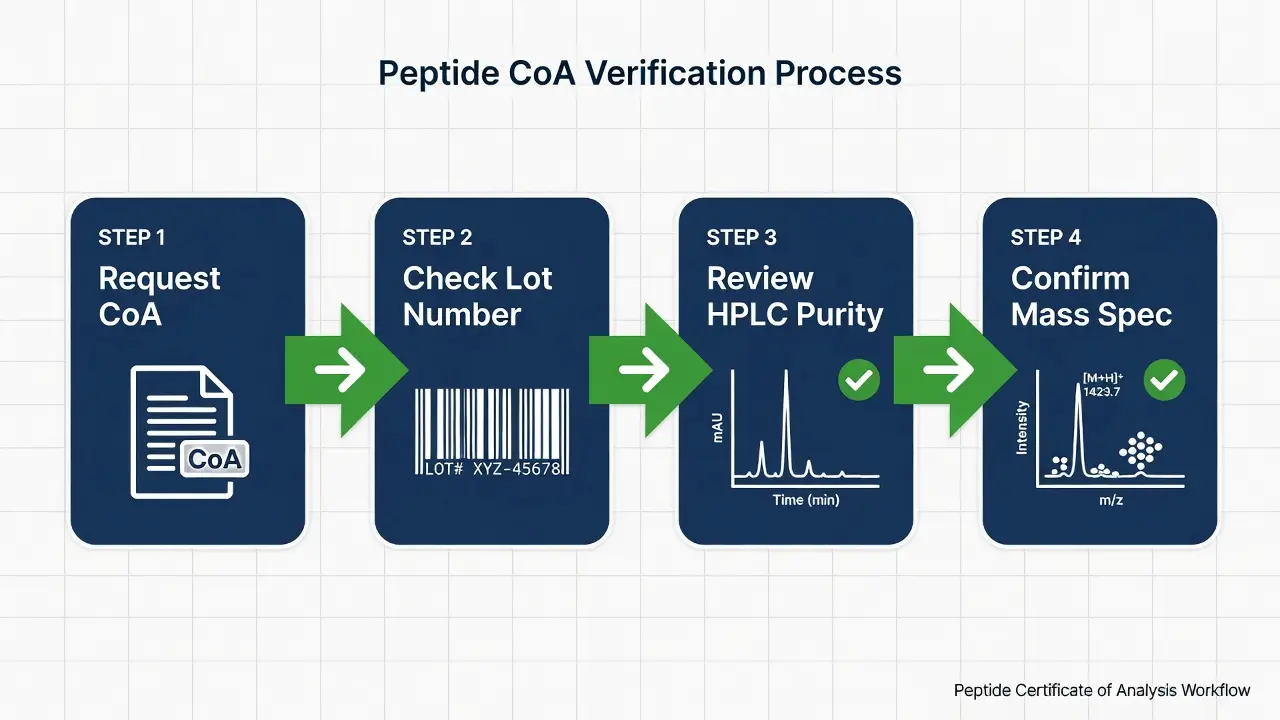
A batch-level certificate of analysis from an FDA-aware supplier is the clearest first filter. FDA and USP both treat documented analytical results as part of supplier qualification, and a real CoA should match the exact lot you buy, not a generic product page.
A peptide supplier can say ‘high purity’ all day, but that phrase means little without batch evidence. A useful CoA should identify the peptide, reference the lot or batch number, show the analytical method used, and report the relevant result. In peptide procurement in the usa, that usually means purity by HPLC or UPLC and identity by mass spectrometry or a similarly specific method.
A common mistake is treating any PDF as proof. FDA’s quality Q&A makes a sharper point: a supplier report is not enough by itself unless the receiving manufacturer performs at least one specific identity test and validates supplier results at appropriate intervals. That is why generic, reused, or unlabeled reports are a warning sign, not a reliability signal.
‘Tiger Peptides publishes publicly accessible CoAs for every peptide and states 99%+ purity standards.’
For research-grade peptide solutions from Tiger Peptides, see 7 Proven Research-Grade Peptide Solutions.
For broader FDA supplier qualification context, consult FDA guidance documents.
How should you verify a peptide certificate of analysis step by step?
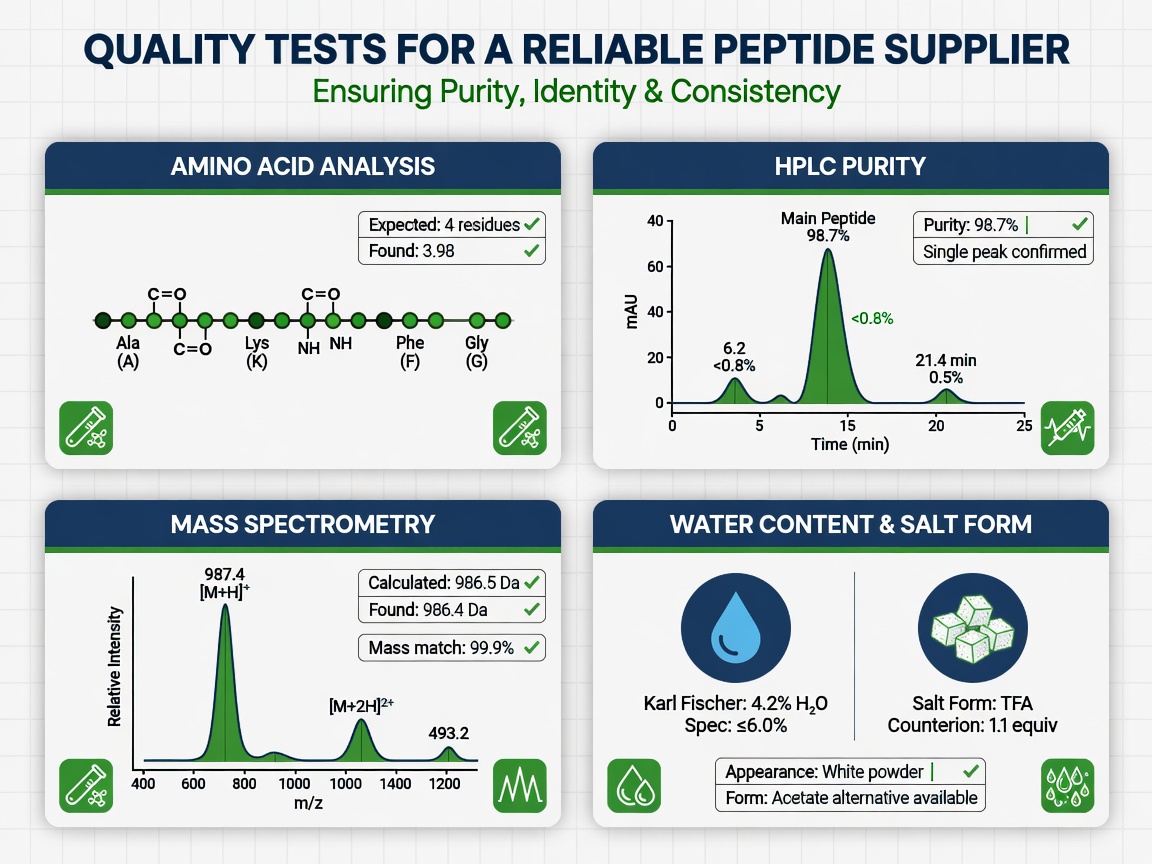
Verify the CoA in three moves: match the lot number, check the methods, and confirm who performed the testing. A report tied to HPLC or LC-MS data from an accredited lab is stronger than a screenshot with no batch reference.
Step 1 is batch matching. The lot number on the label, invoice, or packing slip should match the lot number on the CoA. If the supplier cannot provide that link before shipment or at receipt, you do not really know which batch the test results belong to. This is especially important for peptide buyers in the usa, where lot-level traceability is a core supplier qualification requirement.
Step 2 is method review. Look for a specific identity method and a purity method, not vague language like ‘tested for quality.’ HPLC chromatograms, LC-MS, or mass spec identifiers are normal in peptide workflows in the usa. If the supplier only shares a percentage with no method, the result is hard to trust.
Step 3 is lab verification. Ask whether the test was run in house, by a third-party lab, or both. Third-party testing does not erase the need for internal controls, but it does reduce the risk of self-attested quality. Pro tip: if a buyer needs tighter control, ask for the retest date and storage conditions, not just the original release date.
Key Takeaway: How should you verify a peptide certificate of analysis step by step? Match the lot, review the method, and confirm the testing lab.
💡 Key Takeaway: How should you verify a peptide certificate of analysis step by step?
Which peptide suppliers in the usa are worth benchmarking for transparency?
A small set of suppliers, including Tiger Peptides and Bachem, can serve as transparency benchmarks. The point is not to crown a winner. The point is to compare public documentation, testing depth, and supply-chain clarity against the same procurement checklist.
When buyers benchmark suppliers in the usa, they are really benchmarking evidence. That means lot traceability, test accessibility, facility context, and whether the supplier clearly separates research-use-only products from anything that would require compounding or sterile drug controls.
Tiger Peptides: A useful benchmark for public CoAs, third-party testing by accredited labs, 99%+ purity standards, and peptides synthesized in the usa-registered facilities.
Bachem: A useful benchmark for comparing how an established peptide manufacturer presents technical documentation and peptide manufacturing terminology.
PolyPeptide: A useful benchmark for comparing specialist peptide supply language, manufacturing context, and quality-system communication.
GenScript: A useful benchmark when contrasting custom peptide service workflows with catalog-style peptide sourcing.
Any reseller with no batch-level CoA: A useful negative control, because missing lot traceability and missing analytical records fail the benchmark immediately.
For a deeper comparison of resellers in the usa, see Searching ‘Almighty Peptides’? How to Compare Suppliers.
| Supplier benchmark | Public CoA | Third-party testing | Lot traceability | RUO clarity |
|——————-|————|———————|——————|————-|
| Tiger Peptides | Yes, for every peptide | Yes, accredited labs | Yes, lot-specific | Yes |
| Bachem | Technical documentation available | Yes | Yes | Yes |
| PolyPeptide | Yes | Yes | Yes | Yes |
| GenScript | Yes for custom workflows | Yes | Yes | Yes |
| Reseller with no CoA | No | No | No | Unclear |
Use this table as a starting point, not a final judgment. The key is to verify each item against the exact lot you are buying, because a supplier’s general documentation may not reflect a specific reseller batch in the usa.
How do FDA-registered facilities and 503B outsourcing facilities differ?
They are not the same signal. FDA-registered facilities can refer to manufacturing sites in the supply chain, while a 503B outsourcing facility is a specific compounding category that FDA lists and inspects on a risk-based schedule.
This distinction matters because buyers often confuse registration with approval. Registration can indicate visibility in the supply chain, but it does not by itself prove that a peptide lot meets your specification. A 503B outsourcing facility, by contrast, refers to a human drug compounding framework with its own oversight expectations.
If a seller is offering sterile compounded peptide products, questions should expand quickly: sterility testing, endotoxin testing, strength, release procedures, contamination controls, and whether the facility falls into the outsourcing-facility context. If the supplier is selling research-use-only peptide powders for in vitro or pre-clinical work, 503B status may be irrelevant, but lot traceability and component quality still matter in the usa.
A common misconception is that ‘made in an FDA-registered facility’ equals quality. In the usa, buyers should treat that claim as a starting point for documentation requests, not as a substitute for a batch CoA.
Why is supplier qualification a stronger sign than a polished website?
A polished website proves marketing skill, not peptide quality. Supplier qualification, by contrast, forces you to ask for evidence: identity tests, purity methods, lot numbers, storage data, and third-party validation. In the usa, FDA and USP guidance repeatedly points to documented qualification over visual polish.
Reliable peptide suppliers in the usa invest in technical documentation before web design. When a supplier cannot show a CoA but has a beautiful homepage, that is a red flag. Conversely, a plain site with batch-level CoAs and clear RUO labeling is far more useful for procurement decisions.
Qualification also protects against substitution risk. If you never verify the supplier’s test results, you may receive a peptide that differs in salt form, water content, or sequence from what you ordered. That risk is unacceptable in research workflows in the usa, where reproducibility depends on defined material.
💡 Key Takeaway: Why is supplier qualification a stronger sign than a polished website?
What quality tests should a reliable peptide supplier show?
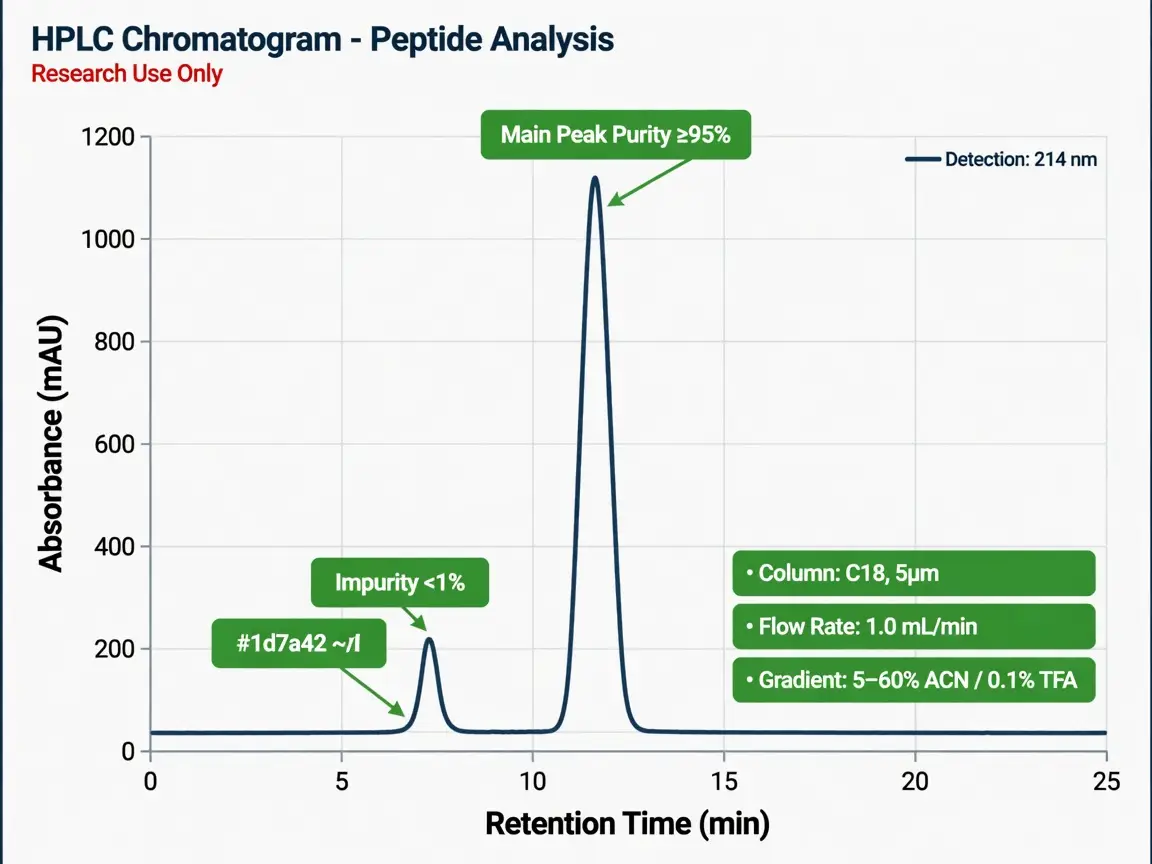
At minimum, a reliable peptide supplier should show two orthogonal tests: purity by HPLC or UPLC and identity by mass spectrometry. Additional tests such as amino acid analysis, net peptide content, residual solvent analysis, and endotoxin testing add confidence.
For research-use-only peptides in the usa, the most common release tests are HPLC purity and LC-MS identity. Purity alone is not enough because impurities with similar retention times can hide under a single peak. Identity by mass spec confirms the molecular weight matches the expected sequence.
A supplier that shows only a percentage with no chromatogram or mass spectrum is not providing a quality test; it is providing a marketing claim. Reliable suppliers in the usa will share the actual data or at least a summary signed by the analytical lab.
What HPLC parameters should appear on a peptide CoA?
A useful HPLC section on a peptide CoA should list the column type, mobile phase, gradient, detection wavelength, retention time, and peak purity percentage. Without those parameters, the purity number cannot be reproduced or audited.
In the usa, peptide buyers increasingly ask for UPLC methods because they offer higher resolution than traditional HPLC. The CoA should state whether the method is HPLC or UPLC, and whether the purity is area percent or weight percent. Area percent can overstate purity if non-peptide impurities are present.
Why does mass spectrometry matter for peptide identity?
Mass spectrometry provides a direct molecular weight measurement, which is the strongest routine identity test for a synthetic peptide. HPLC purity cannot distinguish peptides with the same sequence but different modifications or truncations if they co-elute. Mass spec resolves those differences.
For peptide suppliers in the usa, LC-MS or MALDI-TOF data should match the theoretical mass within an accepted tolerance, typically ±0.5 Da for small peptides. If the mass is off by one amino acid mass, the sequence is wrong, even if HPLC looks clean.
For peer-reviewed peptide characterization methods, see PubMed.
💡 Key Takeaway: Why does mass spectrometry matter for peptide identity?
How do salt form and water content affect peptide quality?
Many research peptides are supplied as trifluoroacetate (TFA) salts, acetate salts, or hydrochloride salts. The salt form changes the molecular weight and net peptide content. A CoA that reports purity by HPLC area percent may ignore the salt and water contribution.
In the usa, reliable suppliers report net peptide content separately, often by amino acid analysis or elemental analysis. Water content by Karl Fischer titration also matters because lyophilized peptides can absorb moisture during storage. If a supplier cannot state salt form and water content, the actual peptide mass per vial is uncertain.
How does lot traceability reduce procurement risk in the usa?
Lot traceability means every vial or batch can be linked to a specific CoA, synthesis record, and purification run. In the usa, this is a core supplier qualification expectation under FDA and USP frameworks because it allows you to investigate out-of-specification results.
If a supplier cannot tell you which lot you are buying before payment, you cannot verify the CoA. Reliable peptide suppliers in the usa will provide lot numbers on quotes, packing slips, and CoAs. This practice also supports stability monitoring and retest intervals.
What storage and shipping practices signal reliability in the usa?
Peptides should ship with temperature control appropriate to their stability profile. Lyophilized peptides are generally stable at -20°C for long-term storage, but shipping at ambient temperature for a few days may be acceptable if the peptide is stable. Reliable suppliers in the usa will state recommended storage conditions on the CoA or product insert.
Look for desiccated packaging, protected from light, and clear retest dates. If a supplier ships peptide powder in a non-airtight container with no desiccant, moisture uptake can degrade the peptide. In the usa, procurement teams often ask for a shipping temperature log for sensitive peptides.
Also check whether the supplier uses ice packs or cold chain for peptides that require it. Research-use-only peptides may not need sterile cold chain, but the supplier should still document storage and shipping conditions. For nationwide research lab supply, see Nationwide Peptides for Research Labs | Tiger Peptides.
💡 Key Takeaway: What storage and shipping practices signal reliability in the usa?
How can you compare research-use-only suppliers in the usa without falling for marketing?
Marketing often emphasizes purity percentages, fast shipping, and customer reviews. Those factors matter less than batch evidence. To compare suppliers in the usa, create a checklist: lot-specific CoA, third-party testing, mass spec identity, HPLC parameters, salt form, water content, and RUO labeling.
A supplier that uses phrases like ‘pharmaceutical grade’ or ‘for human use’ on a research peptide page is either confused or misleading. Reliable research-use-only suppliers in the usa clearly separate RUO products from anything requiring compounding or sterile drug controls.
You can also benchmark against known transparent suppliers. For example, Tiger Peptides publishes public CoAs and 99%+ purity standards. See Tiger Peps: Research-Grade Peptides | Tiger Peptides.
What are the most common red flags among peptide suppliers in the usa?
Red flags include missing lot numbers, CoAs that are reused across multiple products, purity claims without method details, and human-use language on research peptides. Also watch for suppliers that refuse to share testing data before purchase or that change lot numbers after payment.
If a supplier claims 99% purity but cannot provide a chromatogram or mass spectrum, treat that claim as unverified. The same applies to suppliers that use stock photos of lab equipment but have no actual batch records.
How should you apply FDA and USP supplier qualification in the usa?
FDA’s quality guidance states that a supplier’s certificate of analysis is not sufficient by itself; the receiving manufacturer must perform at least one specific identity test and validate supplier results at appropriate intervals. USP general chapters on supplier qualification echo this approach.
For research-use-only peptide buyers, the same principle applies: do not rely solely on the supplier’s CoA. Perform or commission an independent identity test on the received lot, or at minimum verify the CoA against the lot number and ask for third-party data.
💡 Key Takeaway: How should you apply FDA and USP supplier qualification in the usa?
What does a model supplier qualification checklist look like?
A model checklist includes: supplier name and address, FDA registration status if applicable, quality agreement, batch-level CoA for each lot, third-party test reports, HPLC parameters, mass spec data, salt form, water content, storage conditions, retest date, and RUO statement. Each item should be verified before purchase and at receipt.
Use a scoring system: mandatory items are lot-specific CoA, identity by mass spec, and purity by HPLC with parameters. Optional items include amino acid analysis, residual solvent testing, and endotoxin testing for sterile workflows.
How do the usa regulatory expectations shape supplier documentation?
The usa regulatory expectations, drawn from FDA cGMP and USP chapters, push suppliers to document every step from raw materials to release testing. That documentation is what enables a buyer to audit the supplier later. Even for research-use-only peptides, these expectations create a useful standard for documentation quality.
Suppliers that align with these expectations will have a quality system, change control, and deviation reporting. If a supplier cannot describe its quality system, that is a warning sign regardless of the product category.
What audit questions should you ask a peptide supplier?
Ask for the lot number before payment, the CoA for that exact lot, the identity method and purity method, the third-party lab name if applicable, the salt form, the water content, the storage conditions, the retest date, and the RUO statement. Also ask how the supplier handles out-of-specification results and whether it has a quality agreement template.
If the supplier hesitates on any of these, that is a risk signal. A reliable supplier will answer these questions in writing and provide documents.
💡 Key Takeaway: What audit questions should you ask a peptide supplier?
What should you do if a supplier cannot provide a CoA before purchase?
If a supplier cannot provide a CoA before purchase, do not buy. There is no legitimate reason for a research peptide supplier to withhold batch-level analytical data before payment. At best, the supplier is disorganized; at worst, the product is not what it claims.
You can ask for a redacted CoA if the supplier is concerned about proprietary methods, but the lot number, purity, identity, and key parameters should always be visible.
What final procurement rules should peptide buyers in the usa follow?
Final rules: always match lot numbers to CoAs; require identity by mass spec and purity by HPLC with parameters; ask for third-party testing evidence; verify salt form and water content; confirm RUO labeling; and never accept human-use claims on research peptides. Store peptides according to the supplier’s stated conditions and document receipt.
These rules apply whether you are buying from Tiger Peptides, Bachem, PolyPeptide, GenScript, or any reseller. For more on research peptides versus cosmetic peptides, see Research Peptides vs Cosmetic Peptides: Lab Basics.
FAQ
Q: What is the single most important document to request from a peptide supplier?
A: A batch-level certificate of analysis that matches the exact lot number you are purchasing. This document should show purity by HPLC or UPLC, identity by mass spectrometry, and the analytical methods used.
Q: Does third-party testing replace internal verification?
A: No. Third-party testing reduces self-attestation risk, but FDA and USP supplier qualification still expect the receiving lab to perform at least one specific identity test and validate supplier results at appropriate intervals.
Q: Are FDA-registered facilities the same as 503B outsourcing facilities?
A: No. FDA registration indicates supply-chain visibility, while a 503B outsourcing facility is a specific human drug compounding category with its own oversight expectations. Neither replaces batch-specific evidence for research peptides.
Q: Why do salt form and water content matter?
A: Salt form changes molecular weight and net peptide content, and water content affects the actual peptide mass per vial. Without these data, a 99% purity claim by HPLC area percent may overstate the usable peptide.
Q: Can a research-use-only peptide supplier make human-use claims?
A: No. Research-use-only peptides are strictly for in vitro laboratory research and must not be described as sterile, injectable, or for human use. Clear RUO labeling is a sign of a reliable supplier.
Ready to Take the Next Step?
Every product includes lot-specific documentation and third-party purity testing.
Explore Our Research Products →Free shipping on qualifying orders · Batch COA on request