
Research Peptides vs Cosmetic Peptides: Lab Basics
research peptides cosmetic peptides differ by purpose, documentation, and formulation. This lab guide covers purity, COA data, skin delivery, and FDA rules.
📋 Table of Contents
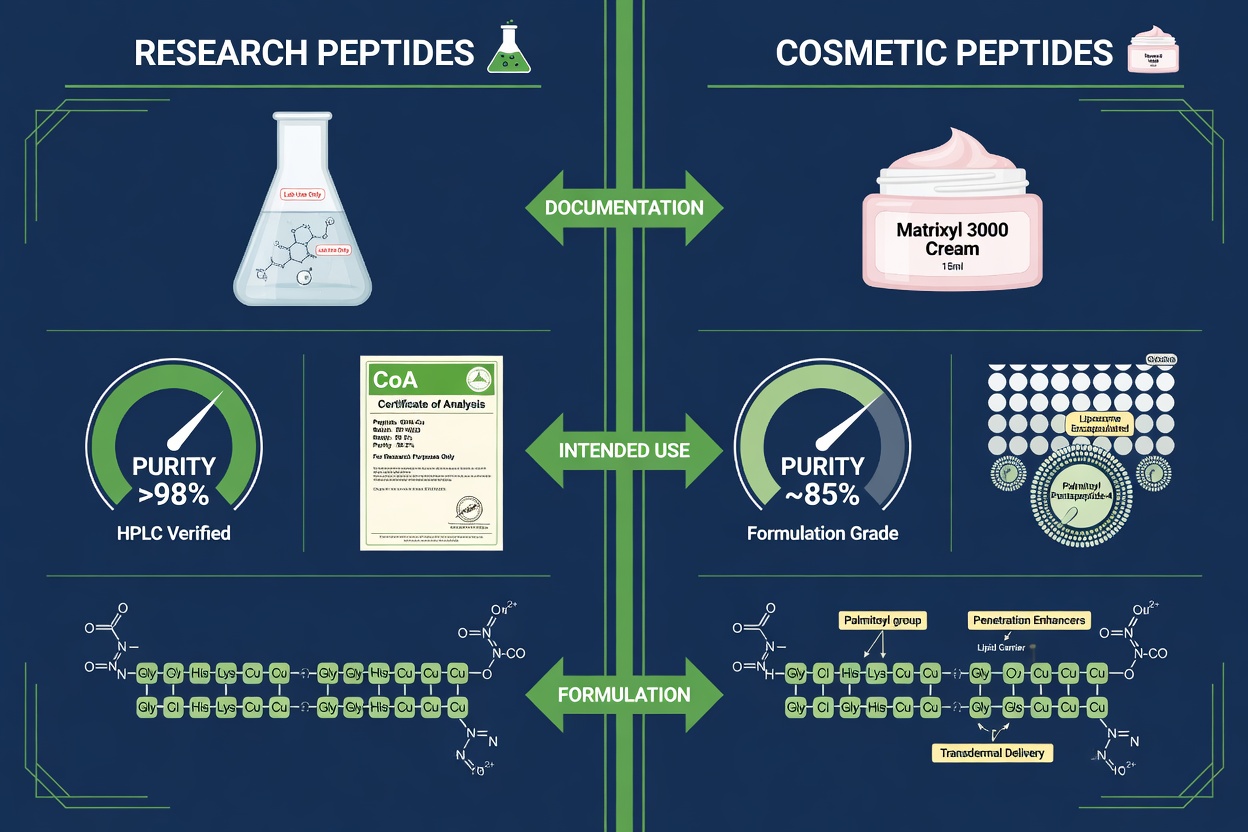
research peptides cosmetic peptides differ by intended use, documentation, and formulation context, not by amino-acid chemistry alone. Research peptides are raw materials supplied for controlled laboratory, analytical, and pre-clinical work, judged by identity, purity, and batch documentation. Cosmetic peptides are ingredients embedded in finished skin-care products, judged by safety under labeled use, formulation stability, and skin delivery. That direct answer shapes procurement, testing, and regulatory review across every research peptides cosmetic peptides comparison. Research-use note: all peptide references in this article are for in vitro laboratory research only, never for human or veterinary application.
Key takeaways
- The research peptides cosmetic peptides distinction is about intended use and documentation, not chemistry alone.
- Research peptides require CoA, purity profile, and batch traceability for in vitro and pre-clinical workflows.
- Cosmetic peptides must survive the vehicle, remain stable, and address the stratum corneum barrier.
- FDA does not require routine premarket approval for cosmetics, but safety under labeled use is a legal obligation.
- Formulation quality, not just peptide name, determines whether a cosmetic peptide can perform.
What Are Cosmetic Peptides and How Are They Defined for Skin-Care Use?
Cosmetic peptides are a subset of peptides used in skin-care formulations. They are typically selected for cosmetic goals related to the appearance or condition of skin, not for laboratory assay development or pre-clinical screening as stand-alone research materials. In a research peptides cosmetic peptides evaluation, this category difference appears immediately: one is a raw material, the other is a finished-product ingredient.
A peptide name on a label does not tell you how well it survives in the formula, how much of it is present, whether it remains stable over time, or whether it can move through the outer skin barrier. A Cleveland Clinic review aimed at consumers makes this point clearly: peptides may support collagen and elastin-related skin processes, yet the presence of peptides alone does not guarantee a strong product outcome.
The formula matters. The delivery system matters. The use pattern matters. Those three variables separate a credible cosmetic peptide from a marketing label, and they also separate the cosmetic category from the research peptides cosmetic peptides supply category where raw identity and purity lead.
A few basics help frame cosmetic peptides correctly: amino-acid sequences, skin-care formulation ingredients, barrier-limited topical actives, and safety tied to labeled use. None of those basics implies that a cosmetic peptide is interchangeable with a research peptide.
At the chemical level, a peptide is defined as a molecule made of at least two amino acids linked by peptide bonds, as noted in a 2024 review. Longer chains become polypeptides, and proteins are typically much larger. This chemistry is shared by research and cosmetic peptides, but the shared backbone does not create shared regulatory or performance outcomes.
For laboratory teams, the peptide definition is the starting point, not the end point. Sequence length, terminal modifications, salt form, counterion content, and residual solvents all matter in a research context. Those same details may be less visible in a cosmetic ingredient listing, which is why the research peptides cosmetic peptides boundary must be maintained during material review.
What Are the Core Differences Between research peptides cosmetic peptides in Laboratory Practice?
Research peptides and cosmetic peptides differ less by chemistry alone and more by intended use, documentation, and context. A research peptide is usually supplied for in vitro work, analytical use, assay development, or other pre-clinical applications. It is not a finished consumer product, and it should not be treated like one.
For labs, the raw material itself is the focus. Buyers want sequence identity, purity data, batch consistency, and reliable analytical documentation. Certificates of Analysis, third-party testing, and traceable production details carry real weight because the peptide may be entering a controlled experimental workflow. In the research peptides cosmetic peptides supply chain, those documents are not optional.
With cosmetic peptides, the peptide is only one part of the story. The finished formulation becomes central. A peptide that looks promising on paper may perform poorly in a serum or cream if the vehicle is weak, the ingredient is unstable, or delivery through the skin is limited. That is why the research peptides cosmetic peptides comparison cannot stop at the amino-acid sequence.
The table below captures the practical split.
| Aspect | Research Peptides | Cosmetic Peptides |
|—|—|—|
| Primary purpose | Laboratory and pre-clinical use | Skin-care formulation use |
| Evaluation focus | Identity, purity, reproducibility, analytical data | Safety in use, formulation stability, skin delivery, finished-product performance |
| Typical format | Raw peptide material | Peptide embedded in a cosmetic vehicle |
| Key documentation | CoA, purity profile, batch traceability, independent testing | Ingredient review, formulation data, safety support, product labeling |
| Main technical question | Is this peptide suitable for controlled research work? | Can this peptide reach its skin target safely and effectively? |
| Regulatory context | Research-use context, not consumer cosmetic marketing | Cosmetic product rules and ingredient safety obligations |
The table above captures the practical split between research peptides cosmetic peptides categories. Every row answers a different operational question, and labs should use it as a first filter before ordering or reviewing a material.
One peptide sequence can sit near the border of both categories, but the category is shaped by how it is prepared, presented, tested, and used. A lyophilized research peptide with a batch-specific CoA is not the same thing as that same sequence inside a finished cream with preservatives, emulsifiers, and a defined shelf life.
💡 Key Takeaway: What Are the Core Differences Between research peptides cosmetic peptides in Laboratory Practice?
💡 Key Takeaway: What Are the Core Differences Between research peptides cosmetic peptides in Laboratory Practice?
Why Do Skin Delivery Limits Matter for Cosmetic Peptides?
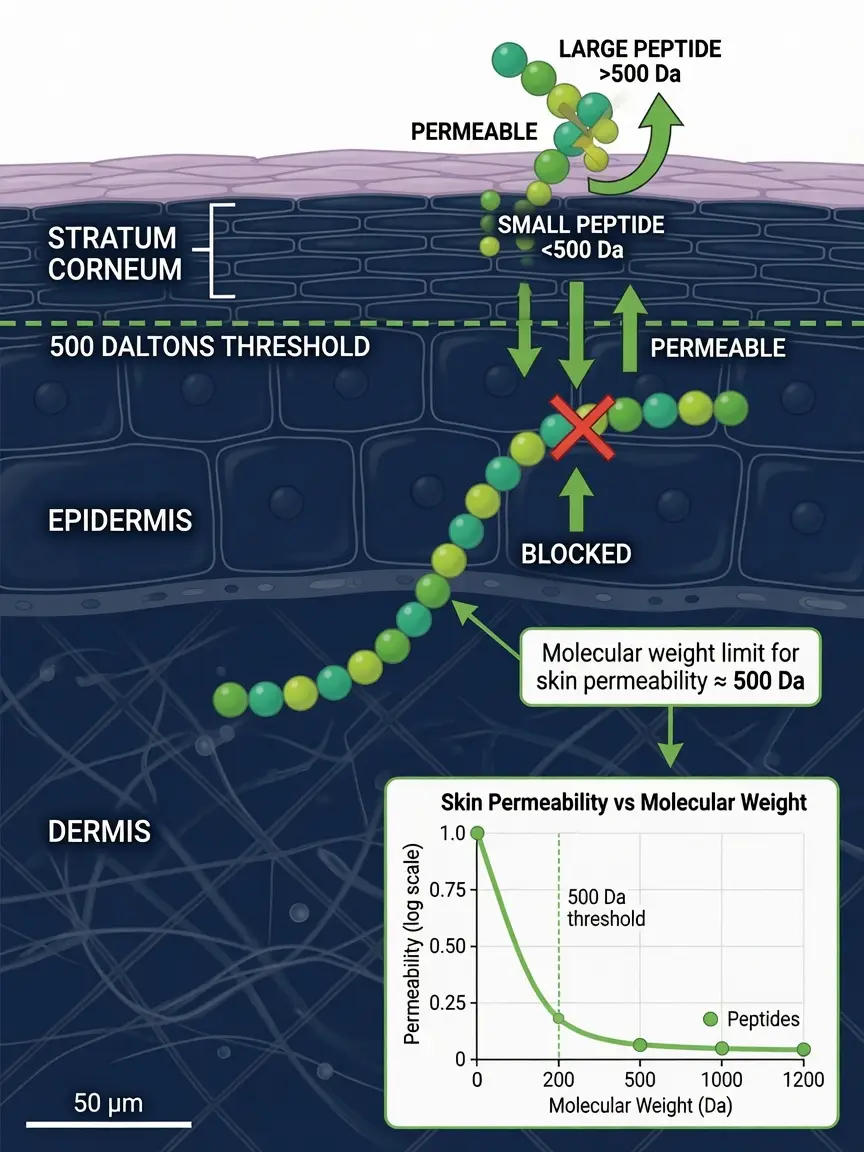
The biggest technical challenge for cosmetic peptides is not naming them. It is getting them where they need to go. Human skin is built to keep things out. The stratum corneum, the outermost barrier layer, is especially resistant to the entry of many active ingredients. A 2024 review noted that diffusion of highly hydrophilic substances, including peptides, through the stratum corneum remains under active discussion. That is a careful way of saying the barrier problem is still very real. See PubMed literature on peptide skin delivery for peer-reviewed context.
This is why cosmetic peptides are often described as a formulation challenge. Even if a peptide has a sequence associated with useful skin-related effects, it still has to remain stable in the product and reach the relevant site in or on the skin. If it stays mostly at the surface or degrades too quickly, the practical value may be modest. This limitation is central to any research peptides cosmetic peptides evaluation, because raw purity data says nothing about skin penetration.
A 2025 review on skin-penetrating peptides adds another piece to the picture. It describes certain peptides as permeation enhancers that can help with macromolecule delivery across the skin and increase permeability by helping larger molecules cross the stratum corneum. That does not remove the challenge, but it shows where cosmetic peptide research is pushing: smarter delivery systems rather than simple ingredient addition. See PubMed literature on skin-penetrating peptides for the 2025 review.
When labs or formulators review cosmetic peptide candidates, these variables usually drive the conversation: molecular size, hydrophilicity, formulation system, and target depth. Larger structures face more resistance at the skin surface; water-loving actives may cross the stratum corneum less readily; creams, serums, encapsulation methods, and excipients shape exposure; and surface action and deeper skin interaction are not the same problem. The research peptides cosmetic peptides split becomes clearer when you ask which of these variables you can control in a raw material versus a finished formula.
For a research peptide, the lab controls reconstitution, solvent, temperature, and assay conditions. For a cosmetic peptide, the formulator controls the vehicle, pH, preservative system, and packaging. Those control points are fundamentally different, and they reinforce why a raw CoA cannot predict topical performance.
How Does FDA Regulation Apply to Cosmetic Peptides?
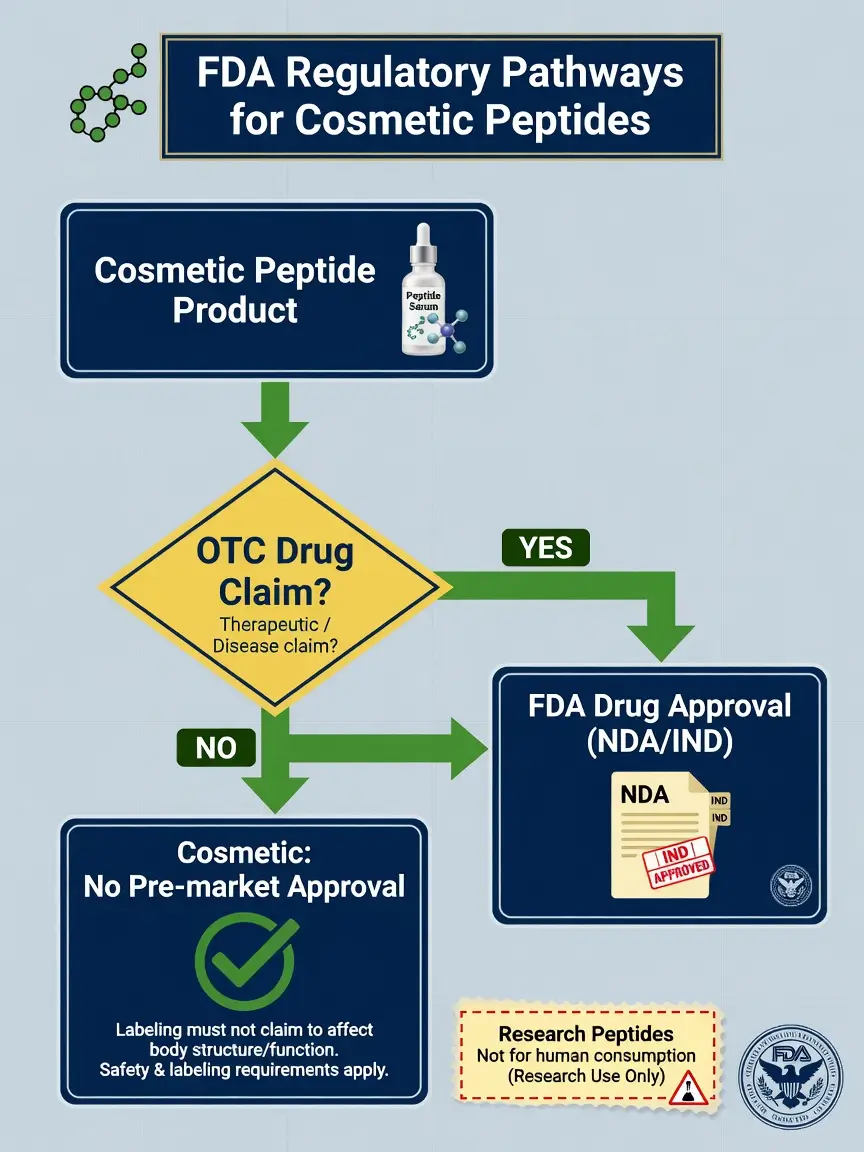
FDA does not require routine premarket approval for cosmetics, but safety under labeled use is a legal obligation. That rule applies to cosmetic peptides embedded in finished products, not to raw research peptides supplied for laboratory work. In a research peptides cosmetic peptides regulatory comparison, the two categories sit in different enforcement lanes.
The Federal Food, Drug, and Cosmetic Act defines cosmetics by intended use: cleansing, beautifying, promoting attractiveness, or altering appearance. A peptide marketed to affect the structure or function of the body would be treated as a drug, which changes the regulatory burden. Cosmetic peptide suppliers must avoid drug-like claims and keep labeling within cosmetic boundaries.
Research peptides are not consumer cosmetics, so their oversight is tied to research-use terms, institutional safety programs, and supplier documentation practices. A lab ordering a peptide for in vitro work is not buying a cosmetic product, and the research peptides cosmetic peptides distinction protects that boundary.
For labs, this means verification should focus on whether the material is presented as a research-use raw peptide with batch documentation, not as a skin-care ingredient. For cosmetic formulators, the focus is on ingredient safety data, stability under labeled storage, and finished-product labeling compliance.
A practical compliance step for any lab is to reject suppliers that use cosmetic or therapeutic language on research peptide product pages. That language blurs the research peptides cosmetic peptides line and can create regulatory risk for both parties.
How Does Formulation Quality Shape Cosmetic Peptide Performance?
Formulation quality, not just peptide name, determines whether a cosmetic peptide can perform. A peptide that is unstable in water, degraded by preservatives, or incompatible with emulsifiers may have little practical value even if the sequence is well characterized. This is a core reason the research peptides cosmetic peptides comparison must include vehicle evaluation.
Common formulation variables include pH, temperature stability, light exposure, oxidation potential, and excipient interactions. A 2024 review on peptide skin delivery noted that diffusion of hydrophilic actives through the stratum corneum remains under active discussion, which means formulators must test rather than assume penetration. Stability data from accelerated and real-time studies are essential for cosmetic peptide products.
Research peptide raw materials are typically lyophilized and stored at -20°C or below, protected from light and moisture, with purity verified by HPLC and mass spectrometry. Cosmetic peptides, in contrast, must remain stable in a finished cream or serum at room temperature for months or years. That difference in storage conditions and stability expectations is a practical dividing line in any research peptides cosmetic peptides workflow.
Encapsulation, penetration enhancers, and optimized vehicles can improve cosmetic peptide delivery, but each adds cost and complexity. A 2025 review on skin-penetrating peptides describes certain peptides as permeation enhancers, not as guaranteed actives. Formulators should evaluate delivery claims with in vitro skin models, Franz diffusion cells, or other controlled methods.
A lab comparing two cosmetic peptide products should ask for quantitative stability data, not just marketing statements. The same rigor used to evaluate a research peptide CoA should be applied to cosmetic peptide formulation data, even though the endpoints differ.
💡 Key Takeaway: How Does Formulation Quality Shape Cosmetic Peptide Performance?
What Should Labs Verify Before Comparing research peptides cosmetic peptides Categories?
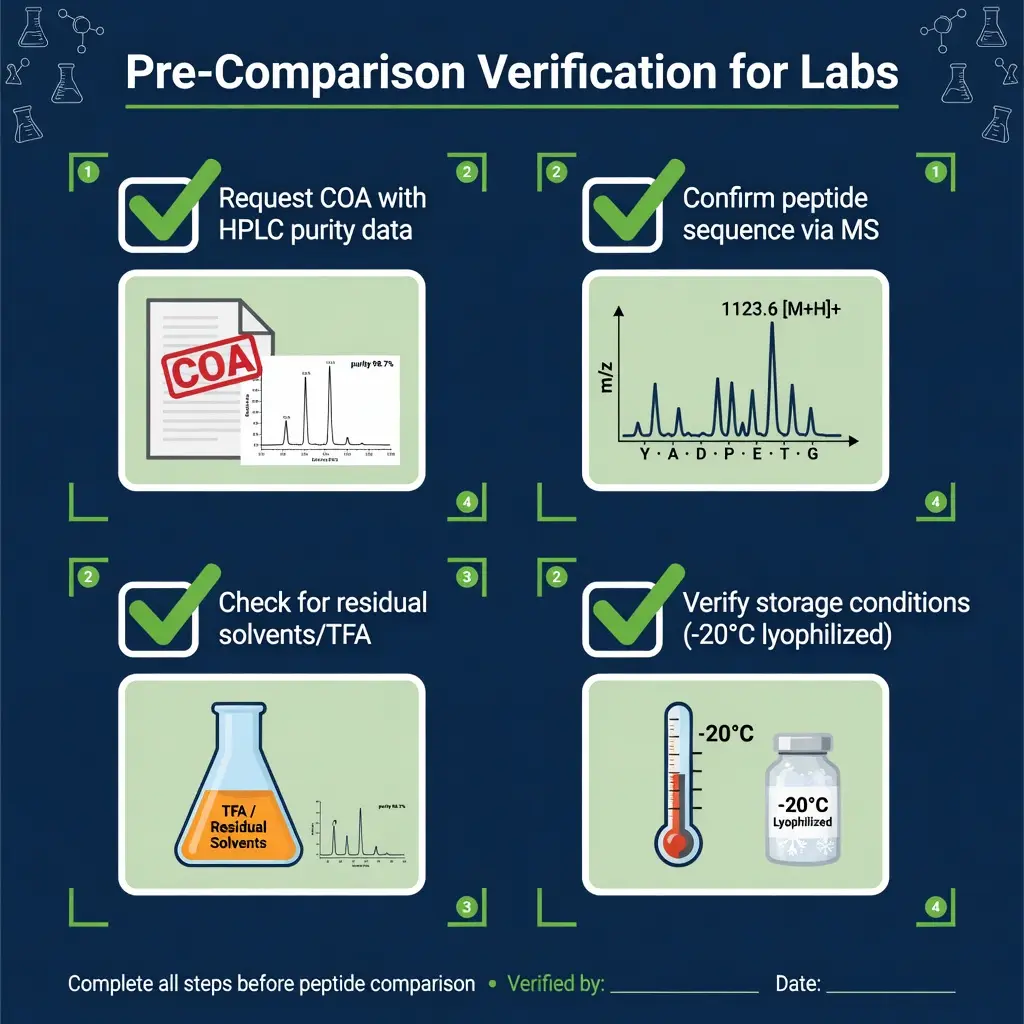
Before a lab orders or reviews any material, it should run a verification checklist. For research peptides, the checklist starts with a Certificate of Analysis that includes sequence identity, purity percentage, residual solvent data, and batch number. For cosmetic peptides, the checklist starts with ingredient safety documentation, formulation stability data, and label compliance.
A reliable research peptide supplier will provide batch-specific CoAs, third-party analytical results, and storage instructions. The material should be lyophilized, sealed, and shipped with temperature control where needed. Labs should also verify that the supplier restricts sales to research use and does not make human-use claims. This is a core theme in the research peptides cosmetic peptides supplier comparison, and you can evaluate criteria in 10 Signs of a Reliable Peptide Supplier in the USA and the catalog at Tiger Peptides | Research-Grade Peptides for Laboratories.
For cosmetic peptides, labs and formulators should request the full ingredient breakdown, not just the peptide name. They should ask for stability data under labeled storage, skin irritation or sensitization data where available, and evidence that the peptide remains intact in the final vehicle. A peptide listed at 0.01% in a formula is not the same as one listed at 2%, and both differ from a raw research peptide with a 98% purity profile.
The table below summarizes verification priorities.
| Verification Item | Research Peptides | Cosmetic Peptides |
|—|—|—|
| Identity | Sequence confirmed by MS, HPLC | Ingredient name and INCI listing |
| Purity | Typically ≥95% or ≥98% by HPLC | Not typically disclosed as raw purity |
| Documentation | Batch-specific CoA, third-party test | Safety data, stability data, label |
| Storage | Lyophilized, -20°C, protect from light | Finished product, room temperature shelf life |
| Use claim | In vitro research only | Cosmetic use, no drug claims |
| Key risk | Undocumented batch, degradation | Unstable vehicle, poor skin delivery |
Using a verification checklist prevents category confusion. A raw peptide with a CoA is not automatically a safe cosmetic ingredient, and a cosmetic peptide with a nice label is not automatically suitable for laboratory assays. The research peptides cosmetic peptides distinction is a documentation and use question first, a chemistry question second.
What Additional Lab Controls Apply to research peptides cosmetic peptides Categories?
Beyond the basic verification checklist, labs should apply category-specific controls. For research peptides, that means logging every reconstitution event, recording solvent lot numbers, and monitoring freezer temperature continuously. A research peptide used in a sensitive assay should never be mixed with a cosmetic peptide from an open cream jar.
For cosmetic peptides, the control is formulation-level. A formulator should keep master batch records, retain samples from each production run, and test stability at multiple time points. The research peptides cosmetic peptides boundary becomes operational when a lab uses separate storage areas, separate logs, and separate waste streams for raw peptides versus finished cosmetic products.
One common failure is sharing pipettes or weighing boats between research peptide stock solutions and cosmetic peptide samples. Cross-contamination can ruin an entire experiment and blur the research peptides cosmetic peptides audit trail. Dedicated equipment and clear labeling prevent that.
A second failure is relying on a cosmetic peptide ingredient listing as if it were a research CoA. A label that says ‘palmitoyl tripeptide-1’ does not confirm sequence, purity, salt form, or residual solvents. Only a batch-specific analytical certificate does that. That is why the research peptides cosmetic peptides documentation gap must be closed before any comparative claim is made.
A third failure is assuming that a research peptide with high purity will automatically perform well in a cosmetic formulation. The opposite is often true: highly pure lyophilized peptides can aggregate, oxidize, or degrade when introduced into an emulsion at room temperature. The research peptides cosmetic peptides performance question is therefore two separate questions, not one.
What Are the Most Common Myths About research peptides cosmetic peptides Comparisons?
Several myths persist in online discussions. The first myth is that a peptide is a peptide, so a research peptide and a cosmetic peptide are interchangeable. That is false because the research peptides cosmetic peptides distinction rests on intended use, documentation, and formulation context, not sequence alone.
The second myth is that a cosmetic peptide label listing is equivalent to a purity certificate. A label does not show HPLC purity, residual solvents, or batch traceability. A research peptide CoA does. This difference is the backbone of the research peptides cosmetic peptides verification gap.
The third myth is that skin delivery is a solved problem for peptides. A 2024 review stated that diffusion of highly hydrophilic substances through the stratum corneum remains under active discussion. A 2025 review described certain peptides as permeation enhancers, which shows the field is still developing delivery tools rather than relying on passive diffusion.
The fourth myth is that FDA approval is required for all cosmetic peptides. In fact, cosmetics do not require routine premarket approval, but safety under labeled use is a legal obligation. Research peptides, meanwhile, are not cosmetics at all, so the research peptides cosmetic peptides regulatory comparison is not a simple approval checkbox.
The fifth myth is that higher raw peptide purity automatically means better cosmetic performance. Purity does not address formulation stability, skin penetration, or target engagement. That is why the research peptides cosmetic peptides comparison must be run on two separate scorecards.
💡 Key Takeaway: What Are the Most Common Myths About research peptides cosmetic peptides Comparisons?
FAQ
What is the main difference between research peptides cosmetic peptides?
The main difference is intended use and documentation. Research peptides are raw materials for in vitro and pre-clinical work, judged by identity, purity, and batch CoA. Cosmetic peptides are ingredients inside finished skin-care products, judged by safety under labeled use, formulation stability, and skin delivery. The research peptides cosmetic peptides split is operational, not just chemical.
Can a research peptide be used in a cosmetic product?
No. Research peptides are supplied for laboratory research use only, with no safety data for topical human use and no cosmetic ingredient review. A raw peptide with a CoA is not a finished cosmetic ingredient. The research peptides cosmetic peptides boundary exists precisely to prevent that misuse.
What documentation should a lab request for a research peptide?
A lab should request a batch-specific Certificate of Analysis that includes sequence identity, HPLC purity percentage, residual solvent data, and batch number. Third-party analytical results and storage instructions add confidence. This documentation is not optional in the research peptides cosmetic peptides supply chain.
Why do cosmetic peptides need formulation data instead of just a purity percentage?
Because a cosmetic peptide must survive in a cream or serum, remain stable at room temperature, and address the stratum corneum barrier. Raw purity says nothing about those factors. The research peptides cosmetic peptides comparison therefore requires two different evidence sets.
Does FDA approve cosmetic peptides before they go on the market?
No. FDA does not require routine premarket approval for cosmetics, but safety under labeled use is a legal obligation. Cosmetic peptides must avoid drug-like claims. Research peptides are not cosmetics and remain in a research-use regulatory context, which is another reason the research peptides cosmetic peptides categories must stay separate.
Ready to Take the Next Step?
Every product includes lot-specific documentation and third-party purity testing.
Explore Our Research Products →Free shipping on qualifying orders · Batch COA on request