
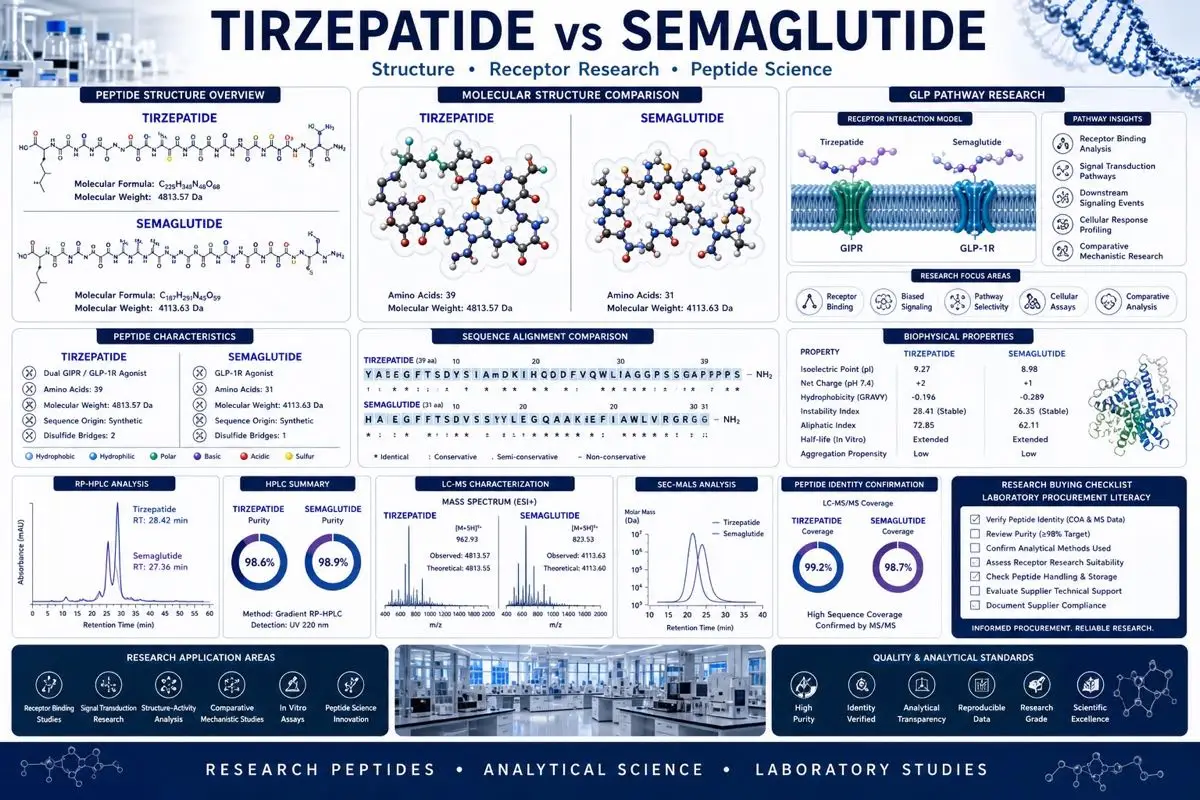
Tirzepatide vs Semaglutide: 6 Research Buying Tips for Labs (2026)
Tips for labs 2026: compare tirzepatide vs semaglutide research buying with 6 proven COA, purity, and supplier verification criteria. Research use only.
📋 Table of Contents
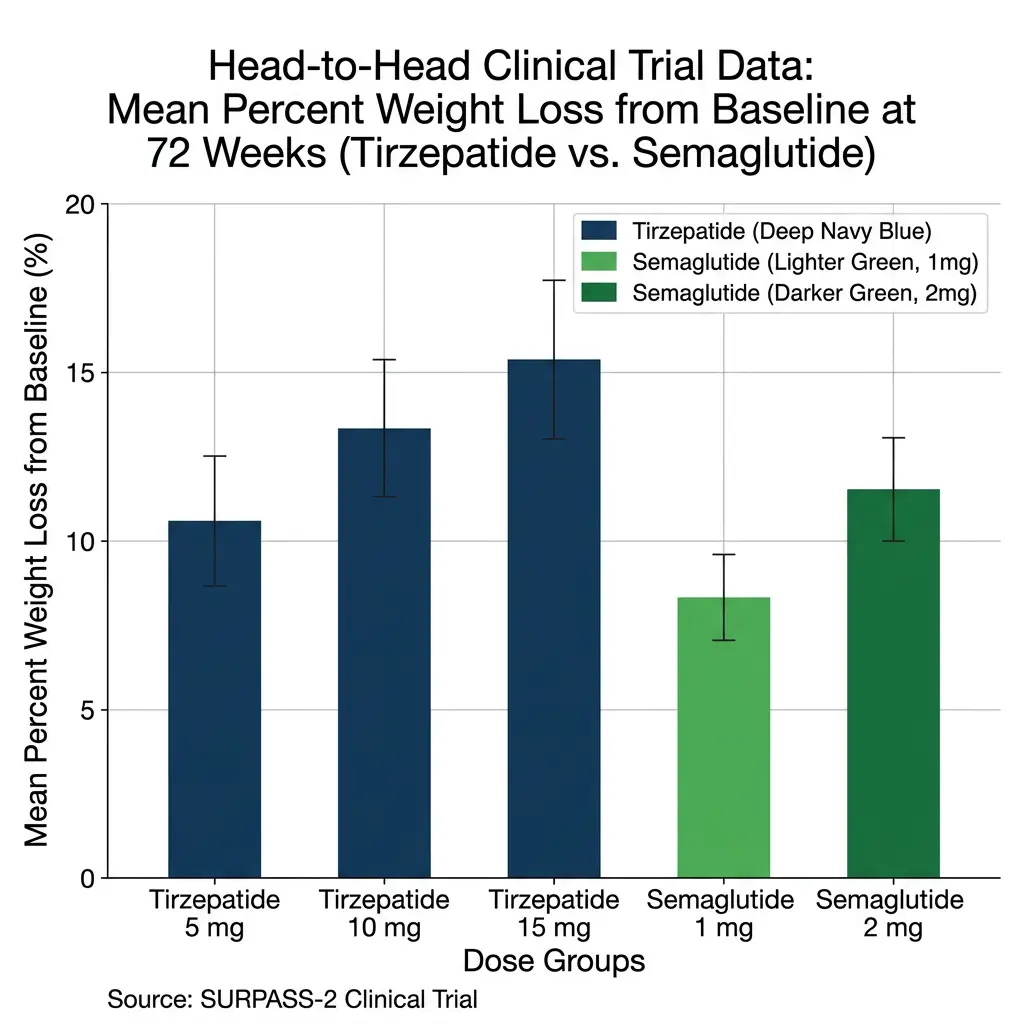
For tirzepatide vs semaglutide research buying, the most actionable tips for labs 2026 start with matching the peptide to the protocol: tirzepatide is usually the stronger efficacy benchmark for body-composition endpoints, while semaglutide is often the better GLP-1-only comparator when cardiovascular context matters. A 72-week phase 3b head-to-head trial reported tirzepatide was superior to semaglutide for body-weight and waist-circumference reduction in metabolic research. The safest buying criteria remain batch-level certificate of analysis review, third-party HPLC/MS verification, lot-specific chain-of-custody records, and clear research-use-only labeling.
⚠️ Research Use Only Notice: The products discussed here are sold strictly for in vitro laboratory research purposes only. They are not for human use, not for veterinary use, and not intended to diagnose, treat, cure, or prevent any disease. All information presented is for educational purposes in a research context. Must be 21+ to purchase.
Key takeaways
- Tirzepatide is a dual GLP-1/GIP agonist; semaglutide is a GLP-1 receptor agonist.
- Direct metabolic evidence favors tirzepatide for average body-composition change metrics magnitude.
- Semaglutide can be the better comparator when regulatory or GLP-1-only framing matters.
- Buy on lot COAs, HPLC/MS identity, and chain-of-custody proof before price.
- Lot consistency and handling predictability often outweigh the lowest listed unit cost.
What are the key differences between tirzepatide and semaglutide?
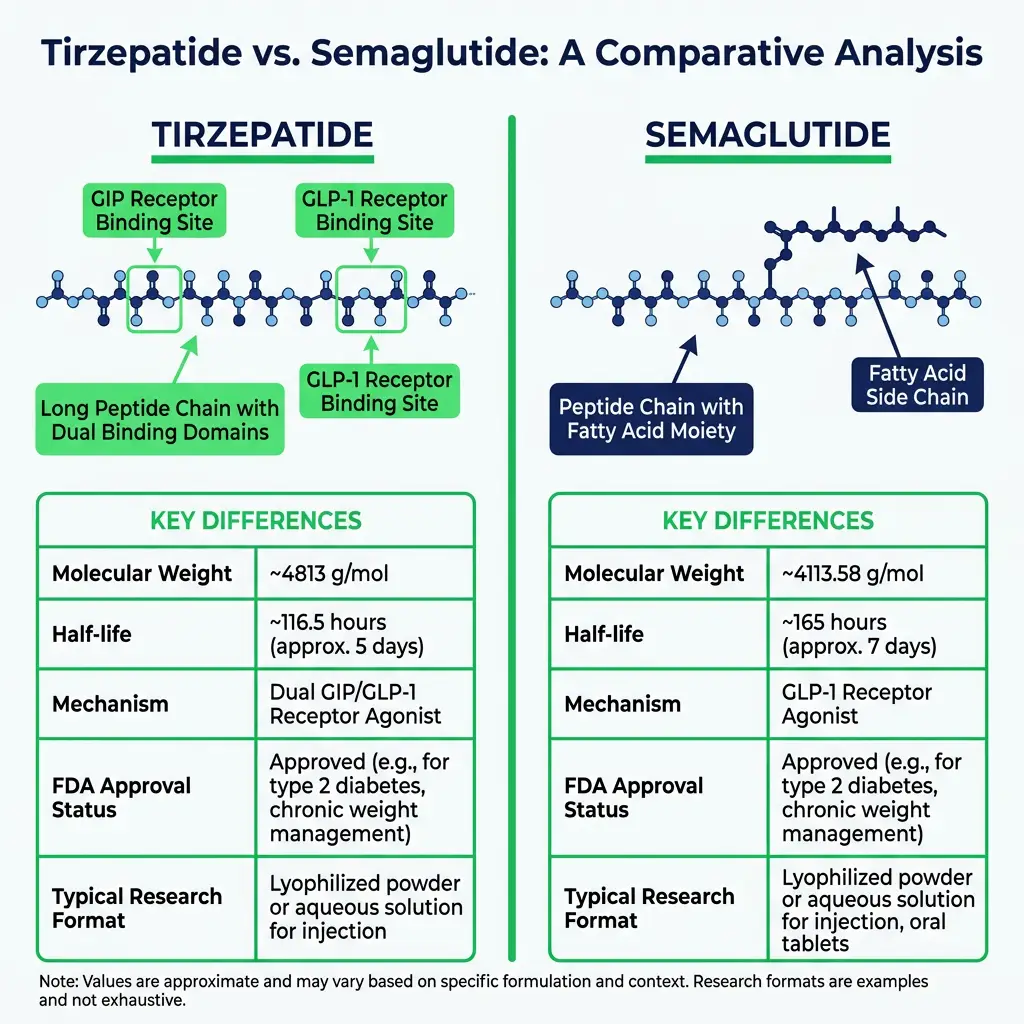
Tirzepatide and semaglutide differ at the receptor level: tirzepatide is a GLP-1/GIP dual agonist, while semaglutide is a GLP-1 receptor agonist. In a 72-week phase 3b head-to-head trial, tirzepatide was superior to semaglutide for body-weight and waist-circumference reduction in metabolic research. Semaglutide’s label includes cardiovascular-risk-reduction context in metabolic research populations with CVD, while tirzepatide is recognized as a chronic metabolic research framing reference point tied to metabolic research populations described in primary labeling.
For procurement, the practical difference is that tirzepatide fits studies prioritizing stronger body-composition research endpoint efficacy benchmarks, while semaglutide fits projects that need a GLP-1-only comparator or cardiovascular-label context. Both compounds require the same documentation standards: batch COAs, third-party HPLC/MS identity, research-use-only labeling, and lot consistency. These tips for labs 2026 apply equally whether you are buying tirzepatide or semaglutide.
The table below summarizes the core differences researchers should review before choosing a reference material.
| Attribute | Tirzepatide | Semaglutide |
|—|—|—|
| Receptor target | Dual GLP-1/GIP agonist | GLP-1 receptor agonist |
| Head-to-head metabolic evidence | Superior body-weight and waist-circumference reduction in a 72-week phase 3b trial | Comparator arm in the same trial |
| Primary label context | Chronic metabolic research framing reference point | Cardiovascular-risk-reduction context in metabolic research populations with CVD |
| Best research fit | Stronger body-composition endpoint efficacy benchmarks | GLP-1-only comparator or cardiovascular-label context |
| Required documentation | Batch COA, HPLC/MS identity, chain of custody, research-use-only labeling | Same standards |
How do tirzepatide and semaglutide differ mechanistically?
Mechanism framing helps explain why tirzepatide and semaglutide are not one-to-one research substitutes. Tirzepatide’s dual GLP-1/GIP agonism helps explain why metabolic research trials have shown stronger average body-composition change metrics with tirzepatide, but mechanism alone is not enough to justify a purchase. Researchers applying the best tips for labs 2026 should treat mechanism as a starting filter, not a final decision.
From a research design standpoint, a dual agonist is not a one-to-one stand-in for a single-pathway GLP-1 comparator. If your assay, literature review, or benchmarking framework is built around GLP-1 receptor agonism alone, semaglutide may be the cleaner reference material even when tirzepatide produces a larger efficacy signal. A common mistake is treating the mechanism label as the main buying criterion. The stronger approach is to ask whether the protocol needs dual-pathway signaling, whether cross-study comparability matters, and whether the supplier can prove identity and purity at the batch level.
Supplier note: Tiger Peptides supplies research-grade peptides at 99%+ purity with third-party HPLC/MS verification and downloadable batch COAs. That documentation standard supports both tirzepatide and semaglutide procurement under the same tips for labs 2026 framework.
💡 Key Takeaway: Mechanism labels are useful, but batch-level proof of identity and purity matters more than the agonist classification alone.
💡 Key Takeaway: How do tirzepatide and semaglutide differ mechanistically?
What does the FDA status comparison tell researchers?
Regulated reference labels for tirzepatide and semaglutide differ in scope. Researchers should read primary labeling and peer-reviewed methods rather than brand marketing summaries. Semaglutide’s reference labeling includes cardiovascular-context language in primary sources; treat that as documentation context for research design, not a purchase claim. The FDA approval for tirzepatide established it as a recognized chronic metabolic research framing reference point tied to metabolic research populations described in primary labeling.
That does not mean semaglutide is automatically the better research purchase. A frequent misconception is that the broader label always signals stronger body-composition research endpoint performance. In direct metabolic research, label breadth and efficacy magnitude are separate questions, so the right choice depends on whether your protocol is anchored to outcome strength or regulatory context. These tips for labs 2026 emphasize reading the primary sources on PubMed and NCBI rather than relying on secondary summaries.
What are the 6 best tirzepatide vs semaglutide research buying tips for labs 2026?
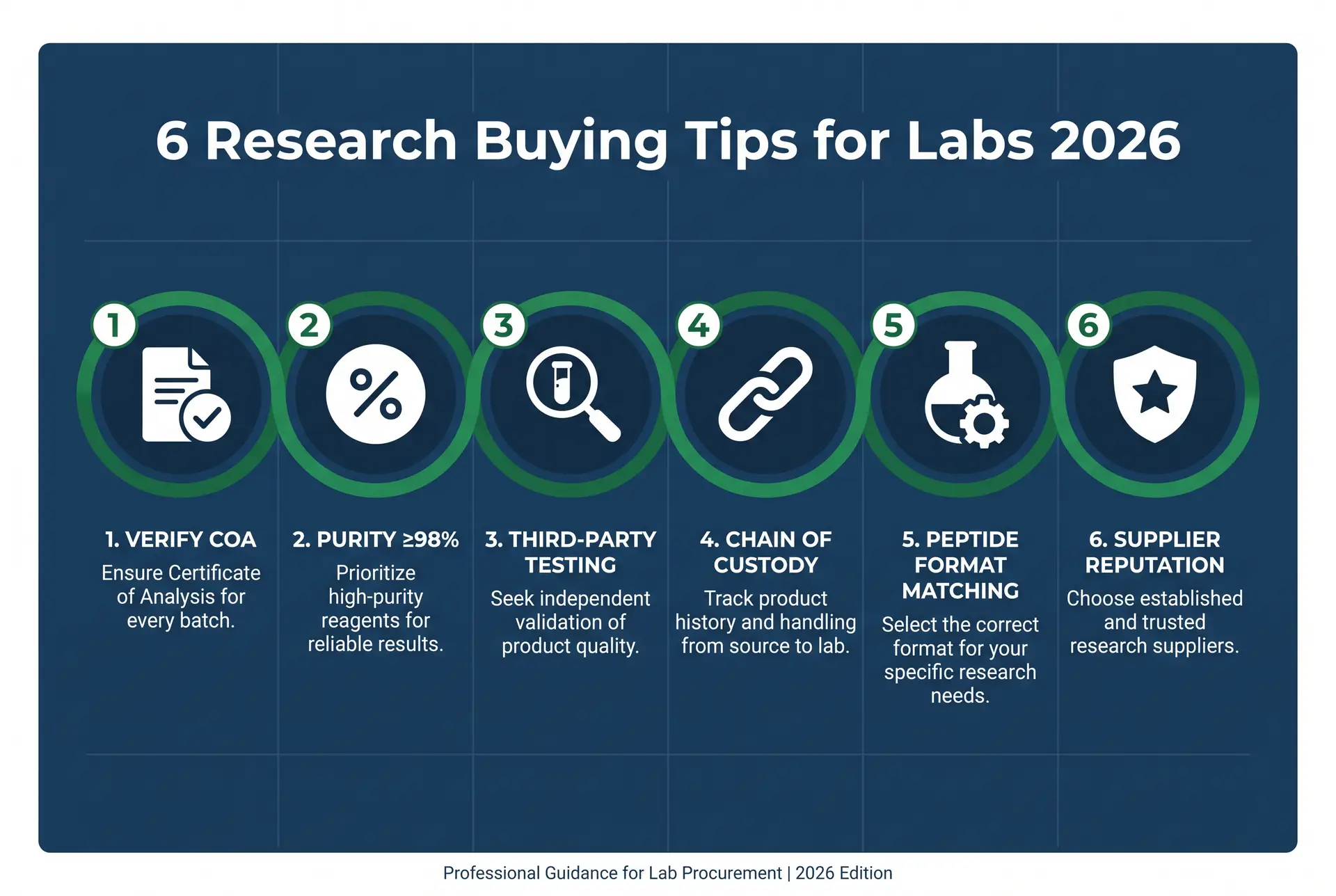
The best six tips are practical and document-driven: start with lot-level proof, then match the compound to the protocol. That order cuts avoidable risk faster than comparing price tags first. These tips for labs 2026 apply to both tirzepatide and semaglutide purchases.
1. Start with published batch COAs. Suppliers such as Tiger Peptides make batch-level certificates of analysis available, which shortens the first screening step for tirzepatide and semaglutide lots. Review the COA before requesting a quote.
2. Separate purity from identity. A high HPLC purity number is useful, but MS confirmation is what tells you the compound is actually the stated peptide. Both tirzepatide and semaglutide lots should carry a mass spectrometry identity match.
3. Match the peptide to the endpoint. Tirzepatide fits studies prioritizing stronger body-composition research endpoint efficacy benchmarks, while semaglutide fits projects that need a GLP-1-only comparator or cardiovascular-label context. This is one of the most overlooked tips for labs 2026.
4. Check research-use-only labeling. Clear category labeling reduces confusion around documentation, storage, and intended procurement standards. For more background, see Research Peptides vs Cosmetic Peptides: Lab Basics.
5. Compare lot consistency before price. A cheaper vial is rarely cheaper if it introduces assay drift, reformulation questions, or mismatched documentation. Lot-to-lot reproducibility is a critical quality metric.
6. Review handling details. Transit speed, fillers or additives, and compatible lab supplies can affect preparation workflows and protocol timing. Ask for storage and handling documentation before finalizing a purchase.
These six tips for labs 2026 align with the broader supplier evaluation framework in 10 Signs of a Reliable Peptide Supplier in the USA.
How should you read a tirzepatide or semaglutide certificate of analysis?
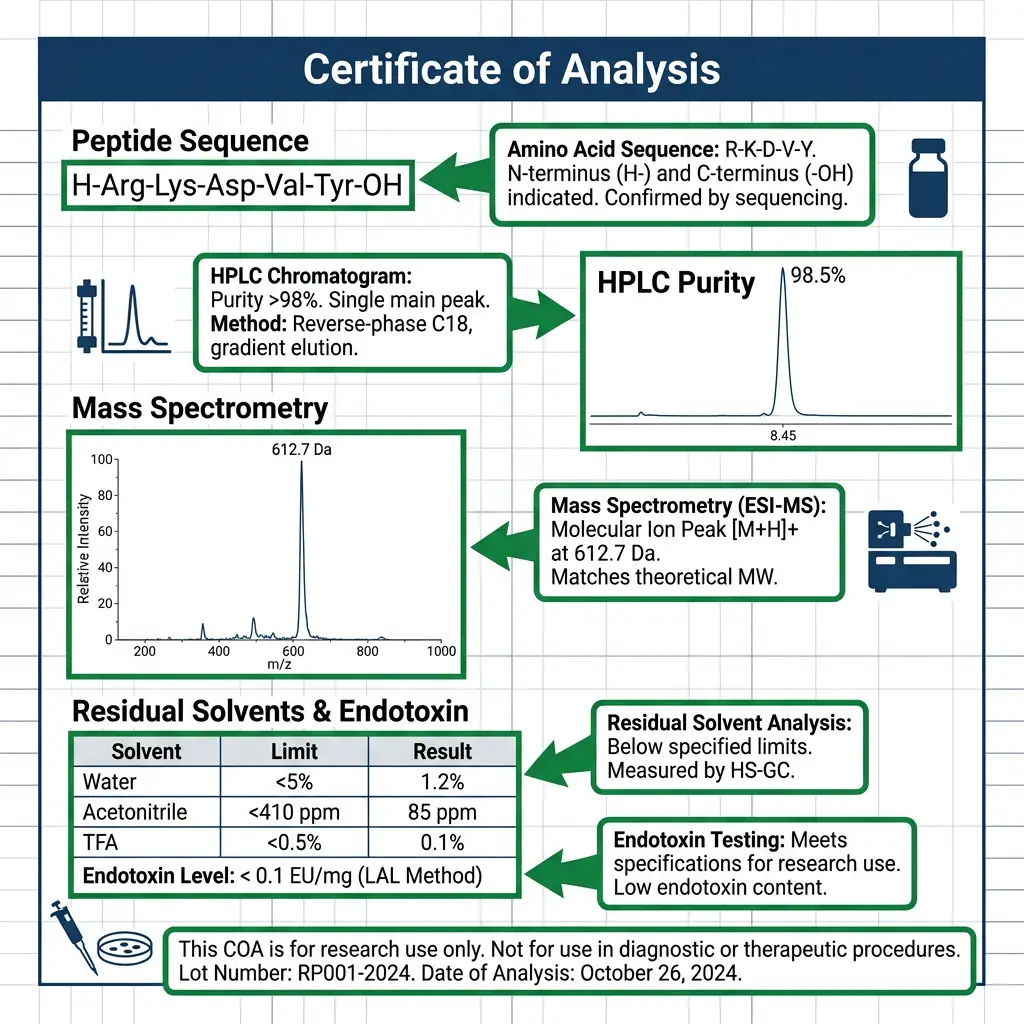
A COA should be read as a validation tool, not as a marketing sheet. The key fields are peptide name, lot number, purity method, identity method, date, and the supplier or third-party lab details. These tips for labs 2026 treat the COA as the first checkpoint in any tirzepatide or semaglutide purchase.
Start with Step 1: confirm that the COA matches the exact lot being purchased. If the lot number on the product page, label, or invoice does not match the COA, stop there and ask for corrected records.
Step 2 is purity review. Look for the method used, commonly HPLC, and check whether the reported result is batch-specific rather than a generic specification. A batch-specific HPLC result is more meaningful than a website-wide purity claim.
Step 3 is identity confirmation, typically by mass spectrometry, because purity without identity can still leave room for a mismatch. For tirzepatide and semaglutide, MS confirmation should match the expected molecular weight.
COA note: Tiger Peptides states every batch includes a downloadable Certificate of Analysis and third-party testing, with tirzepatide COAs marked research use only. That labeling helps labs maintain compliance under the same tips for labs 2026.
The final step is context. Check whether the COA mentions fillers, additives, or excipients. For researchers trying to isolate compound effects, zero-fill formulations can simplify interpretation. A common error is assuming a clean purity percentage answers every quality question. It does not if the identity, lot traceability, or test ownership is unclear.
💡 Key Takeaway: Read a COA in four steps: lot match, purity method, identity confirmation, and formulation context.
💡 Key Takeaway: How should you read a tirzepatide or semaglutide certificate of analysis?
How do you verify third-party testing and chain of custody?
Third-party testing is only useful when the records are traceable. The strongest proof is a third-party lab report that carries a unique identifier, the exact lot number, the test date, and the analytical methods used. If the report cannot be matched to the specific vial or batch you are buying, it does not support a purchase decision. These tips for labs 2026 require traceability before trust.
Chain of custody means the documented path of a specific lot from synthesis through testing, storage, and shipment. A reliable supplier should provide lot-specific chain-of-custody records that show who handled the material and when. For tirzepatide and semaglutide, this documentation reduces the risk of substitution or mishandling.
Ask for the following before buying any research peptide:
- Third-party HPLC report with lot number and date.
- Mass spectrometry identity confirmation for the same lot.
- Chain-of-custody log from manufacturer to your lab.
- Research-use-only labeling on the COA and product page.
If a supplier cannot produce these records quickly, that is a red flag under any serious set of tips for labs 2026. Price should never override missing traceability.
How should you match peptide format to your research protocol?
Tirzepatide and semaglutide are typically supplied as lyophilized powder for research use, but some labs receive reconstituted or pre-formatted materials depending on the supplier. The format you choose should match your assay, storage, and preparation workflow. These tips for labs 2026 recommend confirming format before purchase.
Lyophilized peptides generally offer better long-term stability when stored at -20°C or below, while reconstituted peptides require refrigeration and shorter use windows. For tirzepatide and semaglutide, always check the supplier’s recommended storage conditions on the COA or product insert. Do not assume all formats behave the same.
If your protocol requires precise molar calculations, ask whether the vial contains fillers or excipients. Zero-fill tirzepatide or semaglutide can simplify concentration math, but the supplier must disclose this on the COA. Matching format to protocol is one of the most practical tips for labs 2026, because it prevents workflow surprises after delivery.
What does the head-to-head trial evidence show?
The key head-to-head evidence for tirzepatide vs semaglutide comes from a 72-week phase 3b trial. In that study, tirzepatide was superior to semaglutide for body-weight and waist-circumference reduction in metabolic research. The trial supports tirzepatide as the stronger average efficacy benchmark for body-composition endpoints.
Researchers should note that the trial evaluated metabolic research populations, not general laboratory models. The result does not automatically make tirzepatide the right purchase for every protocol. Semaglutide remains a valid comparator when the study requires a GLP-1-only reference. These tips for labs 2026 suggest reviewing the original trial data on PubMed before finalizing a procurement decision.
For labs that prioritize efficacy magnitude in metabolic research, tirzepatide is the usual choice. For labs that need a single-pathway GLP-1 comparator or cardiovascular-label context, semaglutide may be the better fit. The evidence supports both roles, depending on the endpoint.
💡 Key Takeaway: What does the head-to-head trial evidence show?
When is semaglutide the stronger benchmark?
Semaglutide is the stronger benchmark when your research protocol requires a GLP-1 receptor agonist only, without the confounding dual GLP-1/GIP activity of tirzepatide. If your assay measures GLP-1 pathway activation in isolation, semaglutide provides a cleaner signal. These tips for labs 2026 emphasize that mechanism specificity can outweigh raw efficacy magnitude.
Semaglutide is also the better comparator when cardiovascular-label context matters in your study design. The semaglutide reference labeling includes cardiovascular-risk-reduction context in metabolic research populations with CVD, which may be relevant for protocols anchored to regulatory documentation. Tirzepatide does not carry that same cardiovascular-label framing.
Finally, semaglutide may be preferable when cross-study comparability with older GLP-1 literature is required. Many published metabolic research studies used GLP-1-only agonists, so semaglutide aligns more directly with that historical dataset. This is one of the most underused tips for labs 2026.
What supplier red flags should labs watch for?
Several supplier red flags should stop a tirzepatide or semaglutide purchase before it starts. Missing batch COAs, no third-party testing, or vague research-use-only labeling are immediate disqualifiers. These tips for labs 2026 treat documentation gaps as non-negotiable.
Watch for suppliers that list purity without specifying the analytical method. A purity number without HPLC or MS context is not meaningful. Also be wary of product pages that mention human use, dosing, or therapeutic claims, because research peptides must be sold strictly for in vitro laboratory research purposes only.
Other red flags include lot numbers that change between the product page and the COA, chain-of-custody records that cannot be produced on request, and prices that are dramatically lower than comparable research suppliers. For a full checklist, review 10 Signs of a Reliable Peptide Supplier in the USA. Applying these tips for labs 2026 consistently will filter out most high-risk vendors.
FAQ
Which is better for research buying, tirzepatide or semaglutide?
It depends on the protocol. Tirzepatide is usually the stronger efficacy benchmark for body-composition endpoints, while semaglutide is the better GLP-1-only comparator or cardiovascular-label context. The best tips for labs 2026 match the peptide to the endpoint, not to the marketing.
What documentation should every tirzepatide or semaglutide lot include?
Every lot should include a batch-specific certificate of analysis, third-party HPLC purity data, mass spectrometry identity confirmation, chain-of-custody records, and clear research-use-only labeling. Missing any of these is a red flag.
Why is third-party testing more important than the purity number alone?
Third-party testing provides independent verification that the lot identity and purity are real. A purity number without a third-party lab report and lot traceability can be misleading. The tips for labs 2026 require both HPLC and MS confirmation from an independent source.
Can tirzepatide and semaglutide be used interchangeably in research?
No. Tirzepatide is a dual GLP-1/GIP agonist, while semaglutide is a GLP-1 receptor agonist. They are not one-to-one substitutes. Choose the compound that matches your assay’s signaling pathway and endpoint requirements.
What storage conditions should labs follow for these peptides?
Follow the supplier’s COA and product insert. Lyophilized tirzepatide and semaglutide generally require storage at -20°C or below for long-term stability, while reconstituted material requires refrigeration and shorter use windows. Always verify storage conditions before ordering.
⚠️ Research Use Only Notice: The products discussed here are sold strictly for in vitro laboratory research purposes only. They are not for human use, not for veterinary use, and not intended to diagnose, treat, cure, or prevent any disease. All information presented is for educational purposes in a research context. Must be 21+ to purchase.
Ready to Take the Next Step?
Every product includes lot-specific documentation and third-party purity testing.
Explore Our Research Products →Free shipping on qualifying orders · Batch COA on request