Peptide Warehouse: Best USA Research Sourcing Insights for 2026
2026 peptide warehouse sourcing insights for USA labs: COAs, lyophilized shipping, 99%+ purity, and domestic fulfillment compared. Research use only.
📋 Table of Contents
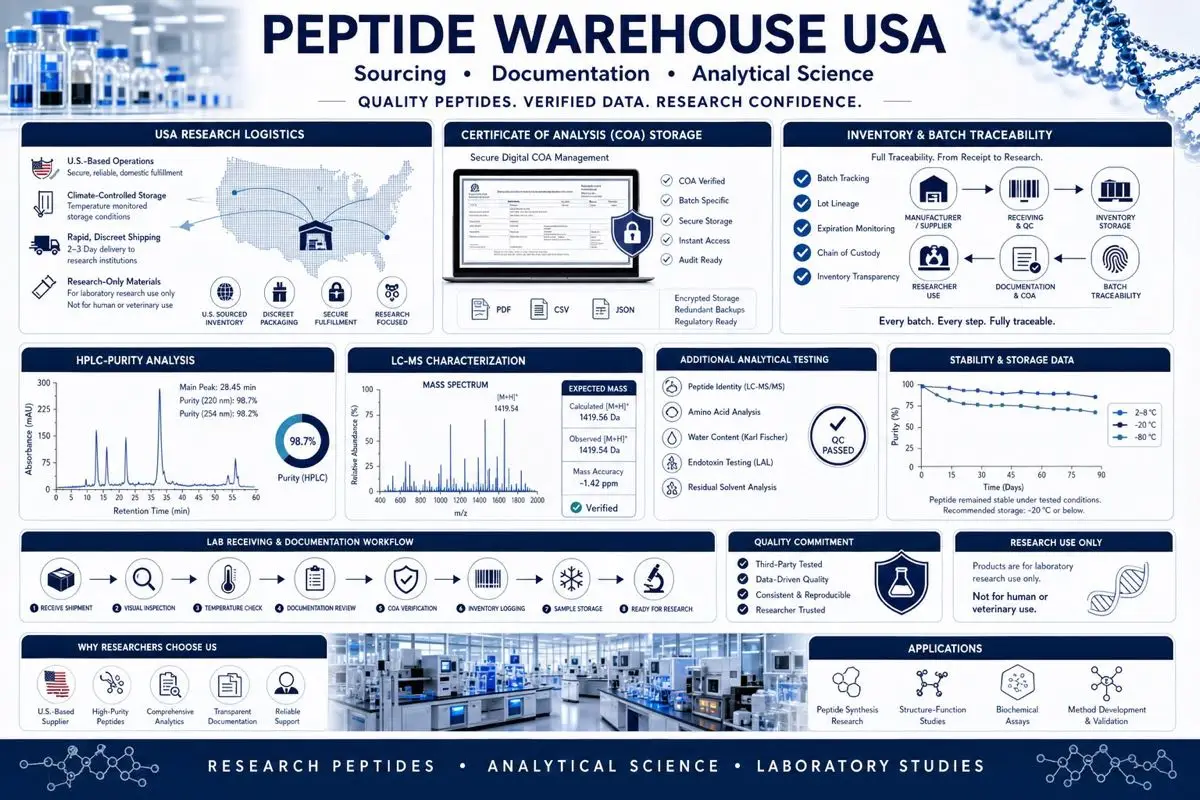
For U.S. laboratories in 2026, a peptide warehouse should reduce procurement uncertainty through domestic fulfillment, batch-level third-party verification, public Certificates of Analysis (COAs), and lyophilized shipping practices—not vague inventory claims. Tiger Peptides in Sevierville, Tennessee, exemplifies this model by pairing 99%+ pure, HPLC/MS-tested research peptides with downloadable COAs, lyophilized format, and research-only positioning. All products are sold strictly for in vitro laboratory research use only, not for human or veterinary use, and purchasers must be 21+.
Key takeaways
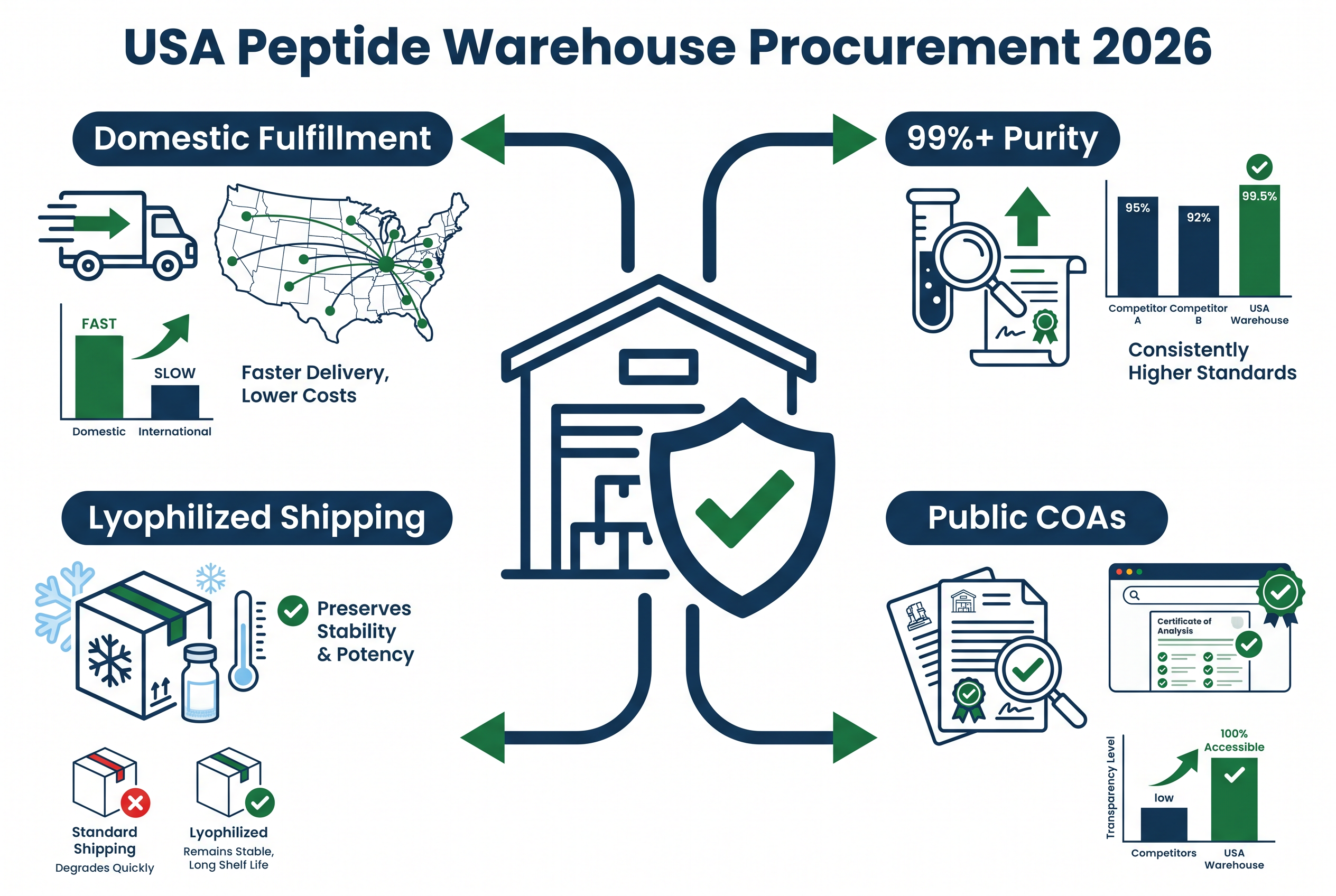
- A peptide warehouse is only useful if it reduces uncertainty with batch data, not just inventory depth—look for public COAs and chromatograms before purchase in 2026.
- Lyophilized peptides with clear storage guidance and fast domestic shipping support controlled laboratory workflows and minimize customs or transit delays.
- Third-party HPLC/MS testing, solid-phase peptide synthesis, and 99%+ purity claims give labs measurable documentation for institutional review in 2026.
- Research-only framing, secure encrypted ordering, and a U.S. point of contact (236 E. MAIN ST, STE 47
SEVIERVILLE, TN 37862, USA) keep procurement aligned with laboratory use boundaries. - Free U.S. shipping on orders over $200 and bulk pricing support recurring or staged research purchasing without compromising traceability.

What Defines a USA Peptide Warehouse for Research Procurement in 2026?
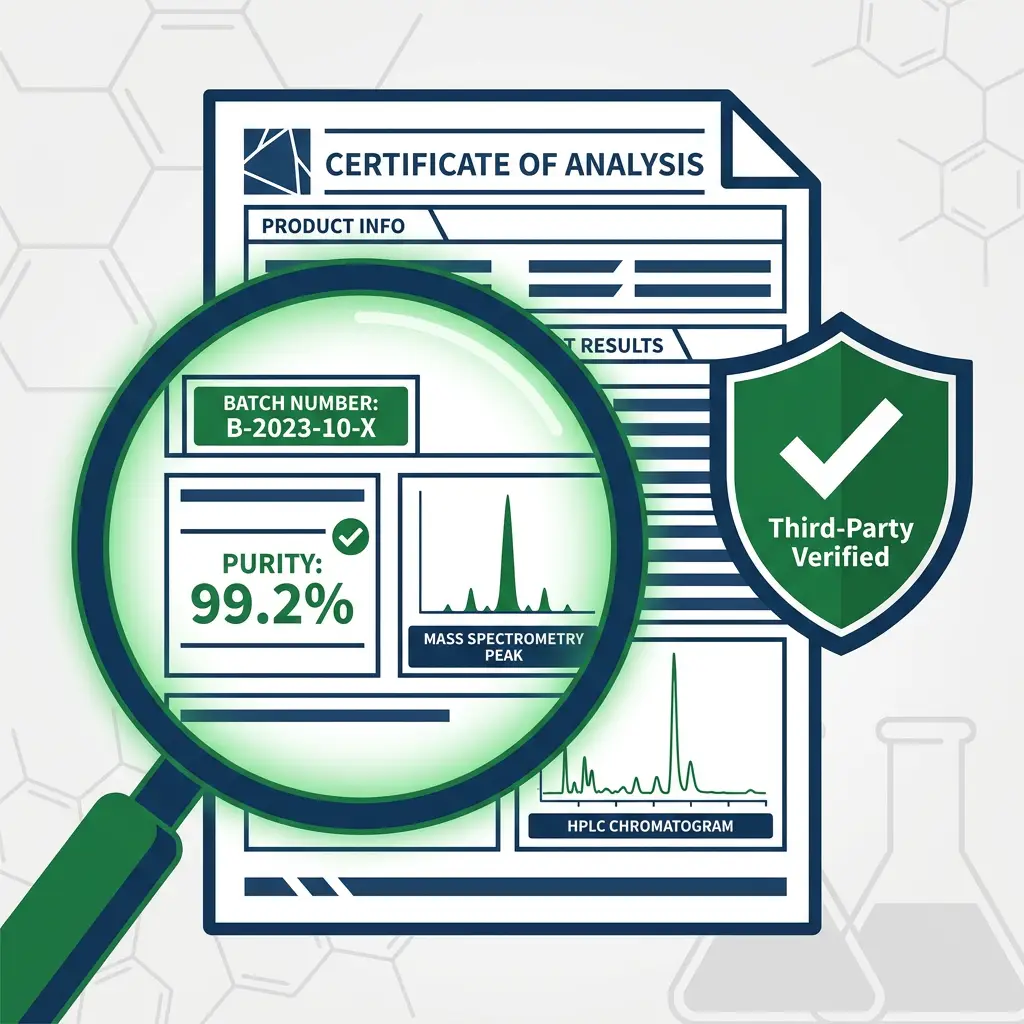
A peptide warehouse is only useful if it reduces uncertainty. Tiger Peptides pairs U.S.-based fulfillment with publicly accessible batch documentation, third-party testing, and rapid nationwide shipping. The listed business address is 236 E. MAIN ST, STE 47
SEVIERVILLE, TN 37862, USA, which gives research buyers a clear domestic point of contact instead of an anonymous offshore supply chain. For 2026 laboratory procurement, this domestic anchor matters more than catalog size alone.
For research teams, that matters in practical ways. You can review Certificates of Analysis with chromatograms on product pages and via QR code, confirm purity data before purchase, and source from a peptide warehouse that presents itself as research-only rather than blurring channels. All materials are explicitly for in vitro laboratory research use only, never for human consumption or clinical application. In 2026, this boundary clarity is a procurement requirement, not a preference.
Tiger Peptides is especially relevant when your lab needs more than a product listing. Buyers who want traceable sourcing, USA-made materials, full chain-of-custody documentation, and support from a team that understands research workflows get more value from a disciplined research supplier than from generic e-commerce fulfillment. The supplier’s focus is straightforward: give biotech, regenerative medicine, and health sciences teams access to 99%+ pure, third-party-tested compounds, public Certificates of Analysis, and a secure ordering process that supports repeatable procurement from one research-focused supplier.
This sourcing model matters in 2026 because institutional review boards and lab managers increasingly demand verifiable documentation before approving a vendor. A peptide warehouse that publishes batch-level data removes a common friction point. Instead of emailing back and forth for a COA, your team can download chromatograms directly from the product page. That transparency is not universal across suppliers, so it should influence your shortlist.
A domestic anchor also reduces supply chain risk. Offshore suppliers may offer lower sticker prices, but they often introduce customs delays, variable documentation, and communication barriers. In 2026, a USA peptide warehouse with a physical address and responsive support team is a measurable risk reduction, not just a convenience.

Which 2026 Research Peptides and Lab Supplies Does a Peptide Warehouse Provide?
A focused research catalog helps teams order materials without sorting through unclear categories or incomplete documentation. Tiger Peptides supplies individual research peptides, peptide blends, and bacteriostatic water for U.S. laboratories and institutions—all strictly for laboratory research use only. For 2026, this curated scope is deliberate: it keeps procurement aligned with research workflows rather than consumer-facing product noise.
Here is what laboratories commonly source from this sourcing model:
- Research peptides: Lyophilized compounds manufactured under strict GMP-compliant conditions and verified by independent analytical laboratories.
- Peptide blends: Multi-compound research options for labs managing defined project requirements.
- Lab supplies: Bacteriostatic water to support laboratory handling workflows.
That focus helps simplify procurement. Instead of spreading sourcing across multiple vendors, teams can centralize core peptide purchases with one research-only supplier that publishes batch data, maintains secure encrypted ordering, and offers bulk pricing for long-term projects. No product is intended for human or veterinary use, and all communications and ordering terms limit use to laboratory research.
If your lab runs recurring studies or staged purchasing schedules in 2026, budgeting becomes easier with free U.S. shipping on orders over $200 and pricing support for larger or ongoing orders through domestic fulfillment. The 2026 research environment rewards predictable logistics, and a peptide warehouse that offers clear shipping thresholds removes a hidden cost variable.
Many labs also appreciate that this catalog does not attempt to be everything. A peptide warehouse that focuses on peptides, blends, and the minimal lab supplies needed for reconstitution avoids the distraction of unrelated inventory. That focus often translates into better batch documentation and more responsive support for research-specific questions.
For labs comparing research-grade peptide catalogs, the Tiger Peptides | Research-Grade Peptides for Laboratories overview clarifies how focused sourcing works in practice. A narrow, well-documented catalog is a strength in 2026, not a limitation.
💡 Key Takeaway: Which 2026 Research Peptides and Lab Supplies Does a Peptide Warehouse Provide?
How Does Third-Party Testing and Public COAs Reduce Procurement Uncertainty in 2026?
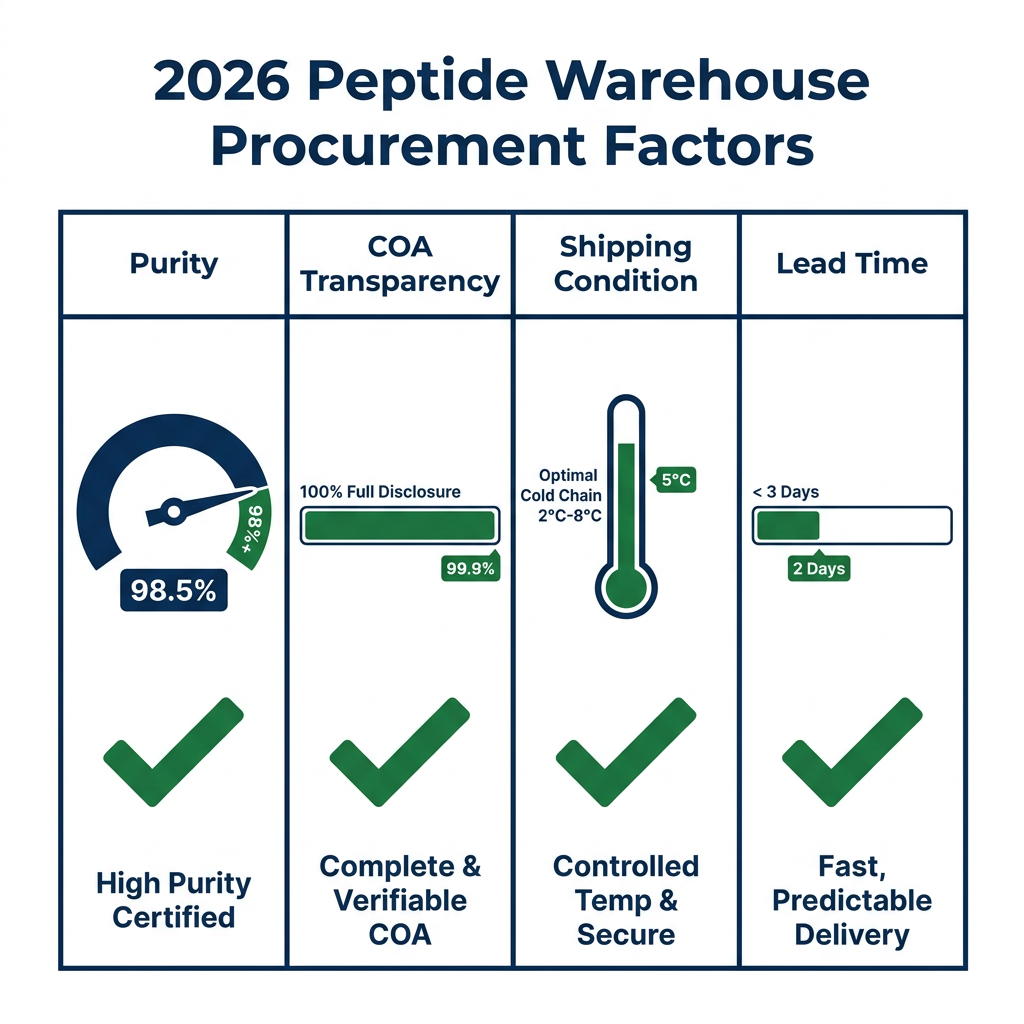
Documentation is where many suppliers become difficult to evaluate. A strong supplier makes third-party testing central rather than an afterthought. Every peptide from Tiger Peptides is described as undergoing third-party HPLC-MS and purity verification before release, with downloadable Certificates of Analysis accompanying each order. In 2026, this public documentation is a baseline expectation for institutional labs.
That gives usable proof, not vague quality language. You can compare batches, review chromatograms, confirm the stated purity level, and keep records aligned with internal purchasing or lab documentation needs when working with a research supplier. The public COAs include chromatograms on product pages and via QR code, so labs can verify the analytical data before committing to a purchase.
Tiger Peptides also states that peptides are produced via solid-phase peptide synthesis, followed by HPLC purification to 99% or higher and mass spectrometry confirmation. For labs that care about analytical transparency, those process details clarify how material was made and how identity and purity were checked before a shipment leaves fulfillment. All verification supports research-use boundaries only; the supplier never implies human use or therapeutic application.
This is also where a transparent supplier stands apart from suppliers that rely on thin labeling or private documentation. In environments where certificate and source documentation matter—especially when institutions review supply channels—public COAs are a practical advantage for traceable, defensible procurement. A 2026 peptide warehouse that withholds COAs should be a non-starter for any lab that values reproducibility.
Third-party testing also reduces the burden on your own quality control team. Instead of sending every lot out for independent analysis, you can rely on the supplier’s published HPLC-MS data as a screening step. However, labs with stringent protocols may still perform in-house verification for critical experiments. The key is that public COAs give you a starting point that is auditable and comparable across vendors in 2026.
Peer-reviewed literature on solid-phase peptide synthesis and HPLC-MS analytical workflows is available through PubMed. This external reference helps labs understand what a valid chromatogram and mass spectrum should show before they accept a supplier’s purity claim.
Why Does Lyophilized Handling and Nationwide Shipping Matter in 2026?
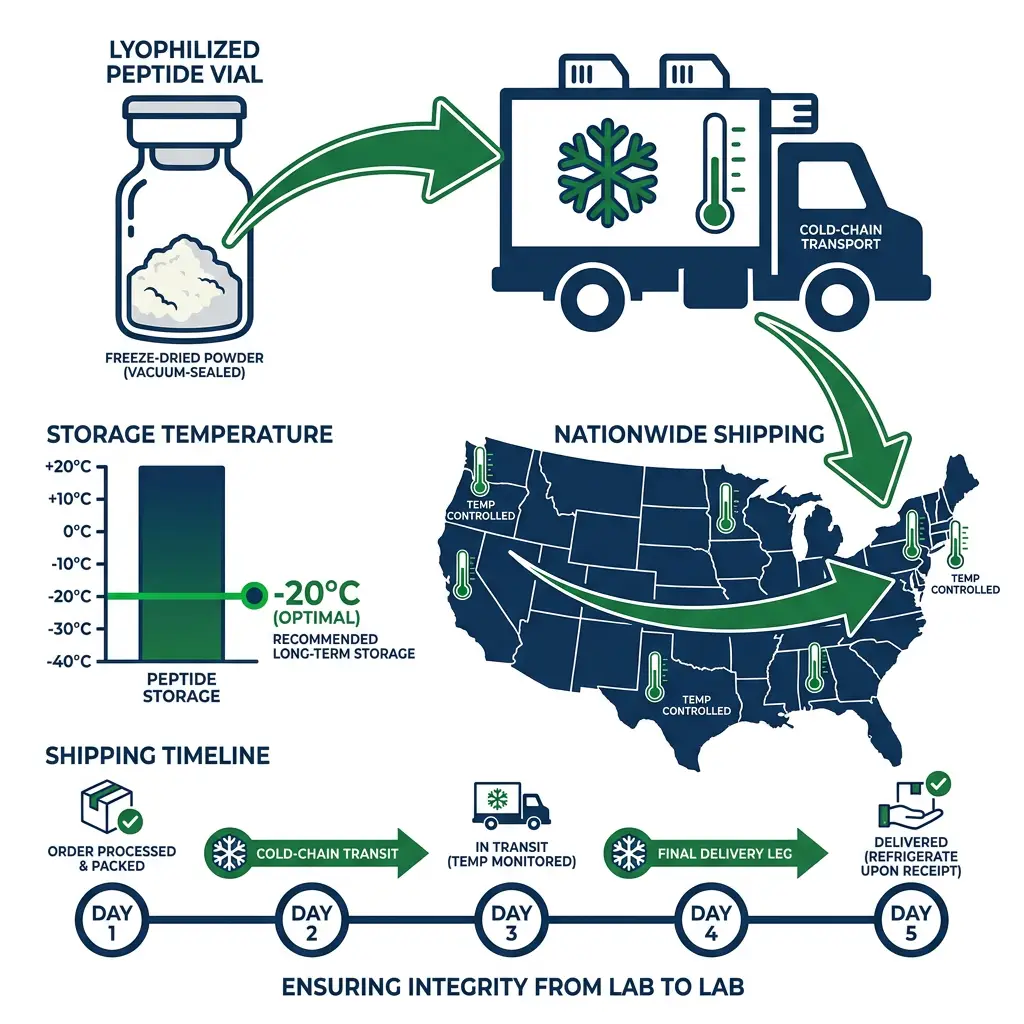
Lyophilized format is a practical advantage for research procurement because it supports stability during transit and storage. Tiger Peptides ships lyophilized peptides, which reduces the risk of degradation that can occur with liquid formulations exposed to temperature fluctuations. In 2026, when domestic labs may receive shipments across multiple climate zones, this format choice is a measurable risk control.
Standard laboratory storage practice for lyophilized peptides typically involves keeping unopened vials at -20°C for long-term stability, while reconstituted solutions are held at 4°C for short-term use according to the COA. However, always follow the specific storage conditions on the product’s Certificate of Analysis. The supplier provides clear storage guidance as part of batch documentation, so procurement teams can plan cold storage capacity before ordering.
Nationwide shipping from a U.S. location removes customs delays and international logistics uncertainty. The listed business address in Sevierville, Tennessee, means orders ship from within the United States, which shortens transit times and simplifies tracking. For 2026 research schedules, a domestic peptide warehouse with lyophilized handling is often the difference between a controlled workflow and an avoidable delay.
Free U.S. shipping on orders over $200 further reduces cost variability. When labs plan staged purchases, this threshold allows them to batch orders without paying incremental freight each time. Bulk pricing support adds another layer of predictability for long-term projects. Neither feature overrides the need for documentation, but both make a 2026 sourcing decision easier to defend internally.
Lyophilized peptides also reduce the risk of microbial growth during transit, which is a common concern with pre-reconstituted liquid peptides. By shipping dry powder and providing bacteriostatic water separately, a peptide warehouse supports controlled reconstitution in the lab rather than in transit. This separation of materials is a best practice for research-use procurement in 2026.

What Storage Conditions Should Labs Follow for Lyophilized Peptides in 2026?
Proper storage is a critical extension of lyophilized shipping. For unopened vials, the standard laboratory practice is to store at -20°C in a desiccated environment, away from light and moisture. Once reconstituted with bacteriostatic water or an appropriate solvent, the solution should be kept at 4°C and used within the timeframe specified by the COA. In 2026, labs should treat storage conditions as part of the procurement specification, not an afterthought.
Avoid repeated freeze-thaw cycles for reconstituted peptides, as this can degrade sensitive sequences. Aliquoting the reconstituted solution into single-use volumes minimizes this risk. Record the lot number, reconstitution date, and storage temperature in your lab notebook to maintain traceability back to the public COA. Tiger Peptides provides batch-specific documentation to support this practice.
If your lab lacks reliable -20°C storage, a lyophilized peptide order may still be appropriate if you reconstitute immediately and use the material within a short window. However, long-term stability depends on controlled freezing. Before ordering in 2026, verify your cold storage capacity against the number of vials you plan to purchase.
💡 Key Takeaway: What Storage Conditions Should Labs Follow for Lyophilized Peptides in 2026?
When Is a 2026 Peptide Warehouse the Right Fit for Your Lab?
Not every lab needs a full-service peptide warehouse, but many institutional and commercial research teams benefit from one in 2026. If your workflow requires repeated access to 99%+ pure peptides with downloadable COAs, a dedicated supplier like Tiger Peptides reduces procurement friction. If your lab operates under strict documentation requirements, public chromatograms and third-party verification become non-negotiable.
The right fit also depends on your project scale. Labs running pilot studies may only need a handful of vials, while larger programs require bulk pricing and staged delivery. A 2026 peptide warehouse that offers both individual vials and bulk options accommodates both without forcing you to switch vendors mid-project. This continuity matters for batch consistency and traceability.
Another signal is the need for research-only positioning. If your procurement policy prohibits suppliers that market to human use, a warehouse that explicitly limits all products to in vitro research use is essential. Tiger Peptides maintains this boundary across its catalog, ordering terms, and communications. In 2026, that clarity prevents compliance issues before they arise.
If your lab has been frustrated by anonymous offshore suppliers, delayed COAs, or unclear purity claims, the shift to a domestic warehouse with public documentation is straightforward. The 2026 research environment rewards suppliers that treat procurement as part of the scientific workflow, not a separate e-commerce transaction. Use the 10 Signs of a Reliable Peptide Supplier in the USA checklist to evaluate whether your current vendor meets these criteria.
A good fit also means the supplier’s catalog aligns with your specific peptide requirements. If you need custom blends or a steady supply of a particular research peptide, confirm that the warehouse can support those needs without long lead times. A focused catalog with domestic fulfillment is often more responsive than a global marketplace.
How Should Labs Order from a 2026 Peptide Warehouse with Clear Documentation?
Ordering from a research-focused peptide warehouse should follow a repeatable process. Start by reviewing the product page for the COA, purity percentage, and analytical method. Tiger Peptides publishes this information directly, so you do not need to request documents before purchase. Confirm the lot number matches the COA when the package arrives.
Next, verify storage and handling instructions from the COA. Lyophilized peptides may require specific temperature ranges, and reconstitution steps should align with your lab’s standard operating procedures. If any documentation is missing or unclear, contact the U.S.-based support team before using the material. For 2026 procurement, this pre-check reduces downstream variability.
Secure encrypted ordering is a baseline requirement. Tiger Peptides provides a secure checkout process, and all transactions remain limited to research use. You must be 21+ to purchase, and the supplier’s terms explicitly exclude human or veterinary use. This ordering structure keeps your lab’s procurement records clean for institutional audits.
For recurring orders, take advantage of free U.S. shipping over $200 and bulk pricing. Consolidate purchases to reduce freight costs, but avoid overstocking lyophilized peptides beyond your validated storage capacity. A disciplined 2026 peptide warehouse procurement plan balances cost efficiency with cold-chain integrity.
Before finalizing an order, cross-check the supplier against the Nationwide Peptides for Research Labs | Tiger Peptides comparison to confirm that domestic fulfillment and public COAs are part of the standard workflow. This step prevents surprises after the invoice is paid.
What External Benchmarks Validate 2026 Peptide Warehouse Sourcing?
Peer-reviewed literature and public databases offer external benchmarks for peptide quality and synthesis methods. The National Center for Biotechnology Information (NCBI) provides access to research on solid-phase peptide synthesis and HPLC-MS analytical workflows. These references help labs set expectations for purity thresholds and analytical documentation in 2026.
Independent third-party testing is another external benchmark. A supplier that sends every peptide lot to an unaffiliated analytical laboratory and publishes the resulting COA is aligning with best practices seen in regulated research environments. Tiger Peptides states this as a standard practice, and the downloadable chromatograms serve as primary evidence. Labs can cross-reference these data with internal QC results if needed.
Purity claims of 99%+ are measurable against HPLC chromatograms and mass spectrometry data. When a 2026 peptide warehouse publishes both the percentage and the raw analytical traces, it allows verification rather than trust. This is a stronger standard than a label that simply says “high purity” without supporting data.
For procurement teams, external benchmarks also include institutional supplier qualification guidelines. Many universities and biotech firms require vendors to maintain a domestic address, provide batch-level COAs, and restrict sales to research use. Tiger Peptides meets these common criteria, which reduces the time needed for vendor onboarding in 2026.
Using public analytical standards, labs can also compare supplier COAs against reference chromatograms from the literature. If a supplier’s HPLC trace lacks baseline resolution or shows unexplained peaks, that should trigger additional scrutiny. A transparent 2026 peptide warehouse invites this level of review rather than avoiding it.
💡 Key Takeaway: What External Benchmarks Validate 2026 Peptide Warehouse Sourcing?
Comparison Table: 2026 Peptide Warehouse Procurement Factors
| Procurement Factor | What to Look For in 2026 | Tiger Peptides Example |
|—|—|—|
| Purity documentation | Public COA with HPLC chromatogram and mass spec | 99%+ purity with downloadable COA |
| Testing method | Third-party HPLC-MS verification | Third-party tested before release |
| Format | Lyophilized for stability | Lyophilized peptides |
| Shipping | Domestic, fast, with clear thresholds | Free U.S. shipping over $200 |
| Research use boundary | Explicit in vitro research only | All products research use only |
| Contact | U.S.-based address and support | 236 E. MAIN ST, STE 47
SEVIERVILLE, TN 37862, USA |
| Storage guidance | Clear COA storage conditions | Lyophilized storage instructions provided |
Common Misconceptions About 2026 Peptide Warehouses
One misconception is that a larger catalog means a better supplier. In 2026, documentation depth matters more than product count. A focused peptide warehouse that publishes COAs and limits itself to research peptides, blends, and bacteriostatic water is often more reliable than a sprawling marketplace with inconsistent quality data.
Another misconception is that all COAs are equivalent. A public COA with chromatograms and mass spectrometry data is not the same as a private one-page certificate with no analytical traces. When you compare suppliers in 2026, ask for the raw data behind the purity claim. If a vendor cannot provide it, that is a red flag.
Some labs assume lyophilized peptides are stable at room temperature indefinitely. This is false for research use. Standard practice is to store unopened vials at -20°C and reconstituted solutions at 4°C for short periods, always following the specific COA. A 2026 peptide warehouse that provides clear storage guidance helps avoid this error.
There is also a misconception that domestic shipping always costs more. Free U.S. shipping on orders over $200 and bulk pricing can make a domestic peptide warehouse cost-competitive with offshore suppliers once you account for customs, delays, and documentation risk. In 2026, the total cost of procurement includes uncertainty, not just invoice price.
Finally, some labs believe that research-only framing is a marketing limitation. In fact, it is a compliance advantage. A supplier that explicitly restricts products to in vitro laboratory research use reduces the risk of misclassification and keeps procurement aligned with institutional policies. This clarity is a feature of a disciplined 2026 peptide warehouse.
How to Audit a 2026 Peptide Warehouse Before First Purchase
Auditing a peptide warehouse before your first order reduces risk. Start by requesting a sample COA for any peptide you plan to purchase. Confirm it includes the lot number, analytical method, purity percentage, and chromatogram. Tiger Peptides makes these documents available on product pages and via QR code, which speeds up the audit.
Check the supplier’s stated manufacturing and testing process. Look for solid-phase peptide synthesis, HPLC purification to 99%+, and mass spectrometry confirmation. These details should be explicit, not implied. A 2026 peptide warehouse that omits process information may be hiding quality gaps.
Verify the research-use boundary in the terms of sale. All products should be labeled for in vitro laboratory research use only, not for human or veterinary use, and purchasers must be 21+. If the supplier’s language is ambiguous or suggests therapeutic use, disqualify it.
Finally, assess the logistics. A U.S. address, lyophilized shipping, and clear free-shipping thresholds indicate a supplier that understands laboratory workflows. Use the Nationwide Peptides for Research Labs | Tiger Peptides guide to compare domestic fulfillment options before committing to a 2026 peptide warehouse.

💡 Key Takeaway: How to Audit a 2026 Peptide Warehouse Before First Purchase
FAQ
What should a 2026 peptide warehouse provide for research procurement?
A 2026 peptide warehouse should provide domestic fulfillment, public COAs with chromatograms, third-party HPLC-MS testing, lyophilized format, and explicit research-use-only terms. Tiger Peptides meets these criteria with 99%+ pure peptides and downloadable documentation.
How do I verify peptide purity before ordering in 2026?
Look for a downloadable COA on the product page that includes the lot number, HPLC chromatogram, mass spectrometry data, and a stated purity percentage of 99% or higher. Tiger Peptides publishes these documents and also provides QR code access.
Does lyophilized format affect peptide stability in 2026?
Yes, lyophilized peptides are generally more stable during transit than liquid formulations. For long-term storage, unopened vials should be kept at -20°C, and reconstituted solutions at 4°C for short-term use, following the COA.
What is the minimum purchase age for a 2026 peptide warehouse?
Purchasers must be 21+ years old, and all products are limited to in vitro laboratory research use only. No product is intended for human or veterinary use.
Does Tiger Peptides offer bulk pricing and free shipping in 2026?
Yes, free U.S. shipping is available on orders over $200, and bulk pricing supports larger or recurring research orders. These features help labs manage procurement costs without sacrificing traceability.
Ready to Take the Next Step?
Every product includes lot-specific documentation and third-party purity testing.
Explore Our Research Products →Free shipping on qualifying orders · Batch COA on request