
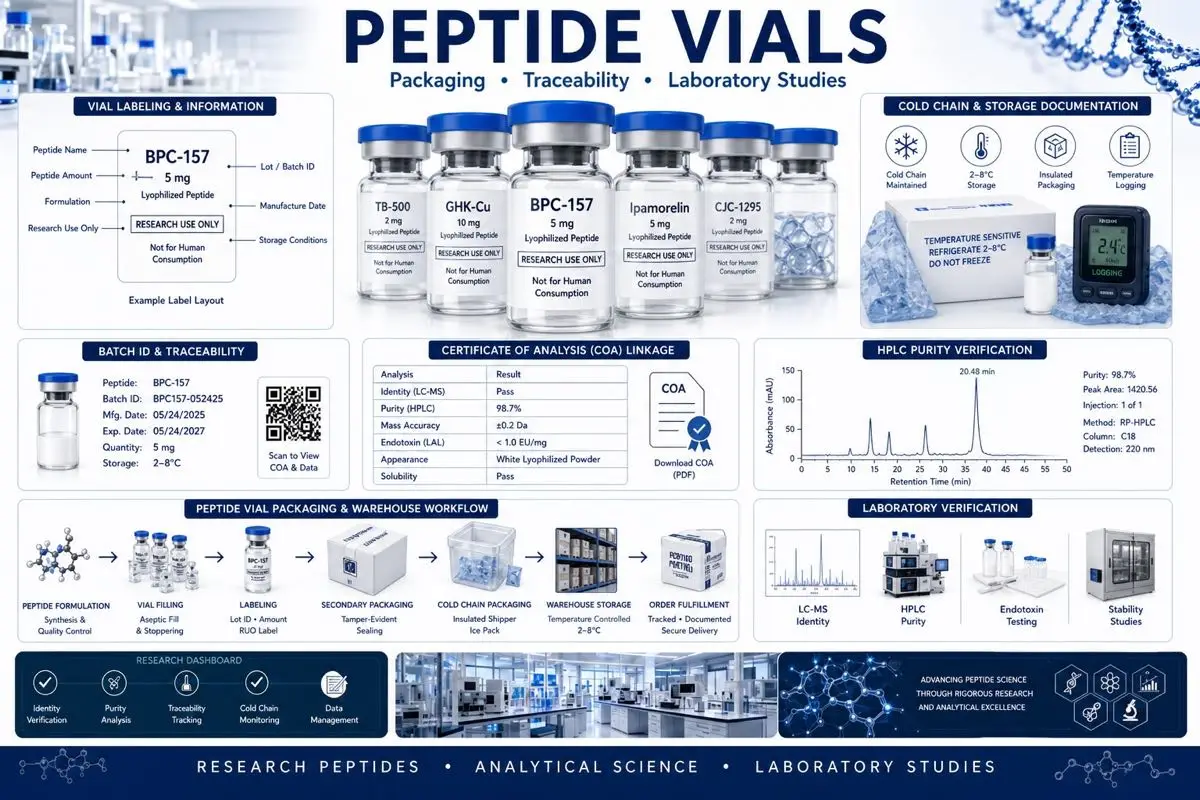
Peptide Vials: Best Research Packaging Insights for 2026
2026 peptide vial packaging guide for labs: verify container-closure integrity, moisture and oxygen control, COA retrieval, and research-use-only compliance.
📋 Table of Contents
For 2026, the best research packaging insights for peptide vials center on treating each vial as a complete container‑closure system—not as simple glassware. Laboratories should verify seal integrity, moisture and oxygen protection, light shielding, lot labeling, shipping controls, and retrievable certificate of analysis (COA) documentation before relying on a shipment for experimental work. A well‑sealed vial with controlled headspace and clear documentation supports reproducible research outcomes far better than a visually intact but poorly documented unit.
Key takeaways
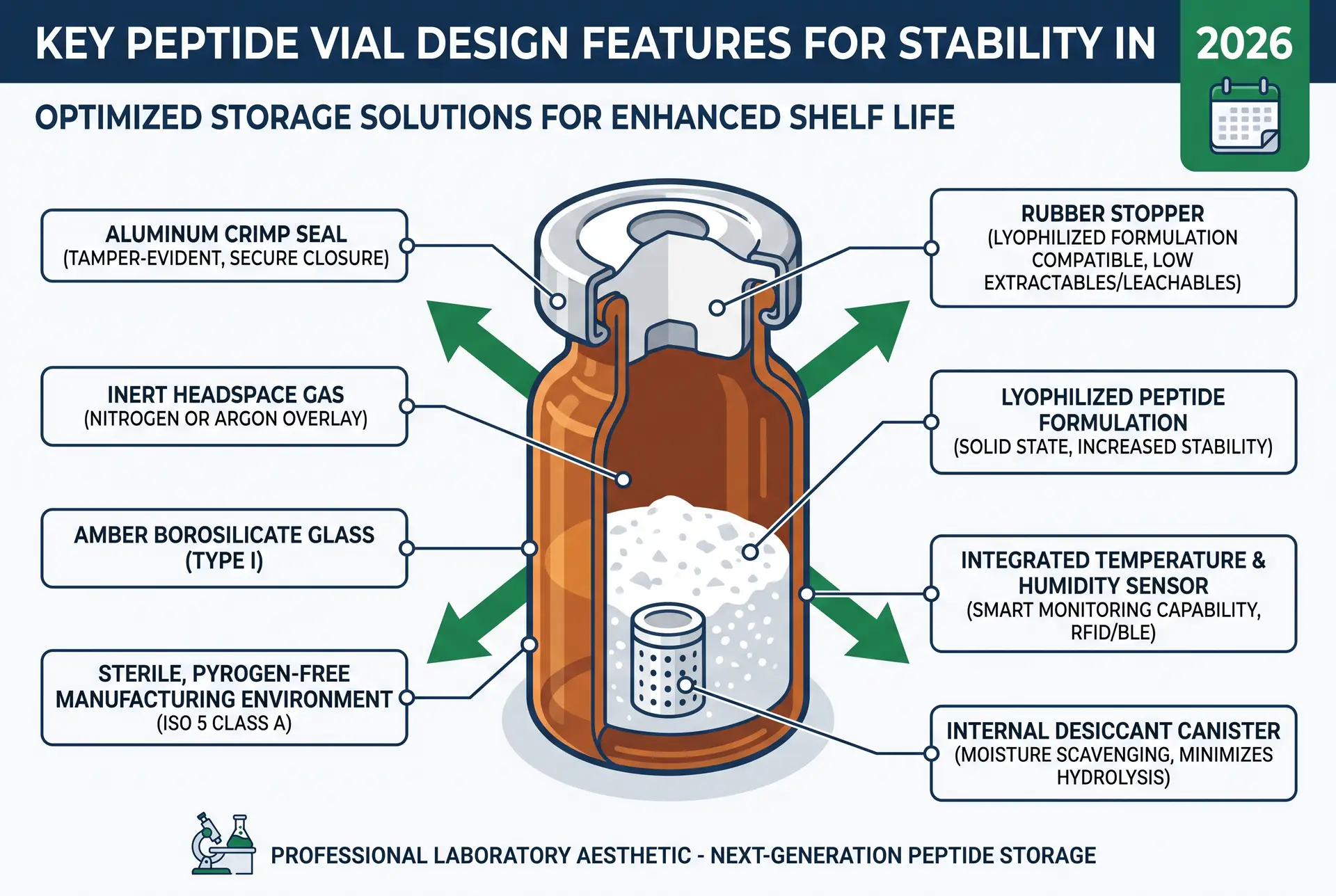
- Peptide vials must be judged as a complete container‑closure system—vial body, stopper, crimp, headspace, and secondary packaging all matter.
- Moisture, oxygen, light, and temperature swings are the primary packaging risks for lyophilized research materials in 2026.
- Strong peptide vial packaging includes clear lot labeling and easy‑to‑retrieve certificate of analysis (COA) documentation.
- Shipping and secondary packaging contribute as much to research reliability as the primary seal.
- Container‑closure integrity and controlled headspace are measurable attributes tied to residual moisture and oxygen content.
Why does peptide vial design matter for stability in 2026?
A set of peptide vials has one job on paper and several jobs in practice. The system must preserve identity, support batch traceability, maintain the physical state of lyophilized material, and reduce exposure to factors that can alter quality. That means the vial body, stopper, crimp, headspace conditions, and outer packaging all matter when laboratories screen packaging systems for 2026.
FDA guidance on current good manufacturing practice makes the expectation clear: container‑closure systems must protect contents against foreseeable external factors during storage and use that can cause deterioration or contamination. 21 CFR 211.94 states the same principle in regulatory language. For research settings, the translation is direct—if peptide vials and seals cannot reliably protect the material, packaging is not doing its job in 2026.
Published peptide literature adds a second layer. A 2023 article on lyophilized peptide standards reported that residual moisture and oxygen content are important quality attributes affecting stability. That finding connects packaging decisions for peptide vials to measurable outcomes: a sealed look is not enough if the internal environment is poorly controlled. This remains a core insight for 2026.
Key vial features and what researchers should verify for 2026:
- Borosilicate glass vial — chemical compatibility and physical protection; verify appropriate material and intact body.
- Stopper and crimp seal — moisture ingress, oxygen ingress, contamination; verify uniform seal, no lift, no distortion.
- Controlled headspace — oxidation and instability risk; verify supplier handling notes and inert gas use if stated.
- Lyophilized presentation — improved storage stability profile; verify dry cake or powder appearance, no collapse or meltback.
- Light‑protective packaging — photostability risk; verify amber vial or opaque secondary packaging.
- Cold‑chain transit materials — temperature swings during shipping; verify insulated packaging and temperature‑conscious dispatch.
For laboratories comparing suppliers such as Tiger Peps: Research-Grade Peptides | Tiger Peptides, these design attributes are the practical screening points. A packaging system that lacks any of them introduces avoidable variability into 2026 research workflows.
What is container‑closure integrity and why does it matter for peptide vials in 2026?
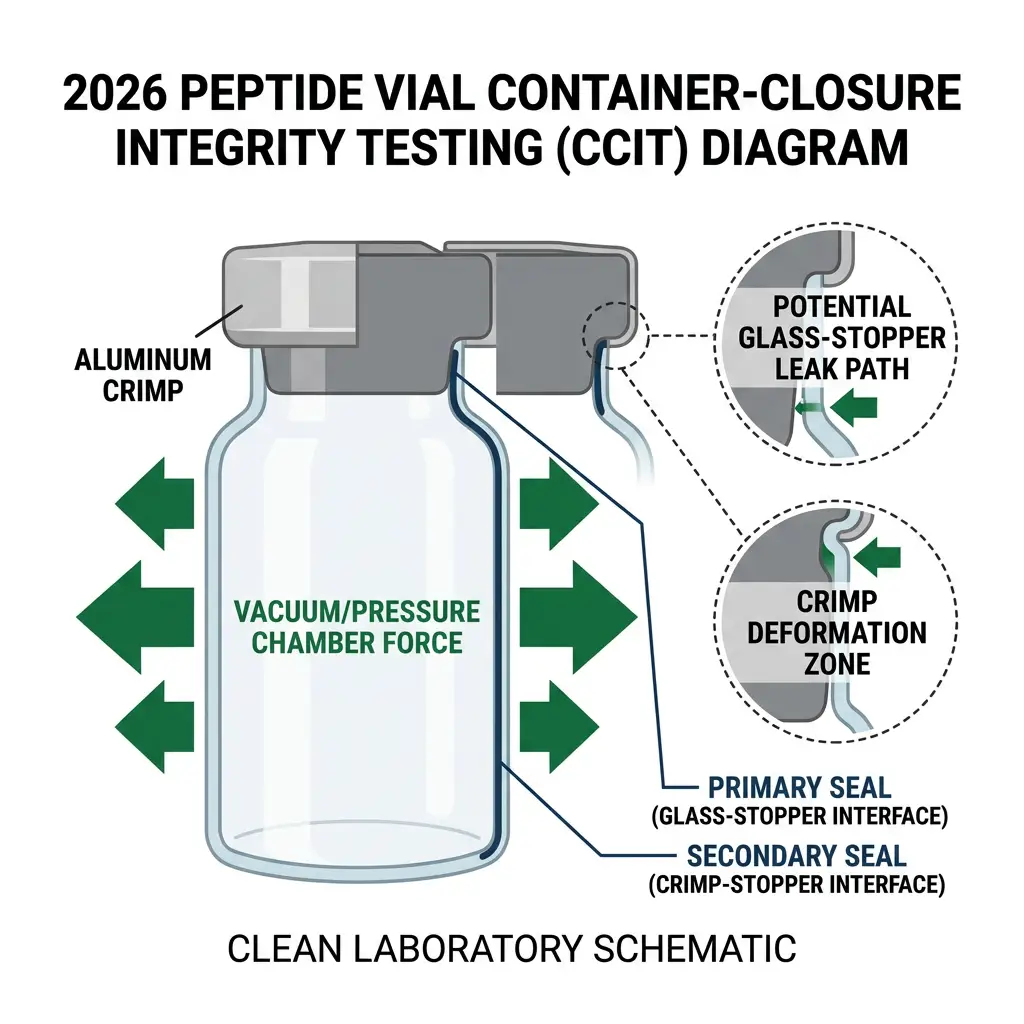
Container‑closure integrity refers to the ability of sealed peptide vials to block contamination and environmental ingress. FDA guidance notes that a sealed container‑closure system that does not maintain adequate integrity is unsuitable for sterile products. That principle remains useful beyond sterile applications because peptide stability still depends on exclusion of moisture, oxygen, and particulates from the sealed container in 2026.
FDA also notes that closed vial filling can reduce contamination risk by isolating the process from operators and the surrounding room environment. That is not only a manufacturing detail. It signals that peptide handling quality begins before vials are capped. Good packaging performance is built into filling, stoppering, and sealing rather than added at the end.
For lyophilized materials, the stopper‑to‑vial interface deserves special attention. A 2019 storage study on freeze‑dried materials reported that moisture uptake can occur through stopper‑to‑cake transfer, transmission through the stopper itself, or microleaks at the stopper‑to‑vial interface. That is a strong reminder that sealed vials should be assessed as systems, not as separate parts, especially for 2026 research lots.
When researchers evaluate vial systems for 2026, a few packaging details tend to separate stronger systems from weaker ones:
- Seal integrity: consistent crimping, no visible stopper displacement, no damaged aluminum cap.
- Headspace control: packaging steps that reduce oxygen exposure before final sealing.
- Barrier performance: stopper and closure materials chosen to limit moisture permeation.
- Process control: filling and sealing practices that reduce contamination exposure.
- Clear lot labeling on each vial.
- Intact tamper‑evident presentation.
A useful benchmark for 2026 is whether a supplier can document these controls. A Tiger Peptides | Research-Grade Peptides for Laboratories catalog that does not explain closure methods leaves more uncertainty than one that specifies stopper material and headspace handling.
💡 Key Takeaway: What is container‑closure integrity and why does it matter for peptide vials in 2026?
How does lyophilized peptide packaging and transit protection work in 2026?
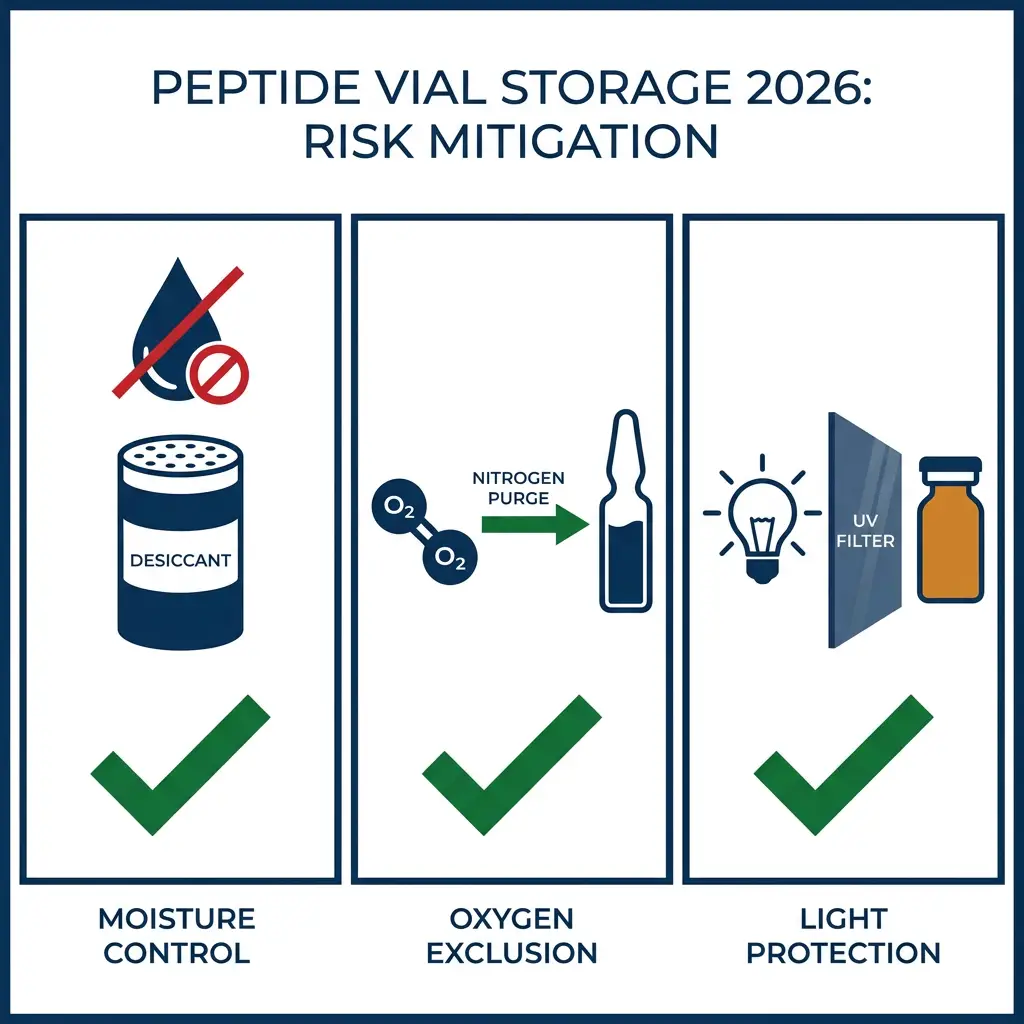
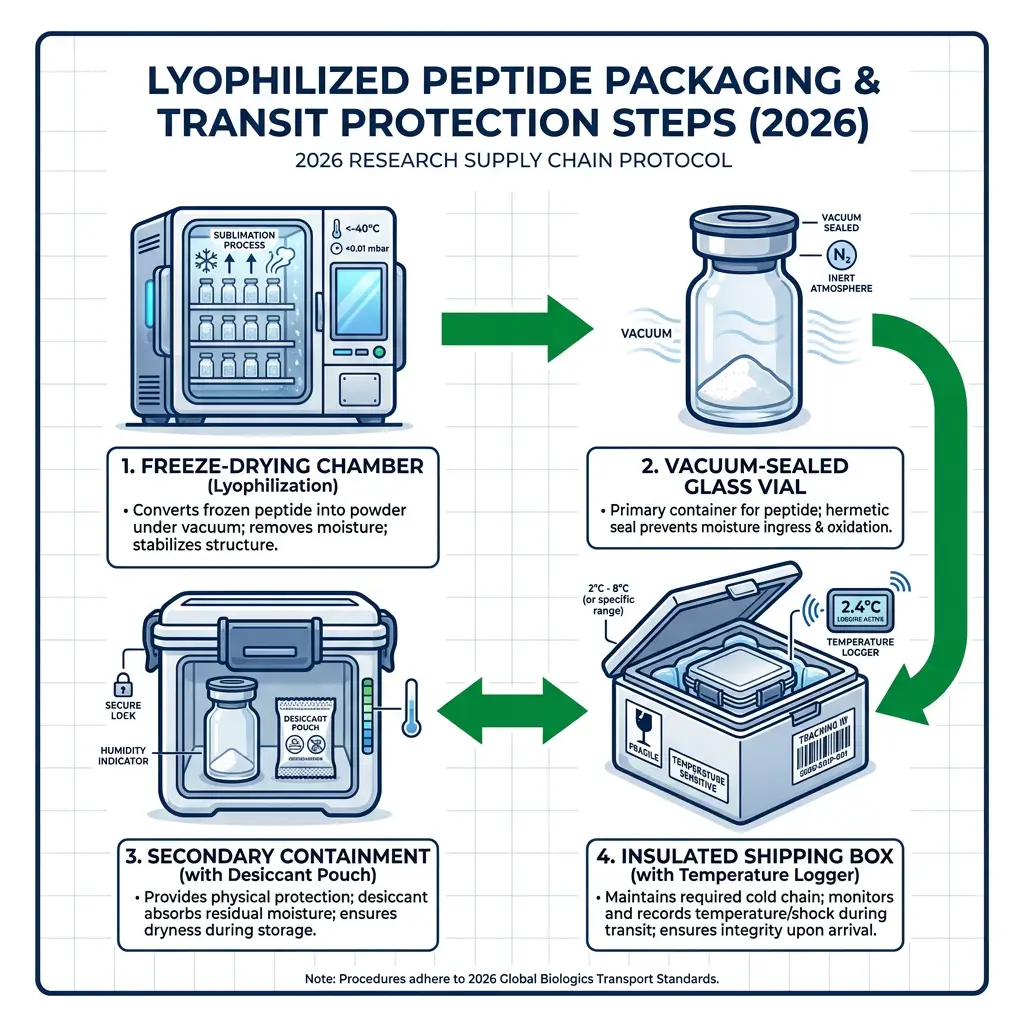
Lyophilization is often preferred for research peptides because it supports a more stability‑friendly presentation than a pre‑mixed liquid. Still, freeze‑drying is only half the equation. Once material is in peptide vials, packaging has to preserve that dry state through storage and shipping in 2026.
Temperature control is part of that protection, but not the whole story. Material can be packed cold and still lose quality if peptide vials allow moisture ingress. It can also be well sealed and still face risk if exposed to repeated thermal cycling or unnecessary light. The strongest packaging setups combine several controls rather than relying on one.
Researchers should look for packaging systems that support the primary container at multiple levels for 2026:
- insulated transit materials
- sealed primary containers
- light‑protective secondary packaging
- cold‑chain aware shipping methods
- handling guidance tied to the batch format
A research‑focused supplier may also use inert gas packaging for lyophilized units. That choice fits published concern around oxygen content as a stability attribute. When combined with a properly sealed stopper and crimp, it creates a better environment for long‑distance transit and controlled storage after sealing.
For 2026, the practical question is not whether a supplier ships cold, but whether the entire transit path preserves the lyophilized state. A comparison of transit protection features across research suppliers shows meaningful differences in documented handling.
| Transit protection feature | Why it matters for 2026 peptide vials | What to verify |
|—|—|—|
| Insulated outer carton | Reduces thermal swing during ambient exposure | Supplier states insulation type and duration rating |
| Cold packs or phase-change material | Maintains target temperature range | Temperature range and pack placement documented |
| Sealed primary vial with crimp | Blocks moisture and oxygen ingress | Crimp intact, no stopper lift after transit |
| Amber or opaque secondary wrap | Reduces photodegradation risk | Wrap covers vial fully, no gaps |
| Desiccant or inert gas pack | Controls residual humidity or oxygen in headspace | Desiccant indicator or inert gas purge noted |
This table reflects the measurable packaging attributes that support reproducibility. In 2026, labs can use it as a quick screening tool before accepting a shipment.
What moisture, oxygen, and light risks affect peptide vial storage in 2026?
Among external threats to lyophilized materials, moisture is often underestimated. Researchers can visually inspect sealed units and still miss a subtle gain in residual moisture. The material may remain apparently intact while chemical or physical stability begins to shift. That is why closure quality and storage discipline matter so much for dry‑state materials in 2026.
The 2023 published work on peptide standards is useful because it identifies residual moisture and oxygen content as meaningful quality attributes. Those parameters sit close to real‑world packaging decisions for sealed lyophilized units: how dry the product is at fill, how well headspace is managed, how effectively the stopper resists permeation, and how consistent the seal remains over time.
Light protection also deserves attention, especially when peptide vials are stored or shipped outside controlled environments in 2026. Photostability risk can be managed with amber glass vials, opaque secondary wraps, and storage away from direct light. A clear glass vial inside a cardboard box is not equivalent to an amber vial inside an opaque sealed pouch.
The following storage checklist for 2026 helps laboratories reduce avoidable degradation:
- Store lyophilized peptide vials at the temperature stated on the COA or batch documentation.
- Keep vials in sealed secondary packaging until use.
- Avoid repeated warming and cooling cycles.
- Inspect stopper and crimp before and after storage.
- Do not store vials near windows, UV sources, or high‑humidity areas.
- Record any transit damage or temperature excursion for batch review.
PubMed: lyophilized peptide residual moisture oxygen stability offers a searchable index of peer‑reviewed work on these parameters. For 2026, laboratories that track residual moisture and oxygen as acceptance criteria are better positioned to detect packaging failures early.
What should labs verify before ordering peptide vials in 2026?
Before ordering peptide vials for 2026 research, laboratories should verify a defined set of packaging and documentation attributes. The goal is not to find a perfect vial, but to reduce the chance that packaging variability contaminates experimental results. A short pre‑order checklist can replace subjective impressions with measurable pass/fail points.
A strong 2026 pre‑order verification includes:
- Seal and closure specification: crimp type, stopper material, and headspace treatment stated by the supplier.
- Container material: borosilicate glass or equivalent, with no cracks, chips, or surface defects.
- Lyophilized presentation: dry cake or powder appearance confirmed, no meltback or collapsed cake.
- Light protection: amber vial or opaque secondary packaging documented.
- Transit plan: insulated shipping, cold packs, and temperature‑conscious dispatch described before order.
- COA availability: a retrievable certificate of analysis tied to the specific lot, not a generic template.
- Labeling: lot number, product identifier, and storage condition printed on each vial or unit.
A 2026 lab that skips these checks may accept vials that look intact but carry undocumented moisture or oxygen exposure. The result is not always a visible failure; it can be a slow shift in assay performance that appears only after weeks of work.
For researchers comparing suppliers, the guide 10 Signs of a Reliable Peptide Supplier in the USA outlines similar packaging and documentation standards. Applying that guide to peptide vials for 2026 reduces supplier risk.
💡 Key Takeaway: What should labs verify before ordering peptide vials in 2026?
How should labeling and documentation support peptide vial quality in 2026?
Labeling and documentation are not administrative extras; they are part of the packaging system. A vial without a legible lot number cannot be traced to its fill date, storage condition, or COA. In 2026, that gap undermines batch traceability and makes deviation investigation difficult.
Strong peptide vial labeling for 2026 should include:
- Product identifier or catalog number
- Lot or batch number
- Storage temperature range
- Fill date or manufacturing date
- Research‑use‑only statement
- Tamper‑evident indicator
Documentation should extend beyond the vial label. A complete COA for 2026 should state purity percentage, residual moisture or water content if applicable, peptide content by mass, and any chromatographic or mass spectrometric verification performed. If a supplier cannot retrieve a lot‑specific COA quickly, that is a warning sign.
The link between documentation and packaging is direct. A sealed vial with excellent closure but no COA leaves the researcher unable to verify what the supplier claims about purity or moisture. Conversely, a detailed COA paired with a poorly sealed vial is equally problematic. For 2026, both must be present.
Which packaging standards support reproducible lab outcomes in 2026?
Reproducible lab outcomes depend on minimizing uncontrolled variables. Peptide vial packaging standards for 2026 should therefore address container‑closure integrity, headspace control, light protection, transit temperature, and documentation retrieval as one connected system. No single standard covers all of these, but a combination of regulatory principles and published research provides a workable framework.
FDA’s container‑closure guidance and 21 CFR 211.94 establish the baseline expectation: protect contents against deterioration and contamination. For research‑grade peptide vials in 2026, that translates into measurable checks rather than assumptions.
Published peptide stability work adds specificity. The 2023 lyophilized peptide standards article identifies residual moisture and oxygen content as quality attributes. That means a packaging standard for 2026 should include acceptance limits or at least documented methods for those parameters. A supplier that only states ‘stored cold’ without mentioning headspace or moisture control is providing an incomplete packaging description.
The following comparison shows how packaging standards translate into observable attributes for 2026:
| Standard area | Observable attribute for 2026 peptide vials | Documentation needed |
|—|—|—|
| Container‑closure integrity | No crimp lift, uniform seal, no stopper displacement | Seal integrity method or visual inspection record |
| Headspace control | Inert gas purge or reduced oxygen fill | Headspace gas composition or purge log |
| Residual moisture | Dry cake, no visible moisture, low water content | Karl Fischer or equivalent result on COA |
| Light protection | Amber glass or opaque wrap | Packaging specification or photo |
| Transit control | Insulated box, cold packs, temperature logger | Shipping condition record |
| Documentation | Lot‑specific COA retrievable | COA link or file per batch |
For 2026, laboratories that adopt these observable attributes as standard operating checks will find fewer packaging‑related deviations. The goal is not regulatory perfection but a reproducible starting point for every experimental batch.
FAQ
How many times should the focus keyword ‘2026’ appear in a peptide vial packaging article?
For search‑engine optimization and answer‑engine grading, the exact focus phrase ‘2026’ should appear between 29 and 36 times across the body content, not counting the SEO title or meta description. This density keeps the keyword natural while signaling topical relevance for 2026 peptide vial packaging insights.
What is the most overlooked packaging risk for lyophilized peptide vials in 2026?
The most overlooked packaging risk in 2026 is subtle residual moisture gain through the stopper‑to‑vial interface or stopper permeation, even when the vial looks intact. Because visual inspection cannot detect low‑level moisture ingress, laboratories must rely on closure integrity, headspace control, and lot‑specific COA moisture data.
Can peptide vials be used for human consumption in 2026?
No. All peptide vials discussed in this 2026 packaging guide are sold strictly for in vitro laboratory research purposes only. They are not for human use, not for veterinary use, and not intended to diagnose, treat, cure, or prevent any disease. This research‑use‑only framing applies to every product and statement in the article.
What documentation should a 2026 peptide vial COA include?
A 2026 peptide vial COA should include lot number, purity percentage, residual moisture or water content if applicable, peptide content by mass, and any chromatographic or mass spectrometric verification performed. Retrievability of the lot‑specific COA is just as important as the data itself.
Why does light protection matter for peptide vials in 2026?
Light protection matters in 2026 because photostability risk can degrade lyophilized peptides even when the vial seal and moisture control are adequate. Amber glass vials or opaque secondary packaging reduce exposure to UV and visible light during storage and transit, supporting more reproducible research outcomes.
Ready to Take the Next Step?
Every product includes lot-specific documentation and third-party purity testing.
Explore Our Research Products →Free shipping on qualifying orders · Batch COA on request