
Synthetic vs Bioactive Peptides: Best Lab Differences (2026)
Bioactive peptides explained: 7 proven lab differences vs synthetic peptides in 2026. Purity, COA, sourcing, analytical methods, and research-use-only guidance.
📋 Table of Contents
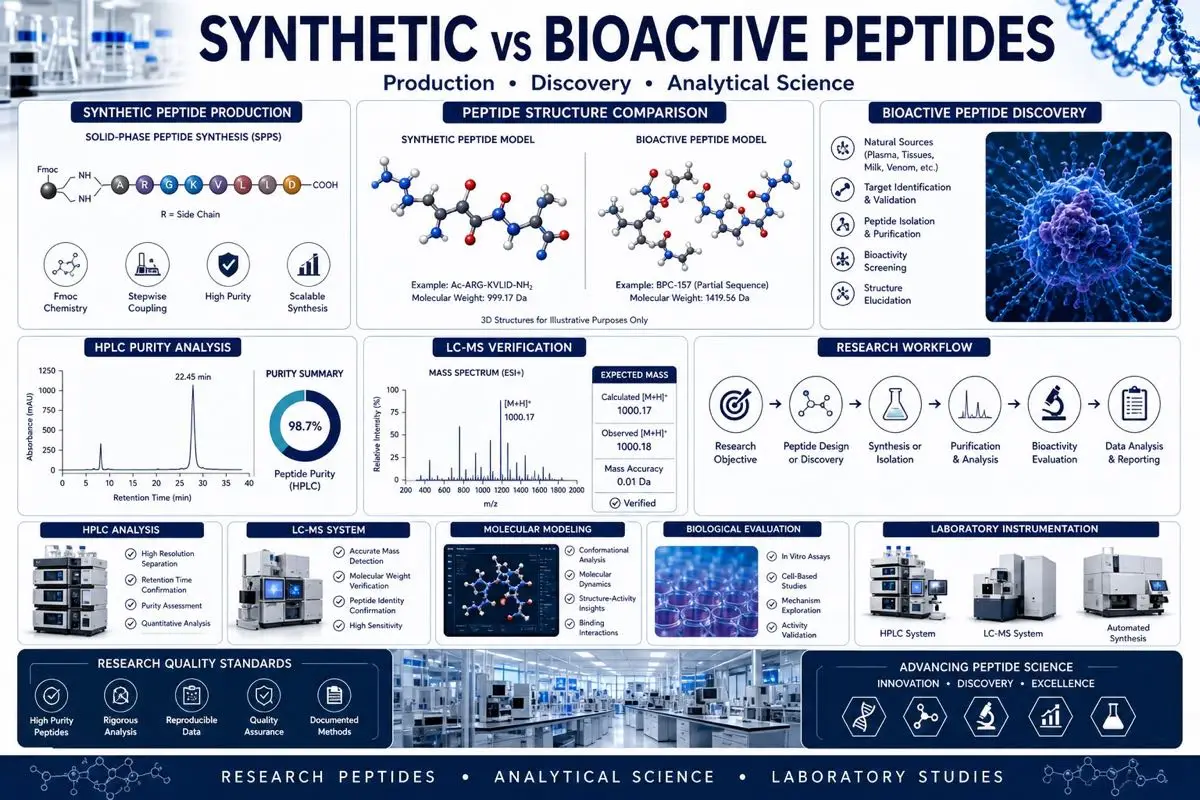
In laboratory research, synthetic and bioactive peptides are not opposites. Synthetic describes how a peptide is made—typically through controlled chemical assembly such as solid-phase peptide synthesis—while bioactive describes what a peptide does or the fact that it originates from a larger precursor protein and shows measurable biological activity after release. A single sequence can fit both labels: it may be identified as a bioactive motif in a natural protein, then produced later as a synthetic standard for controlled laboratory work. This guide compares synthetic and bioactive peptides across sourcing, production, verification, and practical lab decisions for 2026.
Research Use Only Notice: The products discussed on this site are sold strictly for in vitro laboratory research purposes only. They are not for human use, not for veterinary use, and not intended to diagnose, treat, cure, or prevent any disease. All information presented is for educational purposes in a research context. Must be 21+ to purchase.
Key takeaways
For researchers evaluating bioactive peptides in 2026, these five points frame the comparison:
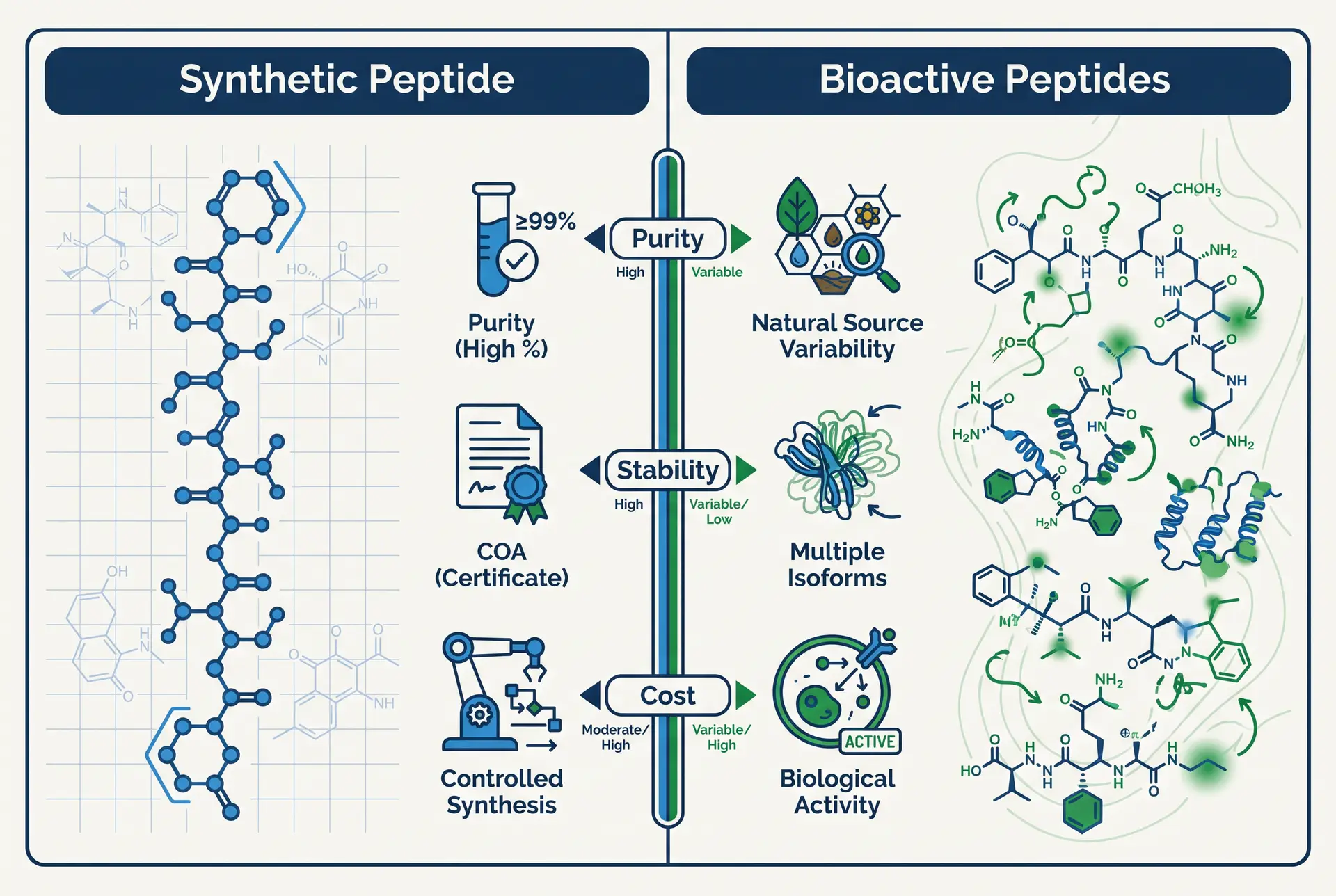
- Synthetic refers to the production method; bioactive refers to functional activity or source-derived release—these are not strict opposites.
- A peptide can be both synthetic and bioactive when a naturally derived active motif is later resynthesized as a defined reference material.
- Synthetic routes favor exact sequence control, analog design, lot-to-lot reproducibility, and defined impurity profiling.
- Bioactive discovery routes often begin with source-dependent protein processing, enzyme selection, and higher early variability.
- Many efficient programs use bioactive screening first, then synthetic resynthesis for confirmation, documentation, and controlled assay work.
What Does the Term “Synthetic vs Bioactive” Actually Mean in the Lab?
The phrase “synthetic vs bioactive peptides” often appears as if it were a simple either-or choice. In practice, the terms answer different questions. One asks how a peptide was made. The other asks whether a peptide shows biological activity or was released from a precursor protein during processing.
That distinction changes project design, material qualification, and expected variability. A team building a receptor-mapping assay may prioritize synthetic control. A team screening enzymatic digests for active fragments may prioritize bioactive discovery methods. Many programs eventually use both.
This comparison is intended for research-use-only educational literacy. It is not medical advice and not for human use. A careful synthetic vs bioactive peptides comparison separates production method from functional status, which prevents documentation drift in procurement notes, assay protocols, and COA archives.
What Are the Evidence Boundaries for This Comparison?
Definitions and examples in this article are drawn from peptide chemistry and bioactive-peptide review literature. A 2026 PubMed-indexed review describes bioactive peptides as short amino acid sequences released from precursor proteins through enzymatic hydrolysis, fermentation, or gastrointestinal digestion. A separate 2025 PubMed-indexed review describes modern peptide production through platforms that include solid-phase peptide synthesis, solution-phase synthesis, liquid-phase synthesis, biosynthesis, and emerging catalytic methods. You can verify the underlying literature through PubMed and NCBI.
Individual projects still require method-specific validation, lot-level documentation, and model-appropriate controls. Treat comparative language as a planning framework, not as a substitute for primary experimental design. The evidence base for synthetic and bioactive peptides continues to evolve, but the core distinction between manufacturing route and functional status remains stable across peer-reviewed sources.
💡 Key Takeaway: What Are the Evidence Boundaries for This Comparison?
Why Are Synthetic and Bioactive Peptides Different Categories?
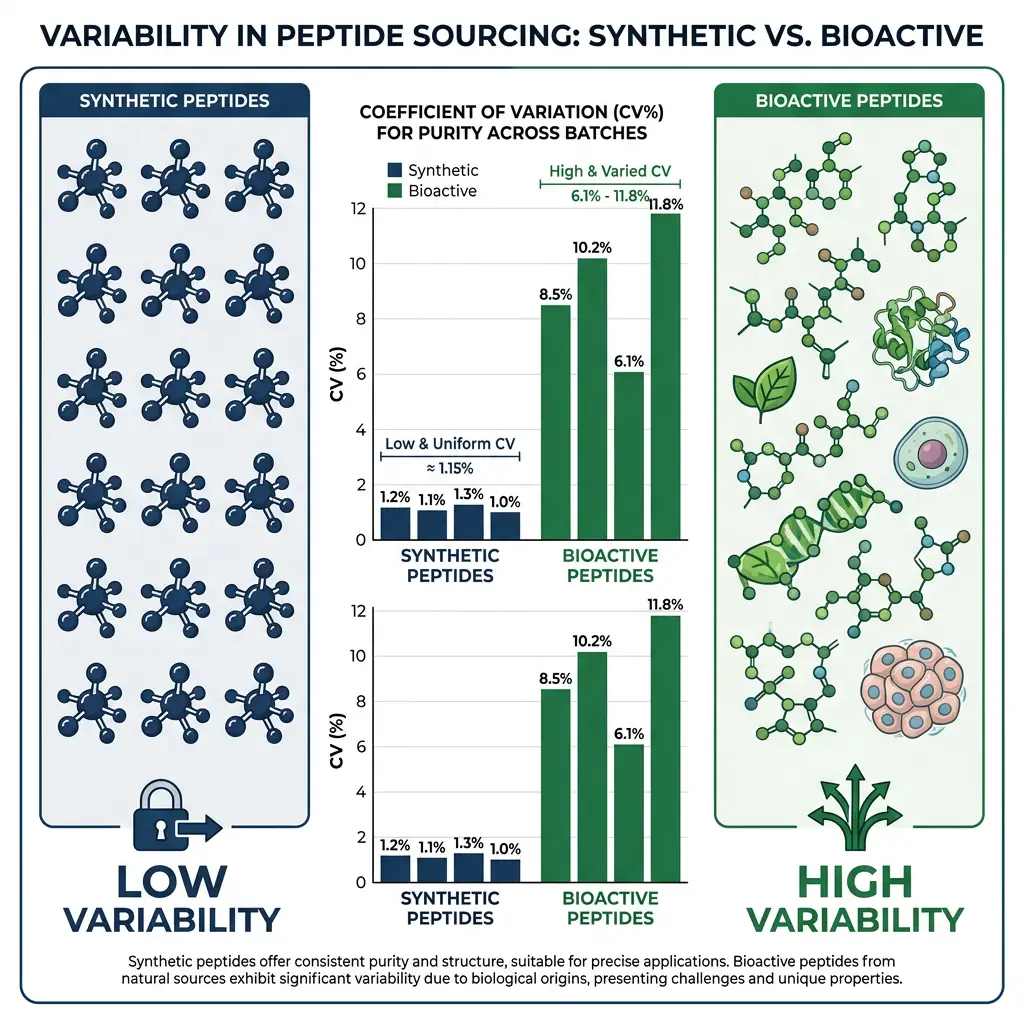
Synthetic and bioactive peptides are different categories because they describe different properties. “Synthetic” answers the question of manufacturing route. “Bioactive” answers the question of functional or source-derived status. That distinction matters because it changes how a project should be designed, how materials should be qualified, and what kind of variability a lab should expect.
The 2026 review noted above describes bioactive peptides as sequences released from precursor proteins through enzymatic hydrolysis, fermentation, or digestion. The 2025 review describes production platforms including solid-phase, solution-phase, liquid-phase, biosynthesis, and catalytic methods.
So when researchers compare synthetic vs bioactive peptides, the more useful comparison is this: standardized chemical production versus source-derived functional sequences. The categories can overlap when a bioactive motif is later remade as a synthetic reference material.
Keeping those labels separate prevents documentation drift. Procurement notes, assay protocols, and COA archives should state whether a material is being used as a chemically defined standard, a discovery isolate, or both in sequence. For a deeper look at how research peptides differ from cosmetic peptides in the lab, see Research Peptides vs Cosmetic Peptides: Lab Basics.
How Are Synthetic Peptides Produced in the Laboratory?
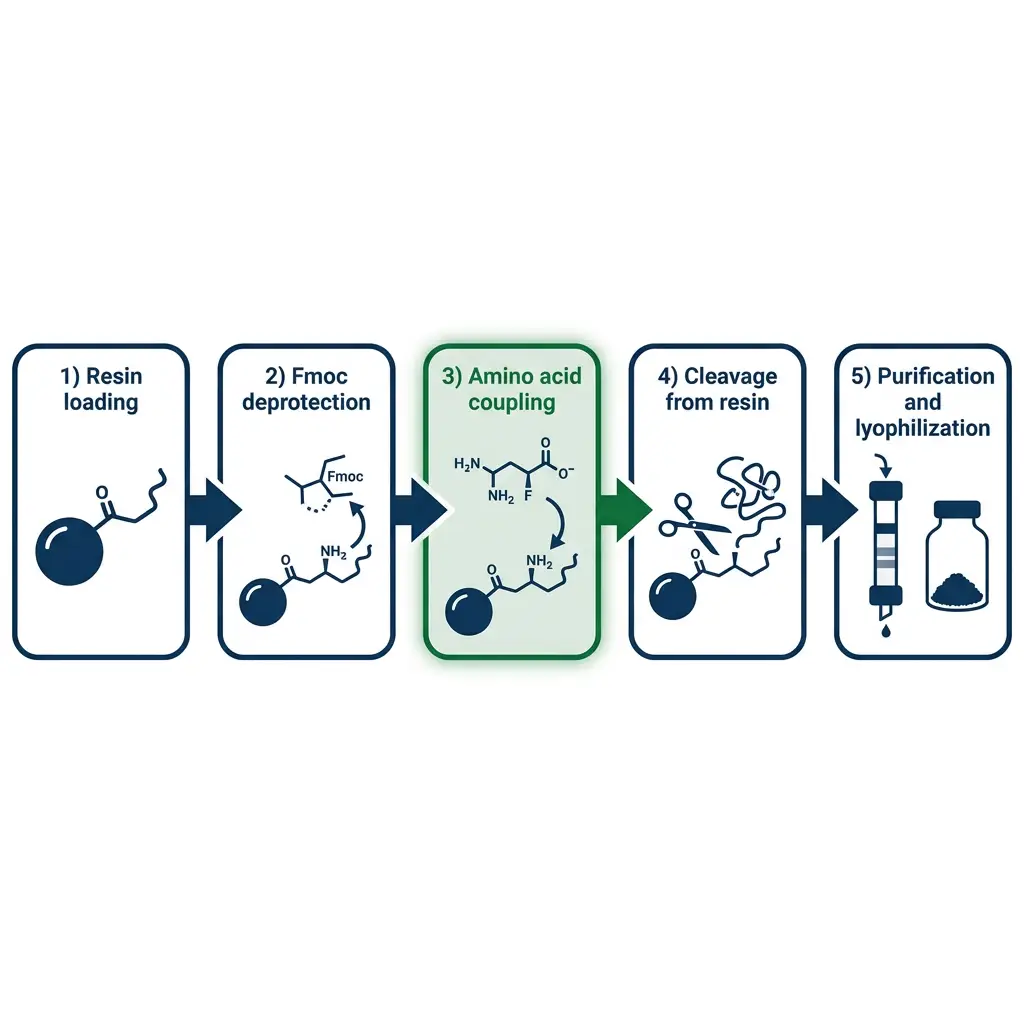
Synthetic peptide work is usually centered on controlled chemical assembly. In current laboratory practice, solid-phase peptide synthesis is the most familiar platform because it supports stepwise sequence construction, reagent control, and automation. Solution-phase methods still matter in selected workflows, but solid-phase systems remain the anchor for many routine research-grade peptide projects.
That manufacturing logic gives synthetic peptides a major lab advantage. Sequence identity is defined in advance, the synthesis path can be documented, and the final material can be purified against a known target. When a lab needs a reference standard, a mechanistic probe, a structure-activity series, or a modified analog, synthetic production is often the most direct route.
The same 2025 PubMed review also points out that synthesis method choice comes with tradeoffs in efficiency, cost, and environmental impact. Synthetic work can support linear and cyclic peptides, yet the burden shifts downstream to cleavage, purification, impurity removal, and solvent or resin waste management. Control is high, but it is not free.
Researchers often favor synthetic peptides when a project depends on exact sequence control, repeatable lot-to-lot performance, targeted substitutions or truncations, cleaner analytical verification, and defined impurity profiling. That preference is strongest in assay development, receptor mapping, epitope studies, and early structure-function work, where a small sequence change can alter the entire data set.
In a synthetic vs bioactive peptides decision tree, these needs usually push teams toward synthesis first. Discovery breadth is not the goal; attribution and reproducibility are. For labs sourcing research-grade peptides, a reliable supplier checklist is available at 10 Signs of a Reliable Peptide Supplier in the USA.
Why Does Bioactive Peptide Sourcing Introduce More Variability?
Bioactive peptides follow a different starting point. Many are hidden inside larger parent proteins and become active only after cleavage. Literature commonly describes them as sequences normally buried in precursor proteins until processing releases them. The biological interest may be high, but the material path is often less controlled at the beginning.
Source matters a great deal. Protein origin, enzyme choice, hydrolysis conditions, and fractionation strategy can all change which fragments appear and how consistently they appear across batches. Early screening can therefore generate promising activity signals that are harder to reproduce until the active sequence is isolated and confirmed.
That is why many laboratories treat bioactive discovery as a hypothesis engine rather than a finished materials strategy. The discovery step identifies candidate motifs. The confirmation step often returns to synthesis so the lab can test a defined sequence under controlled conditions.
For bioactive peptides sourced from natural proteins, variability also arises from raw material lot differences, seasonal or supplier changes in starting protein, and the specificity of the protease used for digestion. Without a defined sequence and a characterized reference standard, reproducing an activity signal across independent runs can be difficult. This is not a flaw in the peptide itself; it is a consequence of discovery-stage sourcing. The path from a complex digest to a single confirmed bioactive sequence is often longer and less predictable than a planned synthetic route.
💡 Key Takeaway: Why Does Bioactive Peptide Sourcing Introduce More Variability?
What Are the Side-by-Side Lab Differences Between Synthetic and Bioactive Peptides?
A direct side-by-side comparison helps labs decide which format fits a given experiment. The table below summarizes the main operational differences for synthetic and bioactive peptides in a research-use-only context.
| Parameter | Synthetic Peptides | Bioactive Peptides |
|—|—|—|
| Primary definition | Made by controlled chemical assembly, usually solid-phase peptide synthesis | Released from a larger precursor protein through enzymatic hydrolysis, fermentation, or digestion |
| Sequence control | Exact sequence defined before synthesis; analogs, truncations, and substitutions are routine | Sequence depends on source protein and cleavage pattern; early discovery may yield mixtures |
| Lot-to-lot reproducibility | High when synthesis, purification, and QC are documented | Lower early in discovery; improves after active sequence is confirmed and resynthesized |
| Typical purity | Can be purified to high purity with defined impurity profiles; COA can state purity percentage | Early isolates may be complex digests; purity and composition require additional fractionation and characterization |
| Analytical verification | Mass spectrometry, HPLC, amino acid analysis, and sequencing confirm identity | Same methods apply after isolation, but initial material may need more extensive separation first |
| Best use in lab | Reference standards, receptor mapping, structure-activity studies, controlled assays | Discovery screening, hypothesis generation, identifying candidate motifs from natural sources |
These differences do not make one category inherently better. They make each category better suited to a different stage of research. A lab studying synthetic and bioactive peptides often moves from the right column to the left column as a project matures.
For bioactive peptides, the key operational challenge is confirmation. Once an active fragment is identified, resynthesis as a synthetic peptide gives the lab a defined material for dose-response curves, binding assays, and reproducibility checks. That transition is a normal part of peptide research and should be planned from the start.
Which Analytical Methods Verify Synthetic and Bioactive Peptides?
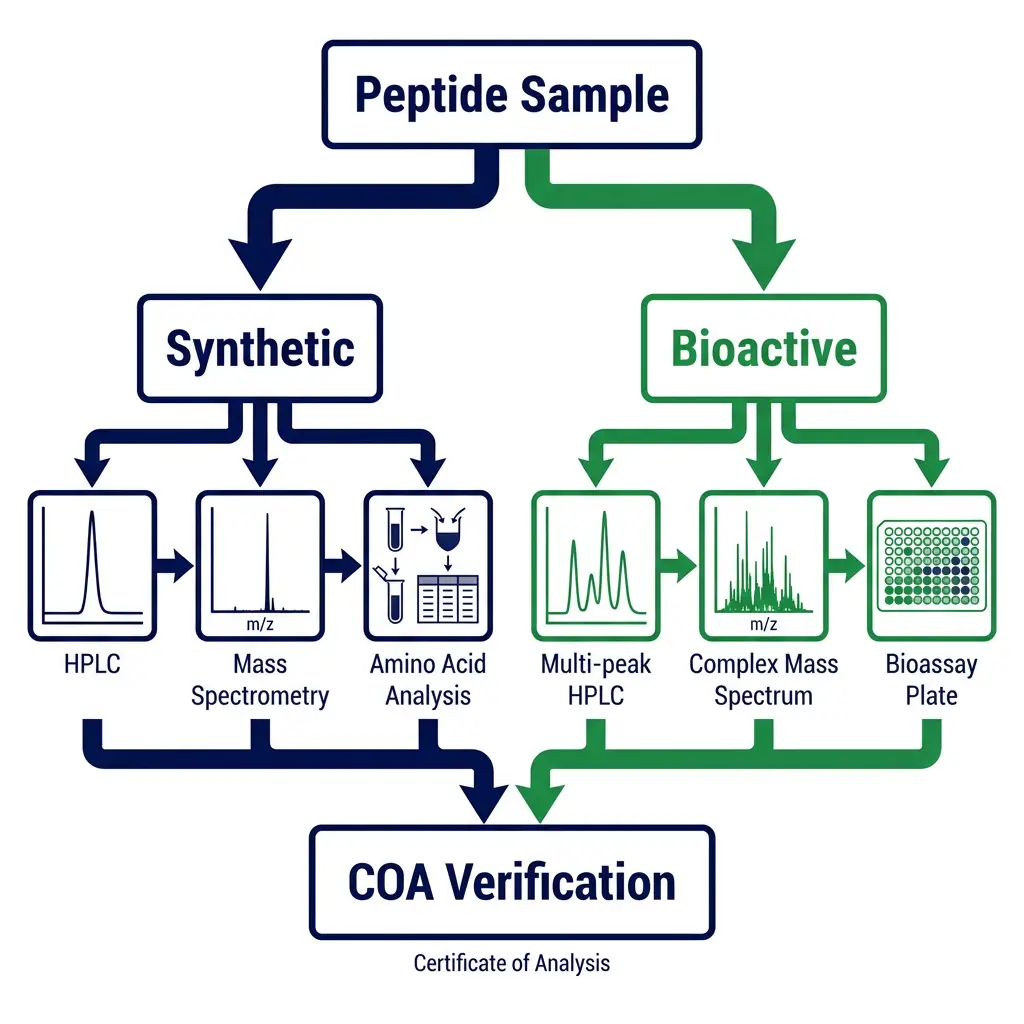
Analytical verification is where synthetic and bioactive peptides converge. Once a bioactive peptide has been isolated to a defined sequence, the same analytical toolbox applies to both formats. The difference is usually the amount of preparatory work required before verification can begin.
Common analytical methods include:
- High-performance liquid chromatography (HPLC) for purity assessment and fraction collection.
- Mass spectrometry (MS) for molecular weight confirmation and sequence verification.
- Amino acid analysis for composition checks.
- N-terminal sequencing or tandem MS for sequence confirmation when identity is uncertain.
- Circular dichroism or other spectroscopic methods for secondary structure when conformation matters.
For synthetic peptides, these methods are often part of a standard COA package. A supplier may report purity percentage, residual solvent levels, counterion content, and mass identity. For bioactive peptides from natural digests, the lab must first separate the active fraction from inactive components before applying the same methods. That additional fractionation step is a major source of time and material loss in discovery programs.
Labs should document every analytical result in a way that allows independent replication. A COA for a synthetic peptide should state the exact sequence, purity method, and storage conditions. For a bioactive peptide isolate, the documentation should include source protein, enzyme, digestion conditions, and fractionation protocol. Without that documentation, comparing results across labs becomes unreliable.
What Are the Development Limits and Pressure Points for Each Format?
Synthetic peptide development has clear limits. Solid-phase synthesis becomes more difficult as sequence length increases, and certain modifications—such as complex glycosylation or unusual cross-links—can be challenging or impossible to install by standard chemical methods. Synthesis also generates waste and may require expensive building blocks for nonstandard residues. These pressure points push some projects toward biosynthesis or semisynthetic approaches.
Bioactive peptide development has different limits. The starting material is a complex biological mixture, so the active component may be present at very low abundance. Protease specificity, hydrolysis time, and pH can all shift the fragment profile. Scaling up a discovery isolate for repeated experiments often requires moving to synthetic production anyway. Thus, bioactive peptides are powerful for finding new sequences but less efficient for producing large quantities of a defined standard.
A practical pressure point for both formats is documentation. Synthetic work requires detailed synthesis logs, purification traces, and COA review. Bioactive work requires detailed source records, enzyme lots, and fractionation maps. In both cases, the absence of documentation turns a promising result into an unrepeatable anecdote. For this reason, many labs adopt a hybrid workflow: use bioactive screening to find candidates, then use synthetic resynthesis to lock down sequence and enable controlled replication.
💡 Key Takeaway: What Are the Development Limits and Pressure Points for Each Format?
How Should a Lab Choose Between Synthetic and Bioactive Peptides?
The choice depends on the question being asked. If the goal is to test a defined sequence, measure binding affinity, or compare analogs, synthetic production is usually the right starting point. If the goal is to discover which fragment of a parent protein shows activity, bioactive discovery methods are more appropriate.
A simple decision checklist can help:
- Do you already know the exact sequence? If yes, go synthetic.
- Do you need to modify residues, truncate, or label the peptide? If yes, go synthetic.
- Are you screening a complex protein digest for unknown active fragments? If yes, start with bioactive discovery.
- Do you need high lot-to-lot reproducibility for a multi-year study? If yes, synthetic is the safer choice.
- Are you trying to replicate a published bioactive peptide result? Resynthesize the exact sequence and verify it before running assays.
Many labs use both approaches in sequence. A discovery project may begin with enzymatic digestion of a source protein, identify a promising bioactive peptide fraction, then resynthesize the confirmed sequence as a synthetic peptide for controlled follow-up. That hybrid workflow gives the best of both categories: broad discovery potential followed by precise attribution.
For labs sourcing research-grade peptides, supplier reliability matters at every step. A checklist for evaluating suppliers is available at 10 Signs of a Reliable Peptide Supplier in the USA. You can also review Tiger Peptides | Research-Grade Peptides for Laboratories for a general overview of laboratory peptide sourcing standards.
FAQ
What is the main difference between synthetic and bioactive peptides?
Synthetic peptides are defined by their production method—controlled chemical assembly such as solid-phase peptide synthesis. Bioactive peptides are defined by their function or source-derived release from a larger precursor protein. A single peptide can be both synthetic and bioactive if a naturally derived active motif is later resynthesized as a defined reference material.
Can a bioactive peptide be produced synthetically?
Yes. Once a bioactive peptide sequence is confirmed from a natural source, it can be resynthesized using standard synthetic methods. This is a common workflow because it gives the lab a defined, reproducible material for controlled assays, while preserving the same amino acid sequence and biological activity.
Why do bioactive peptides show more variability than synthetic peptides?
Bioactive peptides often come from complex protein digests where enzyme choice, hydrolysis conditions, and source protein lot can change the fragment profile. Early discovery material may contain mixtures and low-abundance active components. Synthetic peptides, in contrast, are built stepwise from defined building blocks, which supports tighter control over sequence and purity.
Which analytical methods are used to verify both synthetic and bioactive peptides?
The same core methods apply to both once a bioactive peptide has been isolated: HPLC for purity, mass spectrometry for identity, amino acid analysis for composition, and sequencing for confirmation. Bioactive peptides simply require more upfront separation and fractionation before these methods can be applied.
How should a lab decide between synthetic and bioactive peptides for a project?
Start with the research question. If you need a defined sequence, analog series, or high reproducibility, choose synthetic production. If you need to discover which fragment of a parent protein is active, choose bioactive discovery methods. Many projects use both: bioactive screening first, then synthetic resynthesis for confirmation.
Ready to Take the Next Step?
Every product includes lot-specific documentation and third-party purity testing.
Explore Our Research Products →Free shipping on qualifying orders · Batch COA on request