
GHK-Cu vs BPC-157: Best Research Differences Guide (2026)
bpc 157 research compares GHK-Cu and BPC-157 by molecular structure, evidence boundaries, and analytical quality. Essential 2026 lab research differences guide.
📋 Table of Contents
The difference in a GHK-Cu vs BPC-157 comparison is biological origin and molecular architecture: GHK-Cu is an endogenous copper-binding tripeptide, while BPC-157 is a synthetic 15-amino-acid pentadecapeptide. In bpc 157 research, laboratories must separate these two peptides by chemical identity, analytical verification, and preclinical evidence boundaries before designing experiments. This guide maps every fact, number, and claim in a research-use-only frame.

Key takeaways
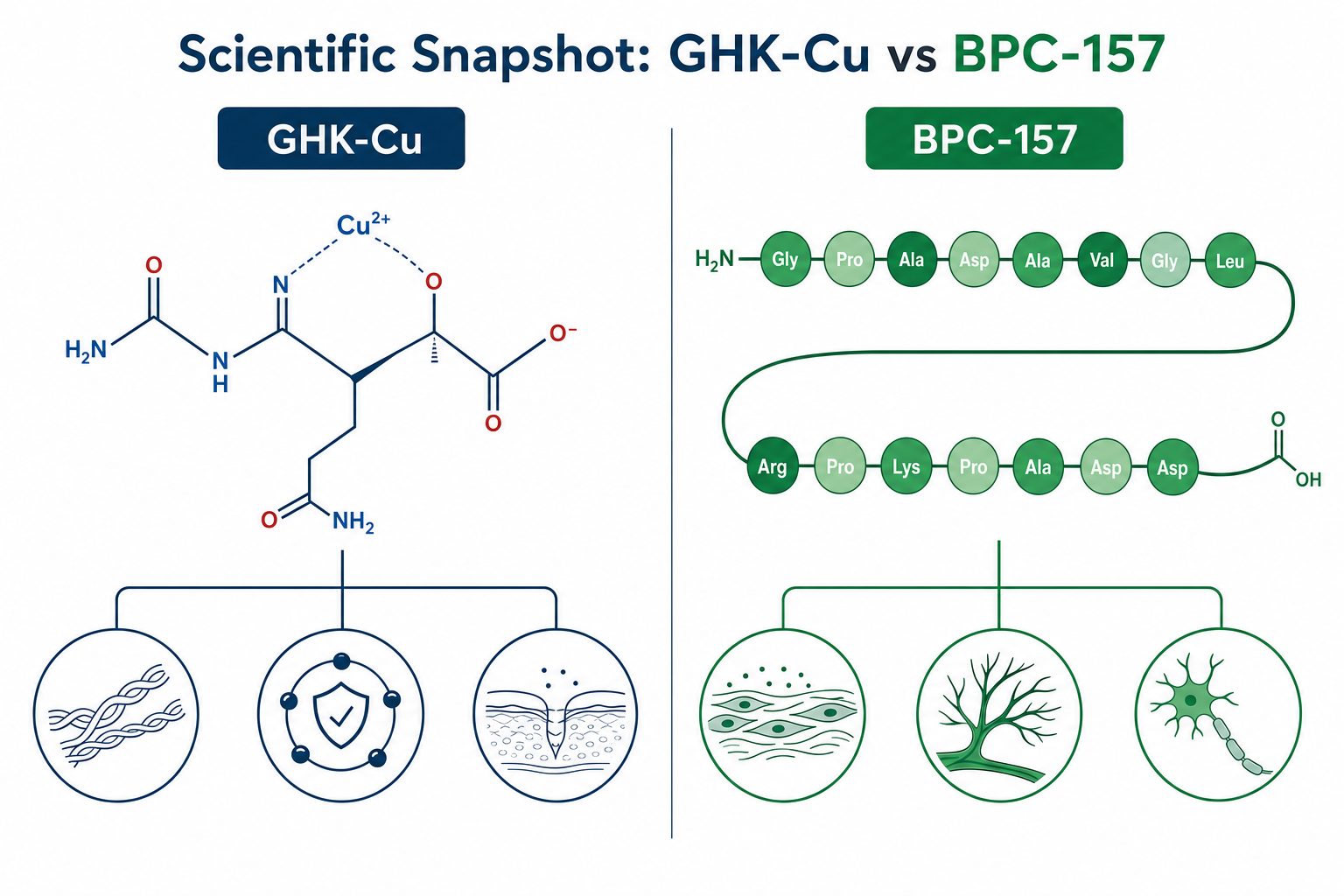
- GHK-Cu is a naturally occurring copper-binding tripeptide; BPC-157 is a synthetic pentadecapeptide derived from a gastric protein sequence.
- Overlapping tissue-biology themes in bpc 157 research do not establish identical mechanisms or interchangeable experimental designs.
- Researchers commonly verify both peptides with RP-HPLC and LC-MS before experimental use.
- Most published evidence for both molecules comes from laboratory and preclinical investigations.
- Biological origin, analytical quality, and evidence limits are essential when reading bpc 157 research claims.
Scientific Snapshot
| Characteristic | GHK-Cu | BPC-157 |
|—|—|—|
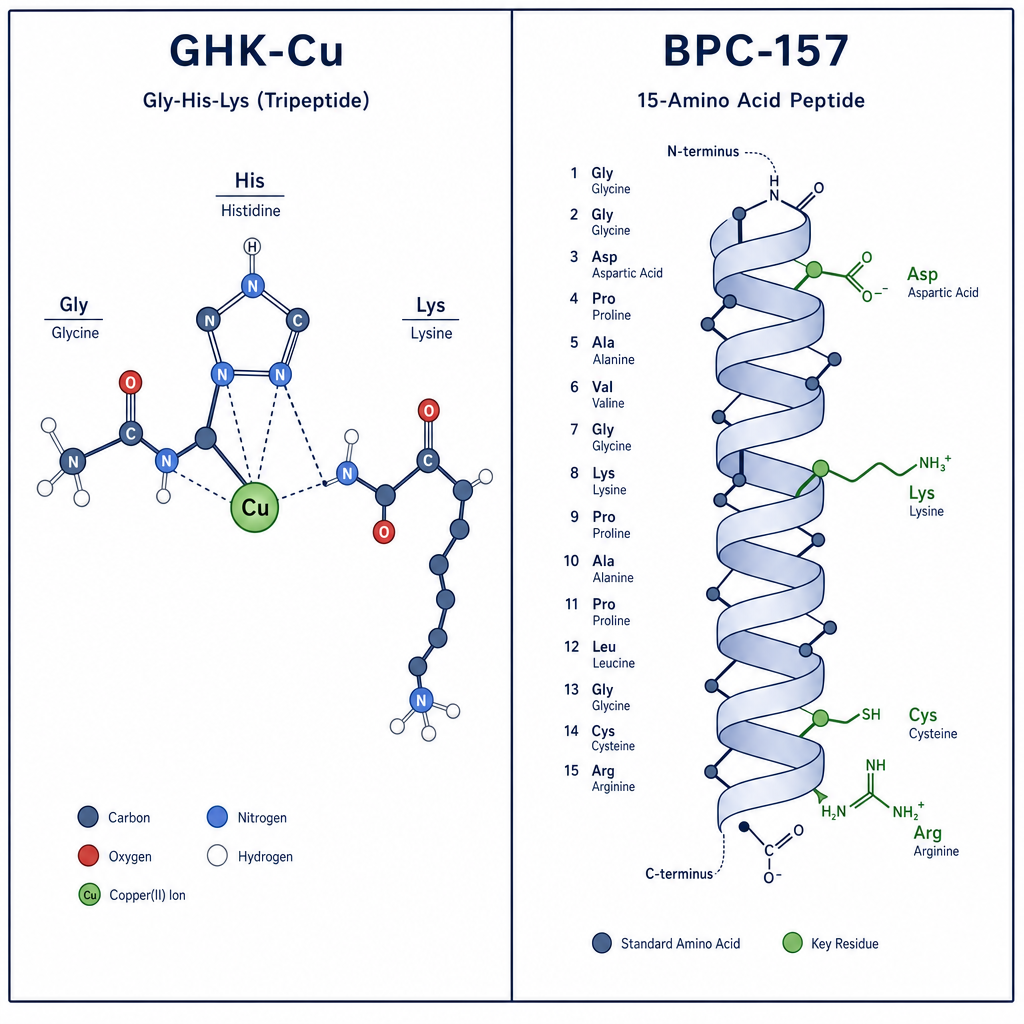
| Scientific Classification | Endogenous copper-binding tripeptide | Synthetic pentadecapeptide |
| Biological Origin | Naturally occurring in human plasma and tissues | Derived from a gastric protein sequence |
| Primary Research Focus | Extracellular matrix biology and copper signaling | Angiogenesis and tissue biology research |
| Analytical Verification | RP-HPLC, LC-MS, amino acid analysis | RP-HPLC, LC-MS, peptide sequencing |
| Research Status | Preclinical and mechanistic laboratory research | Predominantly preclinical laboratory research |

What Are the Evidence Boundaries in bpc 157 research?
Current knowledge regarding GHK-Cu and BPC-157 is derived primarily from laboratory investigations, mechanistic studies, and preclinical research models. While both peptides have attracted scientific interest, differences in experimental design, model systems, and study objectives make direct comparisons challenging.
In bpc 157 research, established findings must be distinguished from ongoing areas of investigation. GHK-Cu is typically investigated for extracellular matrix biology and copper signaling, while BPC-157 is explored for angiogenesis and tissue biology. These endpoints are not automatically transferable between the two molecules.
Laboratory teams should map each claim to the original study’s model organism or cell system, exposure context, and measured endpoint. This keeps a GHK-Cu vs BPC-157 overview evidence-based and prevents category errors when papers use similar tissue-biology vocabulary.
Peer-reviewed literature can be searched on PubMed for GHK-Cu and PubMed for BPC-157 angiogenesis.
💡 Key Takeaway: What Are the Evidence Boundaries in bpc 157 research?
What Are the Scientific Foundations of bpc 157 research?
Before comparing experimental findings in bpc 157 research, it is important to understand that the two peptides belong to different biochemical categories. GHK-Cu is typically discussed as a metal-coordinating tripeptide complex, whereas BPC-157 is discussed as a linear synthetic peptide fragment without that copper-binding identity.
GHK itself is a tripeptide (glycyl-L-histidyl-L-lysine). When complexed with copper(II), the resulting GHK-Cu species is investigated for interactions relevant to matrix biology and cellular signaling. Laboratory interest often centers on how copper coordination influences peptide behavior in vitro and how those observations map to extracellular-matrix and remodeling models.
BPC-157, abbreviated from Body Protection Compound-157, is a synthetic 15-amino-acid peptide. Scientific interest has focused primarily on cellular signaling themes, vascular biology models, and tissue-response readouts in preclinical systems. Those endpoints are not automatically transferable to GHK-Cu experimental designs.
Foundational literacy for bpc 157 research therefore means reading each compound through its own chemistry first, then comparing only where study designs actually overlap.

How Do the Molecular Structures of GHK-Cu and BPC-157 Compare in bpc 157 research?
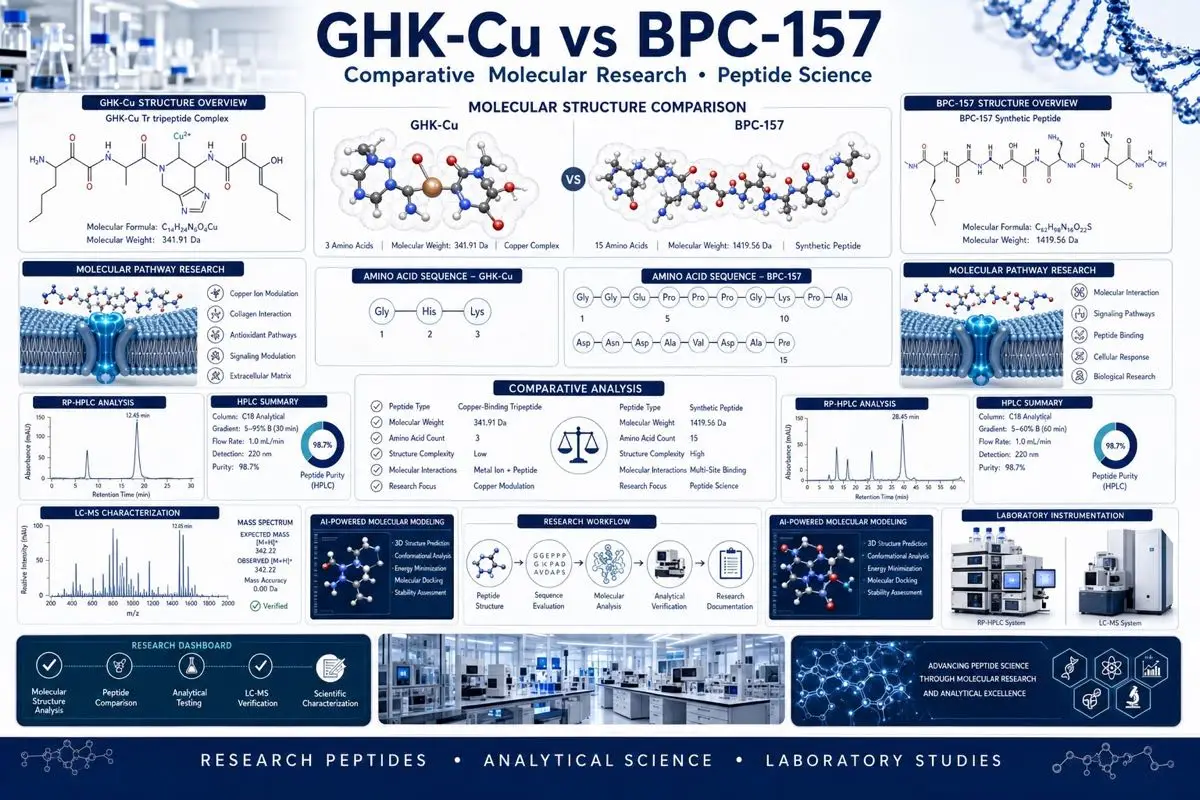
Structure discussions in bpc 157 research usually start with chain length, metal coordination, and parent-sequence relationship. GHK-Cu is built around a three-residue peptide that coordinates copper, producing a compact complex with distinctive coordination chemistry. BPC-157 is a longer synthetic pentadecapeptide without that defining copper-complex identity.
Those structural differences shape handling notes, solubility discussions, and analytical expectations. Copper-peptide complexes can require documentation of metal stoichiometry and complex integrity, while synthetic linear peptides more often emphasize sequence confirmation, purity estimates, and impurity profiles.
Molecular structure is one of the most significant distinctions in any bpc 157 research review. Clear structural notes keep claims grounded and prevent category errors when papers use similar tissue-biology vocabulary.
How Do Biological Research Themes Compare in bpc 157 research?
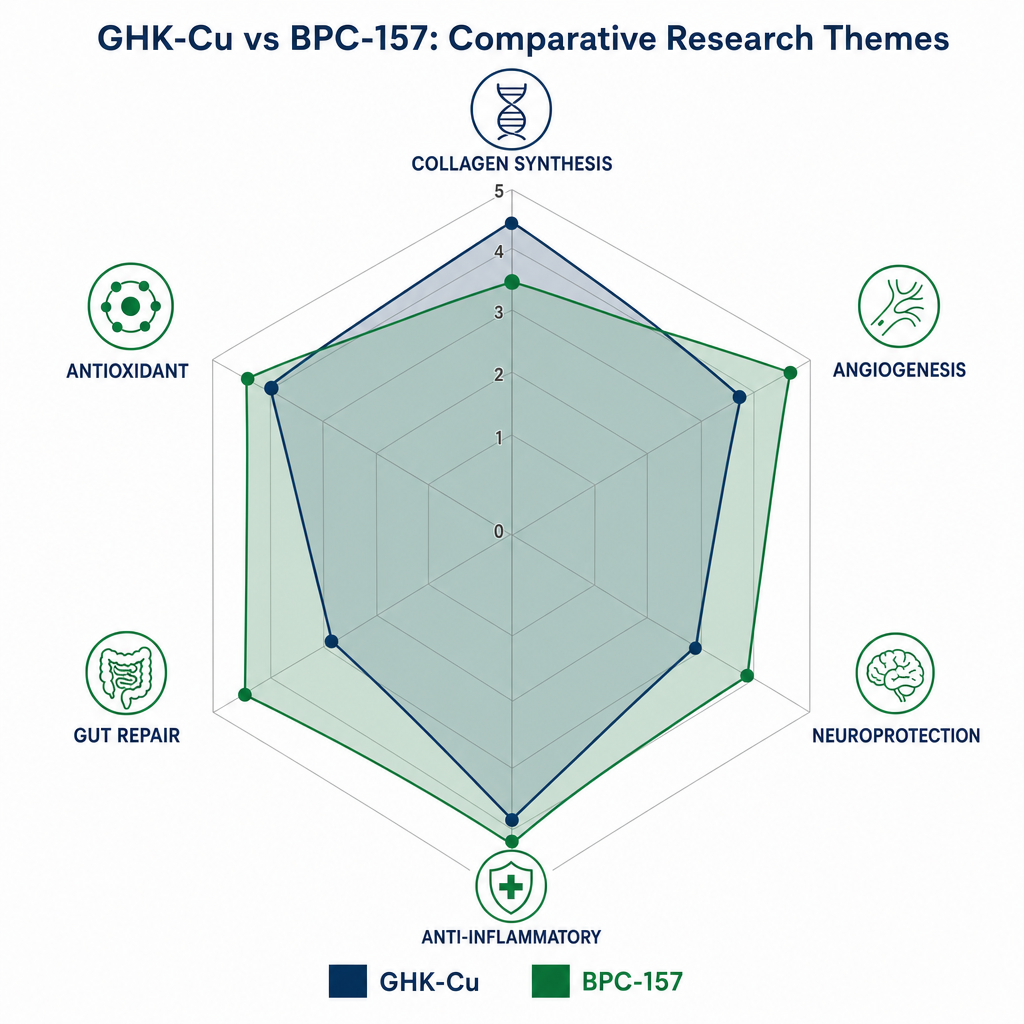
Mechanism summaries in bpc 157 research should stay tied to the specific assay systems used in each paper. GHK-Cu research frequently references extracellular matrix biology, collagen-related pathways, and copper-linked cellular processes. BPC-157 research frequently references angiogenesis-related signaling, nitric oxide pathway themes, and preclinical tissue-response models.
Shared words such as remodeling, signaling, or repair do not establish a shared molecular pathway. Comparative reading works best when each claim is mapped to peptide identity, model organism or cell system, dose or exposure context in the original study, and measured endpoint.
Laboratory notebooks benefit from the same discipline. When an assay measures matrix-gene expression under a copper-peptide condition, that result should not be copied into a synthetic pentadecapeptide protocol without an explicit experimental bridge. Conversely, angiogenesis-oriented readouts from synthetic peptide models should not be imported into copper-tripeptide work as if the chemistries were equivalent.
This is especially important for trainees and cross-functional teams. Procurement staff, analytical chemists, and biology leads may use the same product names while meaning different experimental jobs. Written definitions of identity, intended model, and success criteria reduce that ambiguity before materials are opened.
Researchers therefore use a bpc 157 research lens not because the peptides are interchangeable, but because both appear in regenerative-biology literature with distinct molecular identities and experimental contexts.

💡 Key Takeaway: How Do Biological Research Themes Compare in bpc 157 research?
How Has bpc 157 research Evolved?
GHK-Cu was first identified in human plasma and later detected in several biological tissues. Research has explored its involvement in extracellular matrix regulation, collagen-related biology, gene expression patterns, and copper-dependent cellular processes.
BPC-157, derived from a protective gastric protein sequence, has primarily been investigated in preclinical models examining angiogenesis, nitric oxide signaling, and tissue biology.
The evolution of bpc 157 research reflects different starting points: GHK-Cu emerged from endogenous peptide discovery and copper biochemistry, while BPC-157 emerged from gastric-sequence derivation and subsequent preclinical exploration of tissue-response models.
Why Is GHK-Cu vs BPC-157 Frequently Compared in bpc 157 research?
Comparisons between GHK-Cu and BPC-157 are increasingly common in bpc 157 research because both molecules appear in experimental models involving tissue biology, extracellular matrix, and regenerative readouts. The shared vocabulary of repair, remodeling, and signaling creates a superficial overlap that invites side-by-side discussion.
However, the molecular identities are distinct. GHK-Cu is a copper-binding complex with endogenous origins. BPC-157 is a synthetic pentadecapeptide fragment. A valid bpc 157 research comparison must preserve this distinction at every step, from procurement to analytical verification to assay interpretation.
What Analytical Methods Characterize GHK-Cu and BPC-157 in bpc 157 research?
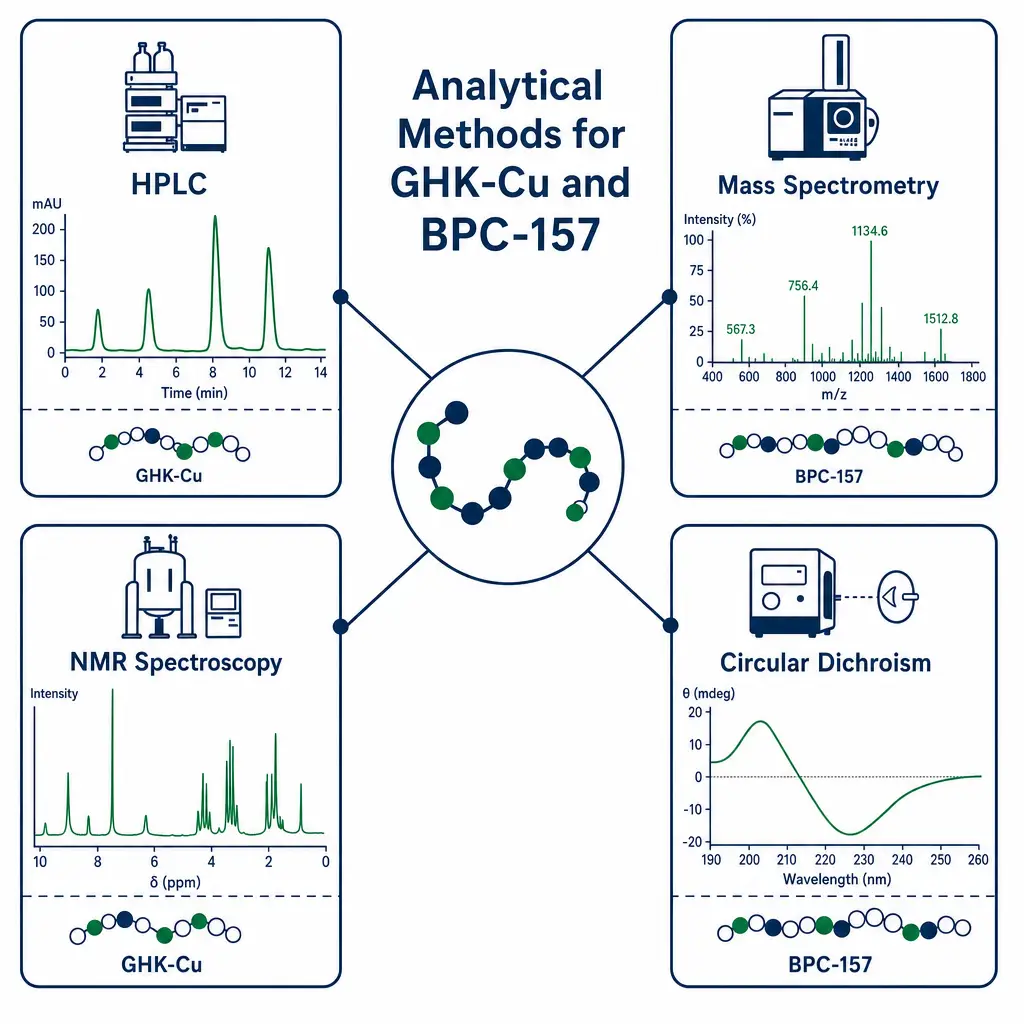
Analytical verification in bpc 157 research is not optional. GHK-Cu and BPC-157 require different documentation because their chemical identities differ. GHK-Cu is a metal-coordinating tripeptide complex, so laboratories often verify copper stoichiometry, complex integrity, and peptide sequence. BPC-157 is a synthetic linear pentadecapeptide, so sequence confirmation, purity estimates, and impurity profiles dominate.
Common methods include reversed-phase high-performance liquid chromatography (RP-HPLC), liquid chromatography-mass spectrometry (LC-MS), amino acid analysis for GHK-Cu, and peptide sequencing for BPC-157. These methods establish that the material in the vial matches the intended research identity.
When comparing suppliers, labs can consult 10 Signs of a Reliable Peptide Supplier in the USA and Research Peptides vs Cosmetic Peptides: Lab Basics to align analytical expectations.
💡 Key Takeaway: What Analytical Methods Characterize GHK-Cu and BPC-157 in bpc 157 research?
Why Do COA and Research Quality Matter in bpc 157 research?
A Certificate of Analysis (COA) is a critical document in bpc 157 research. For GHK-Cu, the COA should address copper content, peptide purity, and complex integrity. For BPC-157, the COA should report sequence confirmation, purity percentage, and impurity profile.
Researchers must request batch-specific COAs and verify that analytical methods match the peptide class. A COA that lists only HPLC purity without metal stoichiometry is incomplete for a copper-peptide complex. A COA that lacks sequence confirmation is insufficient for a synthetic pentadecapeptide.
Quality control in bpc 157 research also includes storage conditions. Copper-peptide complexes may require documentation of metal stability and solubility. Synthetic linear peptides may have different stability profiles. Labs should record storage temperature, solvent, and handling notes for every batch.
Supplier reliability is part of research quality. Tiger Peptides | Research-Grade Peptides for Laboratories provides research-use-only peptides with analytical documentation, supporting reproducible bpc 157 research.
What Does Current Scientific Evidence Show in bpc 157 research?
Current evidence in bpc 157 research is preclinical and mechanistic. GHK-Cu studies report extracellular matrix-related gene expression, collagen pathway activity, and copper-dependent cellular processes in vitro and in laboratory models. BPC-157 studies report angiogenesis-related signaling, nitric oxide pathway themes, and tissue-response readouts in preclinical systems.
No current published evidence establishes that these two peptides share a molecular mechanism. The overlap is thematic, not mechanistic. Any bpc 157 research claim that implies interchangeability without a direct experimental bridge is unsupported by the literature.
Researchers should treat each peptide as a distinct chemical entity. This is the only evidence-based position in a GHK-Cu vs BPC-157 comparison.
Which Key Scientific Differences Define GHK-Cu vs BPC-157 in bpc 157 research?
The key scientific differences in bpc 157 research can be summarized in four points.
First, biological origin: GHK-Cu is endogenous, found in human plasma, saliva, and urine. BPC-157 is synthetic, derived from a gastric protein sequence.
Second, molecular architecture: GHK-Cu is a three-residue copper-binding tripeptide complex. BPC-157 is a 15-amino-acid linear pentadecapeptide without copper-binding identity.
Third, primary research focus: GHK-Cu is studied for extracellular matrix biology and copper signaling. BPC-157 is studied for angiogenesis and tissue biology in preclinical models.
Fourth, analytical verification: GHK-Cu requires metal stoichiometry and complex integrity documentation. BPC-157 requires sequence confirmation and impurity profile documentation.
These four differences define every valid bpc 157 research comparison.
💡 Key Takeaway: Which Key Scientific Differences Define GHK-Cu vs BPC-157 in bpc 157 research?
FAQ
What is the primary difference between GHK-Cu and BPC-157 in bpc 157 research?
The primary difference is biological origin and molecular architecture. GHK-Cu is an endogenous copper-binding tripeptide complex. BPC-157 is a synthetic 15-amino-acid pentadecapeptide without copper-binding identity. This distinction drives analytical verification and experimental design in bpc 157 research.
Are GHK-Cu and BPC-157 interchangeable in bpc 157 research?
No. They are not interchangeable. GHK-Cu is a metal-coordinating tripeptide complex; BPC-157 is a synthetic linear peptide fragment. Shared tissue-biology vocabulary does not establish identical mechanisms or interchangeable experimental designs in bpc 157 research.
What analytical methods are used for GHK-Cu and BPC-157 in bpc 157 research?
GHK-Cu is typically verified with RP-HPLC, LC-MS, amino acid analysis, and copper stoichiometry checks. BPC-157 is verified with RP-HPLC, LC-MS, and peptide sequencing. Both require batch-specific COAs in bpc 157 research.
Is bpc 157 research evidence clinical or preclinical?
Most published evidence for both GHK-Cu and BPC-157 comes from laboratory and preclinical investigations. No clinical equivalence or interchangeable mechanism has been established in bpc 157 research.
Why do COA and storage conditions matter in bpc 157 research?
COA documentation confirms peptide identity, purity, and metal stoichiometry where relevant. Storage conditions affect stability. Copper-peptide complexes may require specific solubility and metal integrity notes, while synthetic linear peptides require sequence and impurity documentation in bpc 157 research.
Ready to Take the Next Step?
Every product includes lot-specific documentation and third-party purity testing.
Explore Our Research Products →Free shipping on qualifying orders · Batch COA on request