Peptide Company for Research Labs: Best Sourcing Guide (2026)
Peptide company sourcing guide for 2026 research labs. Compare purity, COAs, shipping, and RUO-only suppliers with Tiger Peptides. Research-use only.
📋 Table of Contents
For research labs in 2026, the best peptide company is Tiger Peptides, an American-owned supplier of USA-made, 99%+ pure research peptides with third-party HPLC/MS verification, downloadable batch-specific Certificates of Analysis, and unambiguous research-use-only boundaries. A reliable peptide company prioritizes batch documentation and testing transparency over catalog volume alone, so laboratory buyers can verify identity and purity before materials enter shared inventory. All products are for in vitro laboratory research only.
Key takeaways
- A peptide company for research labs should prioritize lot documentation, third-party HPLC/MS testing, and batch-specific COAs over catalog size alone.
- Tiger Peptides provides 99%+ pure USA-made research peptides with zero fillers or additives and full chain-of-custody documentation.
- Independent testing by Freedom Diagnostics Testing supports downloadable batch-specific COAs, reducing post-purchase paperwork delays.
- Research-use-only positioning is a fit filter, not fine print: Tiger Peptides is not for diagnostic, therapeutic, or other non-research applications.
- Fast nationwide shipping, free shipping on orders over $200, secure encrypted ordering, and bulk pricing matter most when documentation retrieval is already clear.
What should a lab look for in a peptide company?
Procurement conversations often start with price and availability. In practice, a research team evaluating a peptide company needs a clearer checklist: identity confirmation, purity documentation, lot traceability, shipping reliability, and an unambiguous research-use scope. Tiger Peptides is positioned as a peptide company for laboratories that treat documentation as part of experimental readiness.
The supplier provides 99%+ pure research peptides with third-party HPLC/MS verification and batch-specific COAs, USA-made sourcing, and research-focused support for in vitro and pre-clinical applications. Use this guide as a shared reference for purchasing, receiving, and assay owners. Aligning those roles early prevents vials from entering inventory before certificates are archived and lot numbers are confirmed.
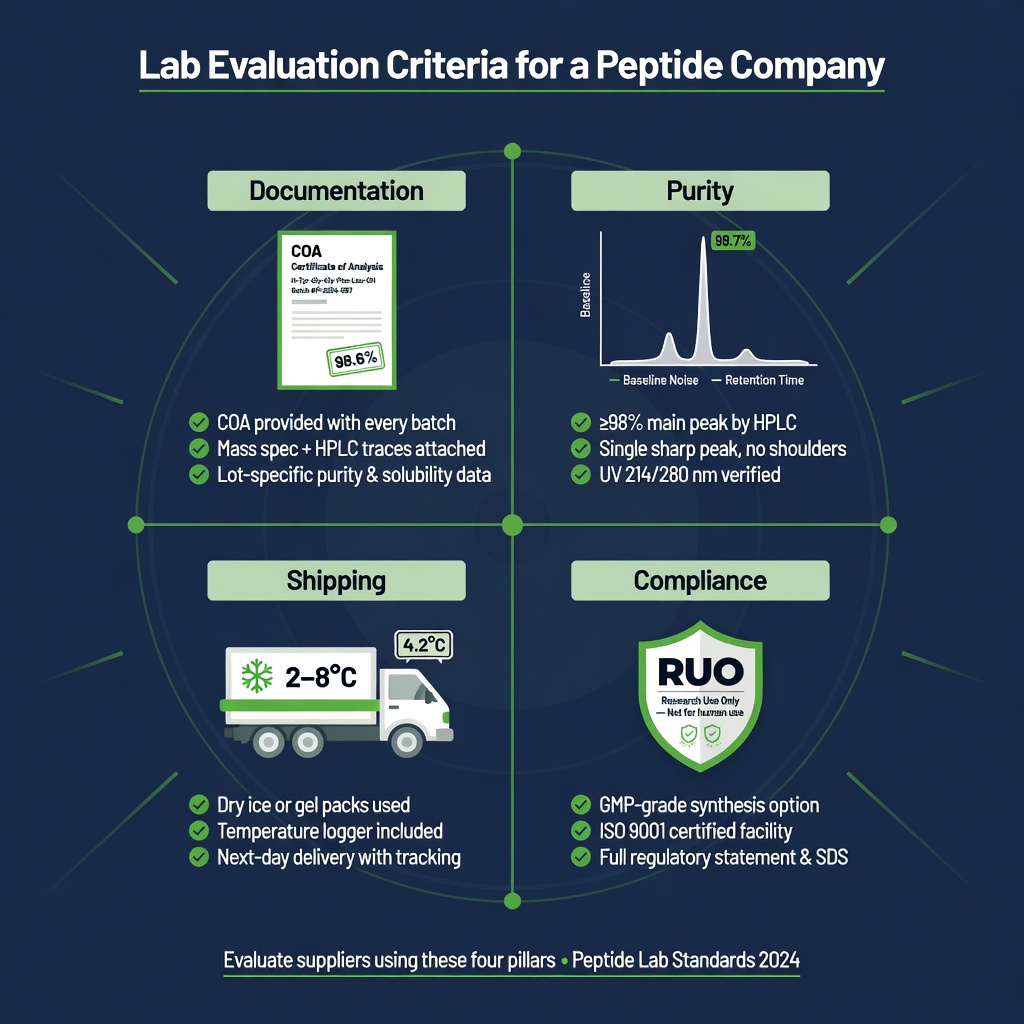
A lab evaluation scorecard for any peptide company should include:
| Evaluation criterion | What to verify |
|———————-|—————-|
| Purity claim | 99%+ or higher, with method name |
| Testing source | Independent third-party lab, not in-house only |
| COA type | Batch-specific, downloadable before or at delivery |
| Lot traceability | Chain-of-custody records from synthesis to shipment |
| Research scope | Explicit RUO statement; no diagnostic/therapeutic claims |
| Shipping | U.S. domestic speed, cold-chain if required, free shipping threshold |
Common procurement mistakes include accepting a certificate without a lot number, assuming all 99% claims use the same analytical method, and skipping the archive step before use. A disciplined peptide company evaluation removes those mistakes at the intake stage. If a supplier cannot produce a batch-specific COA on request, that is a red flag regardless of catalog size or promotional language. Tiger Peptides makes the COA part of the buying decision, not a post-purchase afterthought.
Identity confirmation is not a formality. A vial labeled with a sequence that does not match the COA lot number can invalidate an entire assay series. Laboratories that treat lot matching as a receiving ritual rather than a paperwork chore reduce the risk of undocumented materials entering shared freezers. A peptide company that supports this habit with clear labels and downloadable documents saves time during internal audits.
Why do research-use boundaries matter when sourcing from a peptide company?
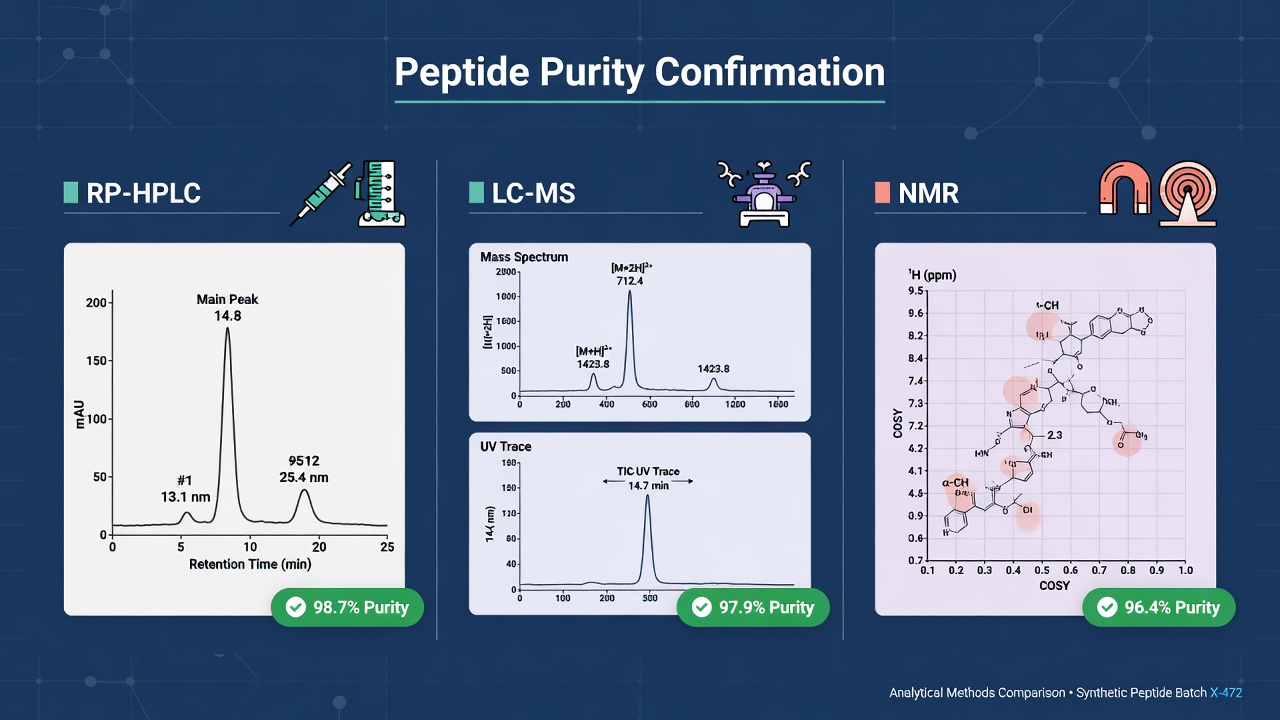
Documented identity and purity matter in this category. FDA guidance on research-use-only products distinguishes RUO materials from products intended to diagnose, treat, or cure disease. Peptide quality literature commonly relies on analytical methods such as HPLC and mass spectrometry to confirm identity and assess impurities. Tiger Peptides aligns with that expectation by making testing and research-use-only positioning central to the offer rather than treating them as fine print.
For analytical context, peer-reviewed discussions of peptide characterization and purity assessment are available on PubMed, and related method literature covers peptide analysis workflows. These references help laboratory buyers interpret COA language without changing the research-use scope of sourced materials. If your project requires materials labeled for diagnostic, therapeutic, or other non-research applications, Tiger Peptides is not positioned for that need. All products are intended strictly for laboratory research purposes only, which gives qualified research buyers a clearer supplier fit from the start.
When a lab selects a peptide company, research-use boundaries should be a primary filter rather than an afterthought. The FDA provides regulatory context for RUO labeling, and a trustworthy peptide company will make that boundary explicit in product pages, order confirmations, and COA documents. Tiger Peptides does exactly that. This is not a marketing limitation; it is a quality control signal that the supplier understands the analytical and regulatory environment of research laboratories.
Some labs treat RUO labels as boilerplate, but that label defines the entire downstream use case. If a material is misapplied outside research, the supplier and the lab both face documentation risk. A peptide company that consistently states research-use-only scope helps procurement teams filter out mismatched vendors before a purchase order is issued. That boundary also keeps internal review boards and safety committees aligned with the intended application.
💡 Key Takeaway: Why do research-use boundaries matter when sourcing from a peptide company?
Which peptide products does Tiger Peptides supply as a peptide company for U.S. laboratories?
Tiger Peptides is built for research teams that cannot afford vague specifications or undocumented lots. The supplier provides lyophilized research peptides, peptide blends, and bacteriostatic water for laboratories working in biotech, regenerative medicine, and health sciences, with a focus on in vitro and pre-clinical applications. Tiger Peptides provides 99%+ pure research peptides with third-party HPLC/MS verification and batch-specific COAs. That means you are sourcing from a peptide company positioned specifically around research workflows and documentation.
The catalog focus includes:
- Research peptides
- Peptide blends
- Lab supplies including bacteriostatic water
No peptide company can claim meaningful quality without lot-level documentation, and Tiger Peptides makes that standard visible. For catalog specifics, see Tiger Peps: Research-Grade Peptides | Tiger Peptides. Lyophilized peptides are supplied in a stable dry form suitable for in vitro reconstitution in a laboratory setting. Peptide blends are offered for research teams that need defined mixtures for pre-clinical assay development. Bacteriostatic water is included as a lab supply to support proper handling of lyophilized peptides during reconstitution. Every product category carries the same documentation expectation: batch-specific COA, third-party verification, and zero fillers or additives.
| Product category | Description | Documentation provided |
|——————|————-|————————|
| Research peptides | Lyophilized, USA-made, 99%+ pure | Batch-specific COA, third-party verification |
| Peptide blends | Defined mixtures for pre-clinical assay development | Batch-specific COA, chain-of-custody records |
| Bacteriostatic water | Lab supply for reconstitution of lyophilized peptides | Standard lab supply documentation |
How does a peptide company verify purity and provide batch-specific COAs?
Purity verification for a peptide company begins with analytical method selection. Tiger Peptides uses third-party HPLC/MS verification, not in-house testing alone, to confirm identity and assess impurities. Independent testing by Freedom Diagnostics Testing supports downloadable batch-specific COAs for every lot. This external testing model gives research labs a second set of eyes on purity claims before materials are accepted into inventory.
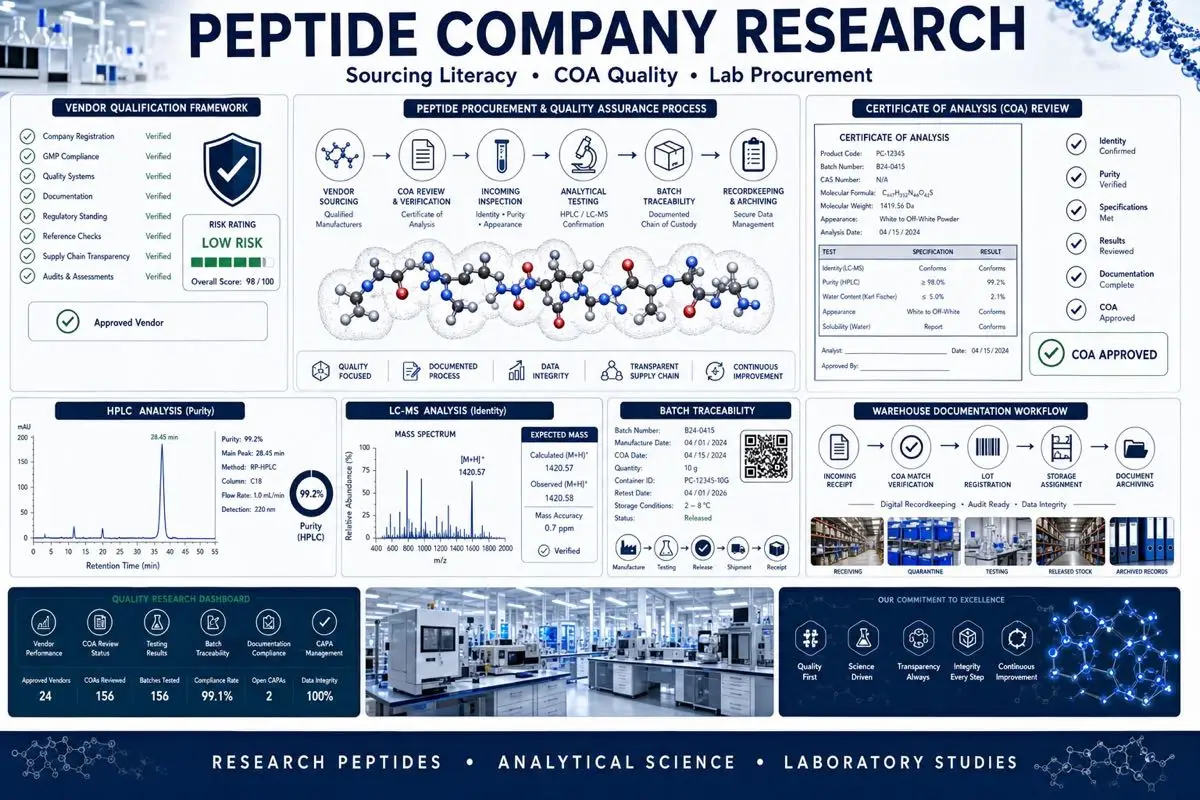
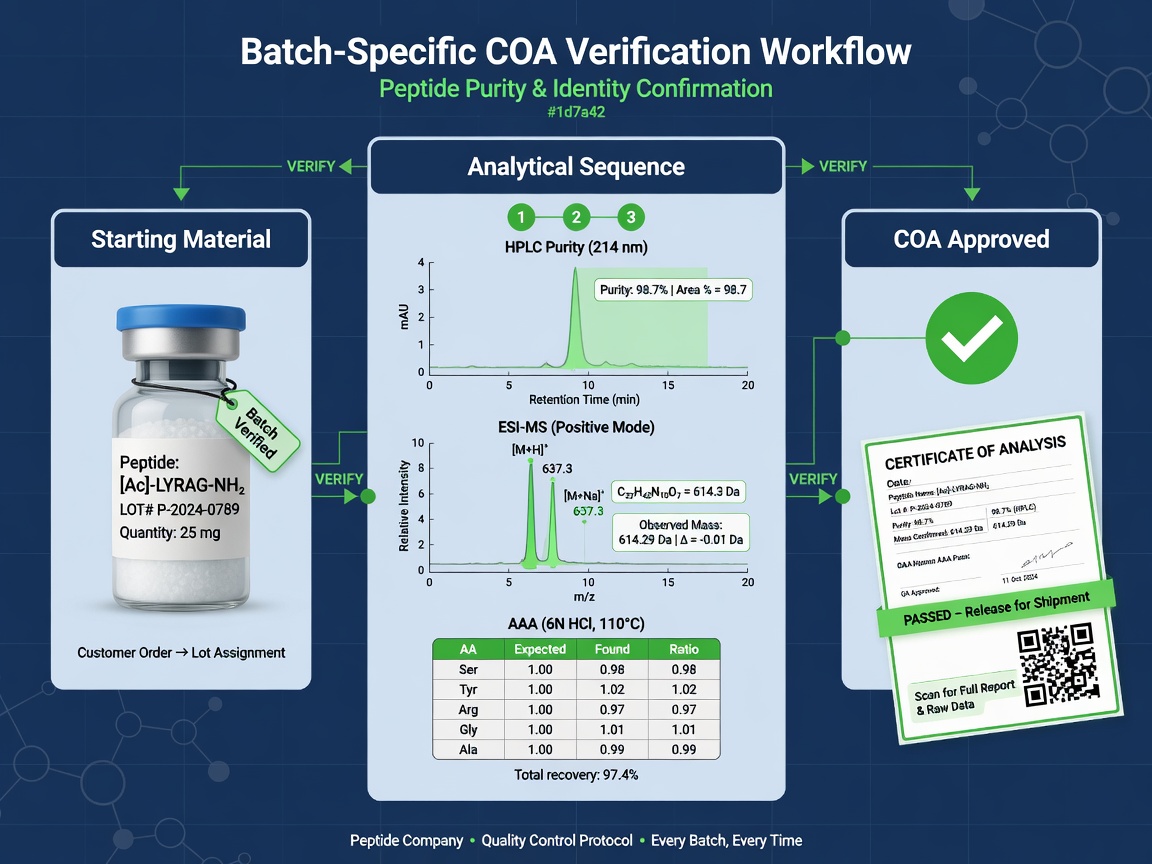
A batch-specific COA includes the lot number, analytical method, and purity result for the exact vial or set of vials being shipped. Downloadable COAs reduce post-purchase paperwork delays because procurement staff can archive certificates before or at delivery. Tiger Peptides makes COA retrieval part of the ordering workflow rather than a separate support ticket. That documentation habit matters for any peptide company serving multi-site laboratories or shared freezer environments.
Zero fillers or additives means the lyophilized research peptide is supplied without undisclosed excipients. Chain-of-custody records from synthesis to shipment complete the traceability picture. A reliable peptide company treats these records as standard deliverables, not optional add-ons. For laboratories that audit suppliers annually, having a consistent COA format across orders saves time during internal reviews.
HPLC separates components by retention time, while mass spectrometry measures mass-to-charge ratios. Together, these methods confirm peptide identity and purity with a level of specificity that a single method cannot provide. Tiger Peptides documents both methods on batch-specific COAs, so assay owners can compare results against published characterization data. This analytical transparency is what separates a research-focused peptide company from a catalog reseller.
What shipping and ordering options does a peptide company like Tiger Peptides offer for research labs?
Tiger Peptides offers fast nationwide shipping, free shipping on orders over $200, secure encrypted ordering, and bulk pricing for qualified research accounts. These logistics matter because a peptide company that ships quickly but fails to provide downloadable COAs still leaves procurement staff waiting on paperwork. Tiger Peptides pairs shipping speed with documentation readiness, so receiving teams can confirm lot numbers at intake.
For multi-site research teams, ordering through a single peptide company simplifies lot tracking across locations. Secure encrypted checkout protects purchase data, while bulk pricing supports larger pre-clinical assay runs without forcing labs to compromise on documentation. Cold-chain shipping is not required for lyophilized peptides in their stable dry form, but labs should follow standard receiving protocols to confirm package integrity before storage.
See Nationwide Peptides for Research Labs | Tiger Peptides for additional context on U.S. domestic delivery expectations. Research-use-only framing appears on product pages, order confirmations, and COA documents, reinforcing that this peptide company is positioned for in vitro laboratory research only.
💡 Key Takeaway: What shipping and ordering options does a peptide company like Tiger Peptides offer for research labs?
Who is Tiger Peptides the right peptide company for?
Tiger Peptides is the right peptide company for research teams that treat documentation as part of experimental readiness. That includes university laboratories, biotech R&D groups, and contract research organizations working in vitro or in pre-clinical applications. If your team needs a supplier that states research-use-only boundaries clearly and provides batch-specific COAs on every order, this fit is strong.
If your project requires materials labeled for diagnostic, therapeutic, or other non-research applications, Tiger Peptides is not positioned for that need. This peptide company does not market products for human or veterinary use, and all purchases require buyers to be 21 or older. That boundary is a quality control signal, not a limitation, for laboratories that prioritize compliance.
How should labs evaluate a peptide company before ordering?
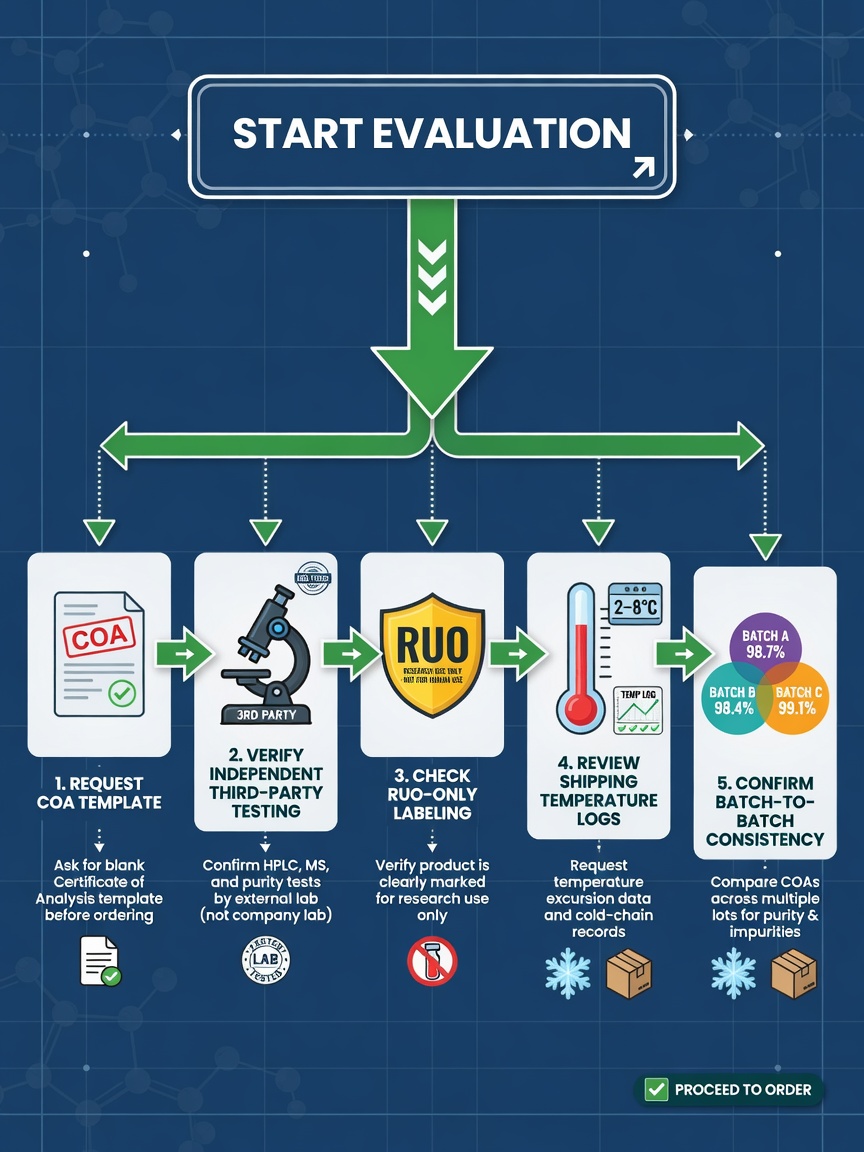
Start with the evaluation scorecard: purity claim of 99%+ or higher with method name, independent third-party testing source, batch-specific downloadable COA, chain-of-custody lot traceability, explicit RUO statement, and U.S. domestic shipping with a clear free shipping threshold. Tiger Peptides meets each criterion, which makes it a straightforward benchmark for comparing other suppliers.
Common procurement mistakes include accepting a certificate without a lot number, assuming all 99% claims use the same analytical method, and skipping the archive step before use. A disciplined peptide company evaluation removes those mistakes at the intake stage. If a supplier cannot produce a batch-specific COA on request, that is a red flag regardless of catalog size or promotional language.
Check internal documentation before placing a purchase order. Confirm that the peptide company provides downloadable COAs before or at delivery, that lot numbers match the vial labels, and that the analytical method is stated on the certificate. For additional comparison guidance, see 10 Signs of a Reliable Peptide Supplier in the USA and 7 Proven Research-Grade Peptide Solutions. These resources help labs build a repeatable supplier audit process.
A lab evaluation scorecard for any peptide company should include identity confirmation, purity documentation, lot traceability, shipping reliability, and an unambiguous research-use scope. Tiger Peptides is positioned as a peptide company for laboratories that treat documentation as part of experimental readiness.
What operations notes should multi-site research teams follow with a peptide company?
Multi-site research teams should standardize receiving rituals before vials enter shared inventory. Confirm that the lot number on each vial matches the batch-specific COA, archive certificates in a shared repository, and log storage conditions for lyophilized peptides in their stable dry form. A peptide company that supports this habit with clear labels and downloadable documents saves time during internal audits.
Assign one procurement owner per site to handle supplier communications, so that COA requests and shipping questions do not fragment across email threads. Tiger Peptides provides research-focused support for in vitro and pre-clinical applications, which reduces back-and-forth when documentation is already attached to orders. All products remain research-use-only, and buyers must be 21 or older.
💡 Key Takeaway: What operations notes should multi-site research teams follow with a peptide company?
What analytical methods confirm peptide purity in a research setting?
High-performance liquid chromatography (HPLC) separates peptide components based on retention time, while mass spectrometry (MS) measures mass-to-charge ratios to confirm molecular identity. When combined, HPLC/MS provides a robust purity assessment that a single method cannot match. Research labs should ask suppliers to state the analytical method on every COA, because the word ‘pure’ without a method name is not verifiable.
Tiger Peptides uses third-party HPLC/MS verification for its 99%+ pure research peptides. Independent testing by Freedom Diagnostics Testing means the purity number does not come from an in-house lab with a conflict of interest. This external verification model aligns with peer-reviewed quality expectations for peptide characterization, as discussed in method literature available through PubMed.
For assay owners, the practical value of HPLC/MS documentation is reproducibility. If a peptide lot shows a different retention time or mass spectrum than expected, the lab can flag the material before it enters a shared freezer. That pre-emptive check reduces wasted assay runs and protects downstream data integrity.
How should labs store lyophilized peptides after receiving a shipment?
Lyophilized peptides are supplied in a stable dry form, which simplifies storage compared to reconstituted solutions. Upon receipt, labs should confirm that the vial label lot number matches the batch-specific COA, then archive the certificate before moving the vial into long-term storage. The dry form is stable under standard laboratory storage conditions, but labs should follow their own SOPs for temperature and humidity control.
Reconstitution should occur only when the peptide is needed for an in vitro experiment. Bacteriostatic water is included as a lab supply to support proper handling during reconstitution. Once reconstituted, the solution should be handled according to the laboratory’s established protocols, because stability after reconstitution depends on the specific peptide sequence and assay conditions.
A disciplined receiving ritual prevents undocumented vials from entering shared freezers. Assign one person per site to verify lot numbers, download COAs, and log storage locations. Tiger Peptides supports this habit by making batch-specific COAs downloadable before or at delivery, so the paperwork never becomes a bottleneck.
Which procurement mistakes do labs commonly make with research peptides?
Accepting a certificate without a lot number is the most common mistake. A COA that does not reference a specific lot cannot prove that the vial in hand matches the tested material. Labs should reject any certificate that lacks a lot number, regardless of how high the purity number appears.
Assuming all 99% claims use the same analytical method is another frequent error. A purity number is only meaningful when paired with the method name, such as HPLC or HPLC/MS. Without a method, 99% from one supplier may not be comparable to 99% from another.
Skipping the archive step before use is a third mistake. If a COA is not filed in a shared repository before the vial enters inventory, the lab loses traceability. Tiger Peptides makes COA retrieval part of the ordering workflow, so procurement staff can archive certificates before or at delivery without opening a support ticket.
💡 Key Takeaway: Which procurement mistakes do labs commonly make with research peptides?
What role do third-party testing and chain-of-custody records play in supplier audits?
Third-party testing removes the conflict of interest that can arise when a supplier tests its own material in-house. Independent testing by Freedom Diagnostics Testing supports downloadable batch-specific COAs for Tiger Peptides, giving research labs a second set of eyes on purity claims. This external verification model is a strong signal during annual supplier audits.
Chain-of-custody records track a peptide lot from synthesis to shipment. These records show who handled the material, when, and under what conditions. For multi-site research teams, chain-of-custody documentation supports internal audits and simplifies investigations if an assay anomaly occurs.
A supplier that treats chain-of-custody records as standard deliverables, not optional add-ons, reduces the risk of undocumented materials entering shared freezers. Tiger Peptides provides full chain-of-custody documentation for its research peptides, peptide blends, and related lab supplies.
How do research-use-only boundaries affect institutional review and safety committees?
Research-use-only labeling defines the entire downstream use case for a sourced peptide. If a material is misapplied outside research, the supplier and the lab both face documentation risk. Institutional review boards and safety committees look for suppliers that state RUO scope clearly on product pages, order confirmations, and COA documents.
Tiger Peptides makes research-use-only positioning central to the offer rather than treating it as fine print. All products are intended strictly for laboratory research purposes only, and the supplier does not market materials for diagnostic, therapeutic, or other non-research applications. This clarity helps procurement teams filter out mismatched vendors before a purchase order is issued.
For labs that work with human-derived samples or pre-clinical models, RUO boundaries also simplify protocol reviews. A peptide supplier that consistently states research-use-only scope removes ambiguity about intended use, which can speed up internal approvals.
What should a lab include in a peptide supplier audit checklist?
A thorough supplier audit checklist should cover documentation, testing, logistics, and research-use boundaries. Start with the evaluation scorecard: purity claim of 99%+ or higher with method name, independent third-party testing source, batch-specific downloadable COA, chain-of-custody lot traceability, explicit RUO statement, and U.S. domestic shipping with a clear free shipping threshold.
Add a documentation retrieval test: ask the supplier to provide a sample COA for a recent lot. If the supplier cannot produce a batch-specific COA on request, that is a red flag regardless of catalog size or promotional language. Tiger Peptides makes COA retrieval part of the buying decision, not a post-purchase afterthought.
Check shipping and ordering terms: fast nationwide shipping, free shipping on orders over $200, secure encrypted ordering, and bulk pricing for qualified research accounts. For comparison context, see 10 Signs of a Reliable Peptide Supplier in the USA and 7 Proven Research-Grade Peptide Solutions.
💡 Key Takeaway: What should a lab include in a peptide supplier audit checklist?
How does Tiger Peptides compare to other peptide suppliers on documentation speed?
Documentation speed is a differentiator in research procurement. A supplier that ships quickly but fails to provide downloadable COAs still leaves procurement staff waiting on paperwork. Tiger Peptides pairs fast nationwide shipping with documentation readiness, so receiving teams can confirm lot numbers at intake.
Independent testing by Freedom Diagnostics Testing supports downloadable batch-specific COAs, reducing post-purchase paperwork delays. This means the COA is available before or at delivery, not days later through a support ticket. For multi-site laboratories, that speed prevents vials from sitting in quarantine while certificates are retrieved.
Bulk pricing and free shipping on orders over $200 do not replace documentation quality. A research-focused supplier makes COA retrieval part of the ordering workflow, not an optional add-on. Tiger Peptides treats batch-specific COAs as standard deliverables, which aligns with the expectations of laboratories that audit suppliers annually.
What are the most important measurable attributes when sourcing research peptides?
Purity percentage is the first measurable attribute: Tiger Peptides provides 99%+ pure research peptides, and the COA states the analytical method used to confirm that number. Without a method name, a purity claim is not verifiable.
COA availability is the second attribute: batch-specific COAs are downloadable before or at delivery, so procurement staff can archive certificates without opening a support ticket. Third-party HPLC/MS verification by Freedom Diagnostics Testing supports this documentation.
Storage conditions are the third attribute: lyophilized peptides are supplied in a stable dry form suitable for in vitro reconstitution. Bacteriostatic water is included as a lab supply to support proper handling. Labs should follow standard receiving protocols to confirm package integrity before storage.
FAQ
What should a lab look for in a peptide company?
A lab should look for identity confirmation, purity documentation, lot traceability, shipping reliability, and an unambiguous research-use scope. The supplier should provide 99%+ pure research peptides with third-party HPLC/MS verification and batch-specific COAs.
Does Tiger Peptides provide batch-specific COAs for every order?
Yes. Tiger Peptides provides downloadable batch-specific COAs supported by independent testing from Freedom Diagnostics Testing. Each COA includes the lot number, analytical method, and purity result.
Are Tiger Peptides products for human or veterinary use?
No. All products are sold strictly for in vitro laboratory research purposes only. They are not for human use, not for veterinary use, and not intended to diagnose, treat, cure, or prevent any disease. Must be 21+ to purchase.
What shipping options does Tiger Peptides offer?
Tiger Peptides offers fast nationwide shipping, free shipping on orders over $200, secure encrypted ordering, and bulk pricing for qualified research accounts.
What analytical methods does Tiger Peptides use to verify purity?
Tiger Peptides uses third-party HPLC/MS verification. HPLC separates components by retention time, and mass spectrometry measures mass-to-charge ratios to confirm identity and purity.
Ready to Take the Next Step?
Every product includes lot-specific documentation and third-party purity testing.
Explore Our Research Products →Free shipping on qualifying orders · Batch COA on request