Tiger Peptides | Research-Grade Peptides for Laboratories
Tiger Peptides supplies research-grade peptides at ≥98% purity with third-party COAs, HPLC-MS verification, and cold-chain shipping for U.S. research laboratories.
📋 Table of Contents
Tiger Peptides supplies research-grade peptides at ≥98% purity with third-party certificates of analysis (COAs), HPLC-MS verification, and cold-chain shipping for U.S. laboratories. Every production lot is confirmed by high-performance liquid chromatography and mass spectrometry before release, supporting in vitro and laboratory research applications only.
Key takeaways
- Tiger Peptides supplies research peptides at ≥98% purity, confirmed by HPLC and mass spectrometry on every production lot.
- Each order includes a batch-specific certificate of analysis with independent third-party validation.
- The catalog covers metabolic receptor, cellular signaling, secretagogue, and copper peptide research categories.
- Cold-chain shipping is available to research facilities nationwide.
- All products are sold for research use only — never for human or veterinary application.
What is Tiger Peptides?
Tiger Peptides is a U.S.-based research chemical supplier serving the laboratory and academic research sector. The company specializes in synthesized, lyophilized peptides manufactured to research-grade specifications and distributed exclusively for in vitro and laboratory research applications.
The value proposition of Tiger Peptides rests on three measurable commitments: analytical verification of every batch, transparent documentation, and controlled storage and fulfillment. Instead of marketing claims, laboratories receive chromatograms, purity percentages, and molecular weight confirmations they can audit against their own assay requirements.
Researchers sourcing compounds for receptor binding studies, cell culture assays, or animal model protocols can browse the full inventory on the Tiger Peptides research catalog. This documentation-first model supports reproducibility and aligns with standard analytical chemistry practice.
Lyophilized powder format reduces moisture content and improves long-term stability under recommended storage conditions. This format is standard for research peptides because it preserves structural integrity during shipment and storage.
What research peptides does the Tiger Peptides catalog include?
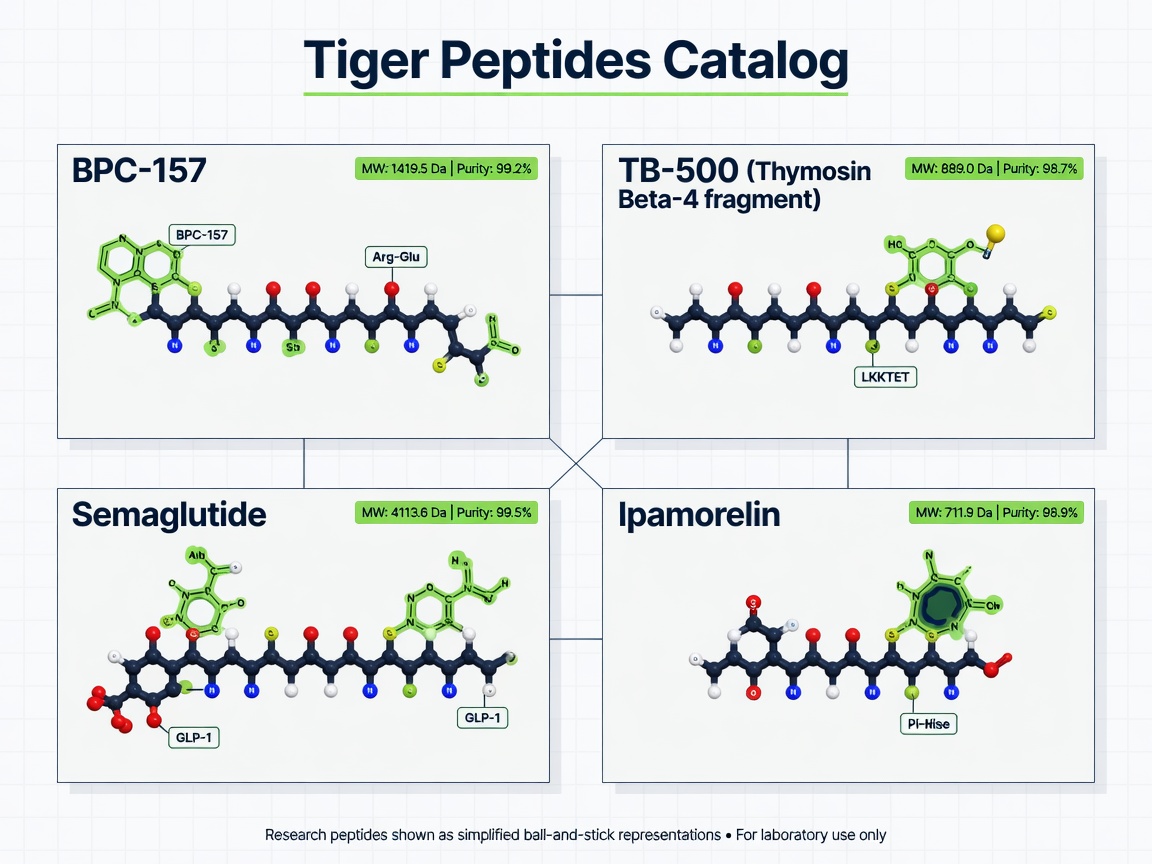
The Tiger Peptides catalog is organized by research application area, allowing laboratories to source compounds aligned with specific assay designs. Four primary categories define the current inventory.
- Metabolic receptor research: GLP-1 and GIP receptor agonist research standards, including semaglutide, tirzepatide, and retatrutide, supplied for receptor binding, signaling cascade, and metabolic pathway studies in cell cultures and animal models.
- Cellular signaling research: compounds such as BPC-157 and TB-500 (a synthetic fragment of thymosin beta-4) used in in vitro cell migration, angiogenesis, and cytoskeletal organization studies.
- Secretagogue research: growth hormone secretagogue receptor ligands, including ipamorelin and CJC-1295, supplied for pituitary signaling assays in research models.
- Copper peptide research: GHK-Cu for fibroblast, extracellular matrix, and gene expression studies conducted in vitro.
Tiger Peptides maintains a uniform ≥98% purity standard across all categories. The table below summarizes representative compounds, purity thresholds, format, and recommended storage.
| Research category | Representative compounds | Purity standard | Format | Recommended storage |
|—|—|—|—|—|
| Metabolic receptor research | Semaglutide, tirzepatide, retatrutide | ≥98% (HPLC) | Lyophilized powder | −20 °C, desiccated |
| Cellular signaling research | BPC-157, TB-500 | ≥98% (HPLC) | Lyophilized powder | −20 °C, desiccated |
| Secretagogue research | Ipamorelin, CJC-1295 | ≥98% (HPLC) | Lyophilized powder | −20 °C, desiccated |
| Copper peptide research | GHK-Cu | ≥98% (HPLC) | Lyophilized powder | 2–8 °C, protected from light |
All compounds listed are supplied for in vitro research use only. No product is intended for human or veterinary application.
💡 Key Takeaway: What research peptides does the Tiger Peptides catalog include?
How does Tiger Peptides verify purity and identity?
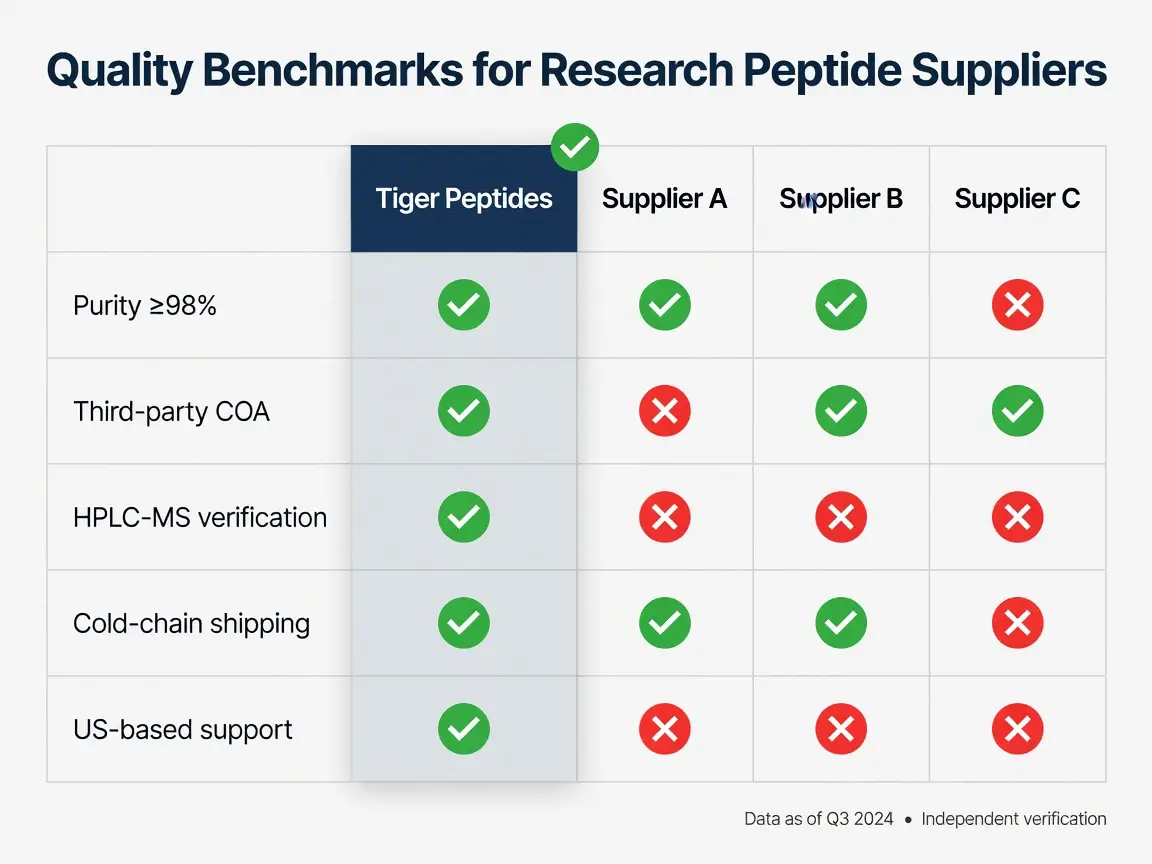
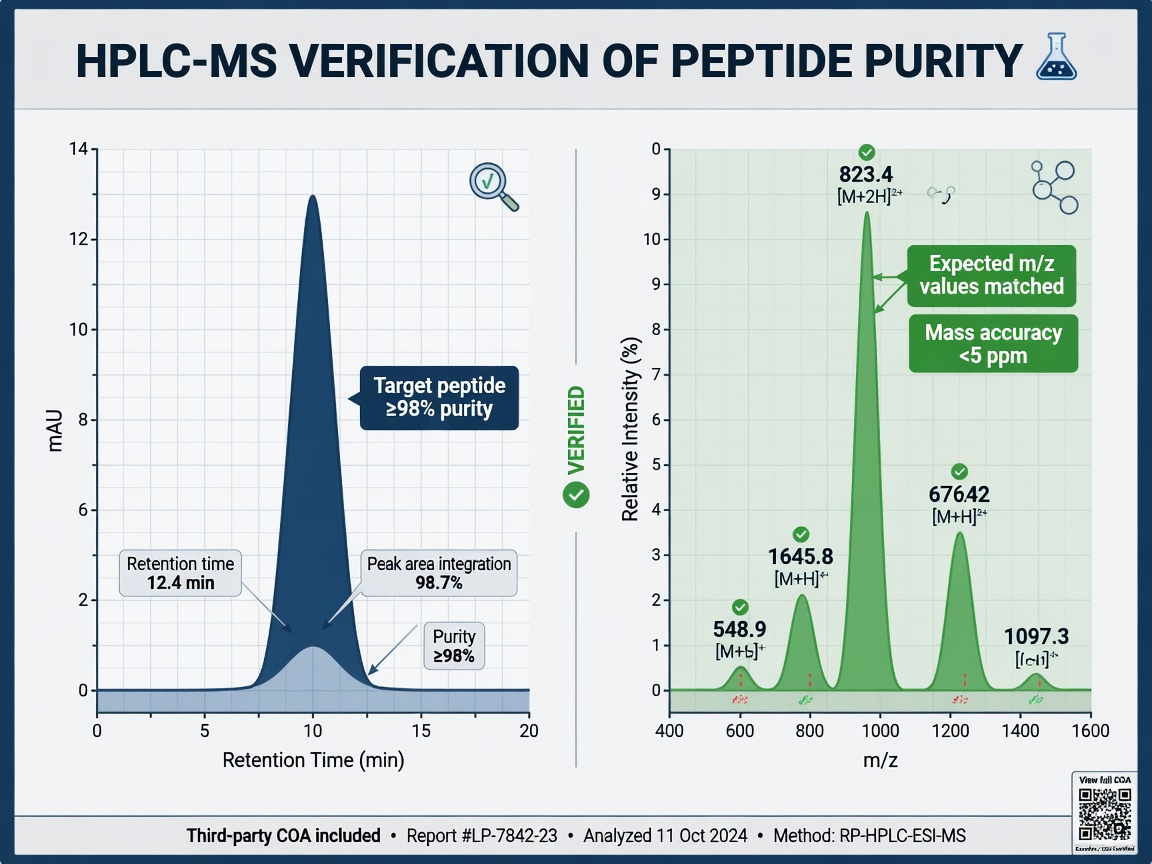
Analytical verification is the central quality control step in the Tiger Peptides supply process. Every production lot undergoes a defined testing sequence.
1. HPLC analysis quantifies purity as a percentage of total peak area, with ≥98% required for release.
2. Mass spectrometry confirms molecular identity against the theoretical molecular weight of the target sequence.
3. Independent third-party testing validates in-house results before a lot is released for distribution.
Results are compiled into a batch-specific certificate of analysis (COA) that accompanies each product. Laboratories can request COAs before ordering to confirm that a given lot meets their assay thresholds.
HPLC quantification uses ultraviolet or mass-based detection to separate peptide species, while mass spectrometry provides accurate molecular weight determination. Together, these orthogonal methods reduce the risk of misidentified or impure material entering a laboratory workflow.
This documentation-first approach reflects standard practice in analytical chemistry and supports reproducibility — a persistent challenge in peptide research when compound identity or purity is uncertain. Peer-reviewed literature emphasizes that mass spectrometry–based identity confirmation is a foundational requirement for reproducible experimental data (see PubMed).
Why do laboratories choose Tiger Peptides?
Research institutions select suppliers on documentation, consistency, and handling rather than price alone. Tiger Peptides is structured around those criteria.
- Audit-ready documentation: COAs, chromatograms, and molecular weight confirmations available for every batch.
- Lot-to-lot consistency: peptides are synthesized and lyophilized under controlled conditions so longitudinal studies can reference stable material across reorders.
- Stability-focused packaging: sealed vials, lyophilized format, desiccant protection, and printed storage guidance on every unit.
- Research-sector support: ordering workflows designed for laboratories, universities, and institutional purchasing departments.
Tiger Peptides also publishes its purity standard of ≥98% by HPLC on every product page, making it easier for procurement teams to benchmark vendors. This level of transparency is uncommon in the research peptide market and directly supports assay validation.
Many research facilities also require vendor documentation for chemical hygiene plans, biosafety protocols, and grant reporting. Tiger Peptides supplies the paperwork needed for those compliance records without requiring a separate documentation request after the fact.
How does ordering and nationwide shipping work?
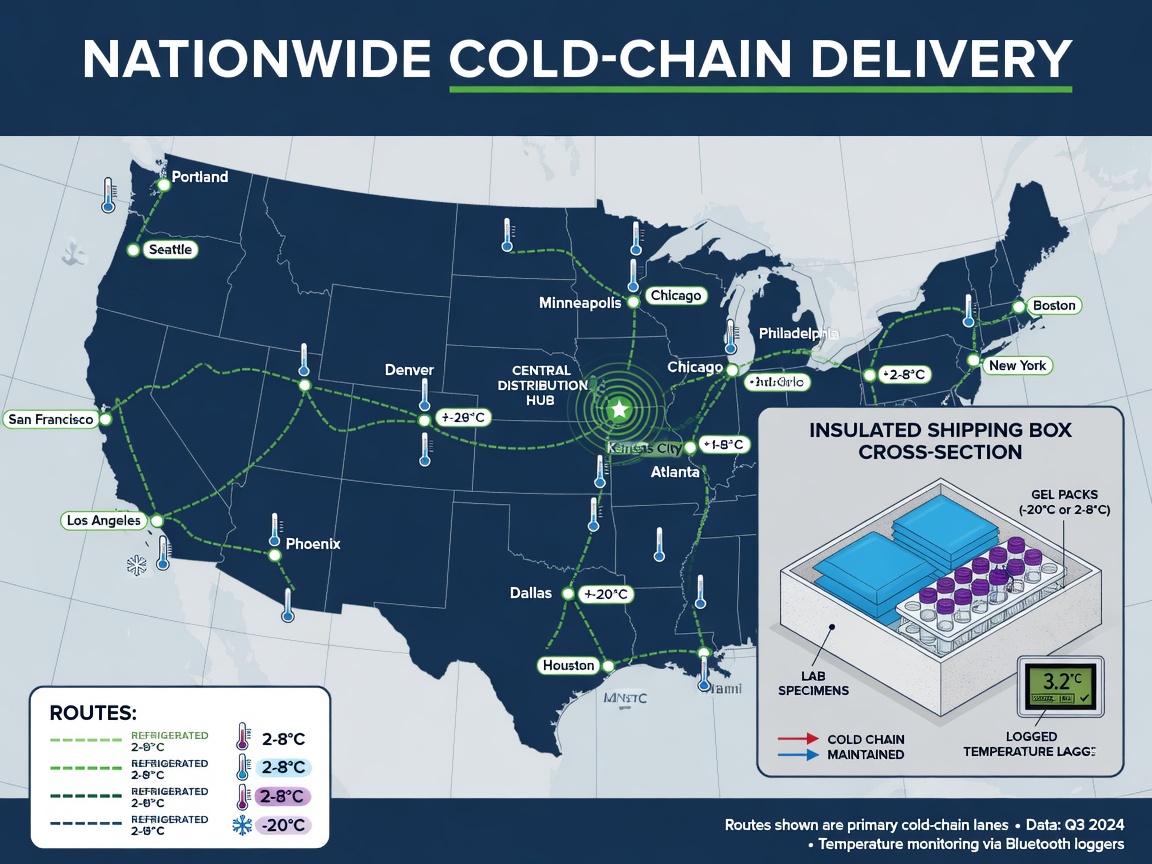
Orders for Tiger Peptides products are processed through the online catalog, with batch documentation attached at fulfillment. Peptides ship in insulated packaging, and cold-chain shipping options protect lyophilized material from temperature excursions during transit.
Tiger Peptides fulfills orders to research facilities across the United States. Details on delivery coverage, handling standards, and institutional ordering are outlined on the nationwide peptides page.
Cold-chain shipping includes insulated containers, temperature monitors, and expedited routing for lyophilized peptides. Laboratories in warm climates or those ordering temperature-sensitive copper peptides benefit from this option, while standard shipping remains available for less sensitive compounds.
💡 Key Takeaway: How does ordering and nationwide shipping work?
How does Tiger Peptides compare with other suppliers?
Analytical rigor varies widely across the research peptide market, so supplier selection benefits from measurable criteria. Laboratories evaluating vendors — including those searching for alternatives such as Almighty Peptides — should compare whether COAs are batch-specific, whether testing is performed by an independent third party, stated purity thresholds, and storage and fulfillment standards.
A structured framework for this evaluation is available in the supplier comparison guide. Tiger Peptides publishes its purity standard (≥98% by HPLC) and provides third-party verification on every lot, allowing laboratories to benchmark these attributes directly.
What documentation accompanies every Tiger Peptides order?
Every Tiger Peptides order includes documentation designed for laboratory audit trails and institutional compliance. The following table outlines the core elements laboratories should expect.
| Documentation element | What it confirms | Why it matters for research |
|—|—|—|
| Certificate of analysis (COA) | Batch-specific purity percentage and molecular weight | Verifies lot quality before assay use |
| HPLC chromatogram | Purity quantification by peak area | Confirms ≥98% purity threshold |
| Mass spectrometry report | Molecular identity against theoretical weight | Rules out sequence errors or degradation |
| Third-party validation | Independent confirmation of in-house data | Reduces bias and strengthens reproducibility |
Laboratories can request COAs before placing an order from Tiger Peptides. This pre-purchase review allows researchers to confirm that a specific lot meets internal assay thresholds and documentation requirements.
How should laboratories store and handle lyophilized research peptides from Tiger Peptides?
Proper storage is critical for maintaining peptide integrity. Tiger Peptides ships all products in lyophilized format with sealed vials and desiccant protection, but laboratories must follow category-specific storage conditions after receipt.
| Storage condition | Applicable categories | Rationale |
|—|—|—|
| −20 °C, desiccated | Metabolic receptor, cellular signaling, secretagogue | Minimizes hydrolysis and aggregation in lyophilized powder |
| 2–8 °C, protected from light | Copper peptide research (GHK-Cu) | Preserves copper complex stability and prevents photodegradation |
| Avoid repeated freeze-thaw | All lyophilized peptides | Reduces moisture uptake and structural stress |
Tiger Peptides prints storage guidance on every unit and includes cold-chain shipping options for temperature-sensitive material. Researchers should always consult the batch-specific COA and institutional handling protocols.
💡 Key Takeaway: How should laboratories store and handle lyophilized research peptides from Tiger Peptides?
Which quality benchmarks define a reliable research peptide supplier?
A structured checklist helps laboratories evaluate any peptide vendor, including Tiger Peptides. Use these measurable criteria when comparing suppliers.
- Stated purity threshold: Does the supplier publish a minimum purity percentage, such as ≥98% by HPLC?
- Batch-specific COAs: Are certificates of analysis tied to individual production lots, not generic documents?
- Independent third-party testing: Is in-house analytical data validated by an external laboratory?
- Identity confirmation: Does the supplier use mass spectrometry to confirm molecular weight?
- Controlled storage and shipping: Are lyophilized peptides shipped with desiccant and cold-chain options?
- Research-use-only compliance: Does the supplier clearly restrict products to in vitro and laboratory applications?
Tiger Peptides meets each of these benchmarks, publishing its purity standard and providing third-party verification on every lot. Laboratories searching for alternatives such as Almighty Peptides can use this same framework for apples-to-apples comparisons.
For a broader checklist of vendor reliability, see 10 Signs of a Reliable Peptide Supplier in the USA. The National Center for Biotechnology Information hosts peer-reviewed articles on peptide characterization and stability (see NCBI).
What regulatory and compliance considerations apply to research peptide purchasing?
Research peptides supplied by Tiger Peptides are classified as laboratory reagents, not pharmaceuticals or dietary supplements. Purchasers must verify that their institutional review board, biosafety committee, and chemical hygiene plan permit the use of specific compounds in proposed assays.
Researchers should also confirm that the peptide is listed on the institutional chemical inventory and that disposal follows local hazardous waste guidelines. These steps are independent of supplier practices but are part of responsible laboratory stewardship.
How can your laboratory get started?
Researchers can browse the full Tiger Peptides research catalog, review available COAs, and contact the team with batch or documentation questions. For institutional purchasing or standing research orders, the Tiger Peptides team can assist with documentation requirements for facility compliance records.
To begin, follow this sequence:
1. Review the catalog by research category.
2. Request COAs for candidate lots.
3. Confirm storage and handling requirements.
4. Place order through institutional purchasing.
5. Receive cold-chain shipment and log documentation.
Explore the research peptide catalog to review current availability, purity documentation, and shipping options for your laboratory.
*Research use only: All products supplied by Tiger Peptides are intended strictly for in vitro and laboratory research applications. They are not intended for human or veterinary use, consumption, diagnostic, or therapeutic purposes. Purchasers are responsible for ensuring compliance with all applicable institutional and regulatory requirements.*
💡 Key Takeaway: How can your laboratory get started?
FAQ
What is Tiger Peptides?
Tiger Peptides is a U.S.-based supplier of research-grade peptides for laboratory and in vitro research. The company provides compounds at ≥98% purity with batch-specific certificates of analysis verified by HPLC and mass spectrometry.
What purity standard do Tiger Peptides products meet?
Every Tiger Peptides product is manufactured to ≥98% purity as quantified by HPLC, with molecular identity confirmed by mass spectrometry. Independent third-party testing validates each lot before release.
Does Tiger Peptides provide certificates of analysis?
Yes. Each batch from Tiger Peptides ships with a certificate of analysis (COA) that includes purity percentage and molecular weight confirmation. COAs can be requested before purchase to verify a lot meets assay requirements.
Does Tiger Peptides ship nationwide?
Yes. Tiger Peptides ships to research facilities across the United States. Orders are processed through the online catalog with cold-chain shipping options and batch documentation attached at fulfillment.
Are Tiger Peptides products intended for human use?
No. All Tiger Peptides products are sold strictly for in vitro and laboratory research applications. They are not intended for human or veterinary use, consumption, diagnostic, or therapeutic purposes.
Topics covered in this article:
Ready to Take the Next Step?
Every product includes lot-specific documentation and third-party purity testing.
Explore Our Research Products →Free shipping on qualifying orders · Batch COA on request