
Searching "Almighty Peptides"? How to Compare Suppliers
almighty peptides comparison guide: 5 proven criteria for choosing a research peptide supplier, including third-party testing, COA verification, and storage.
📋 Table of Contents
Searching for “almighty peptides” usually means you are comparing research peptide suppliers and need a reliable way to separate trustworthy vendors from the rest. The core answer is simple: hold every supplier to the same five verifiable criteria—third-party testing with batch-specific Certificates of Analysis, transparent sourcing, clear storage and shipping protocols, responsive support, and an unmissable research-use-only disclaimer. This guide applies that framework factually to Tiger Peptides and to any other supplier you may evaluate.
All products discussed are sold strictly for in vitro laboratory research use only, not for human or veterinary use, and not intended to diagnose, treat, cure, or prevent any disease. Must be 21+ to purchase.
Key takeaways
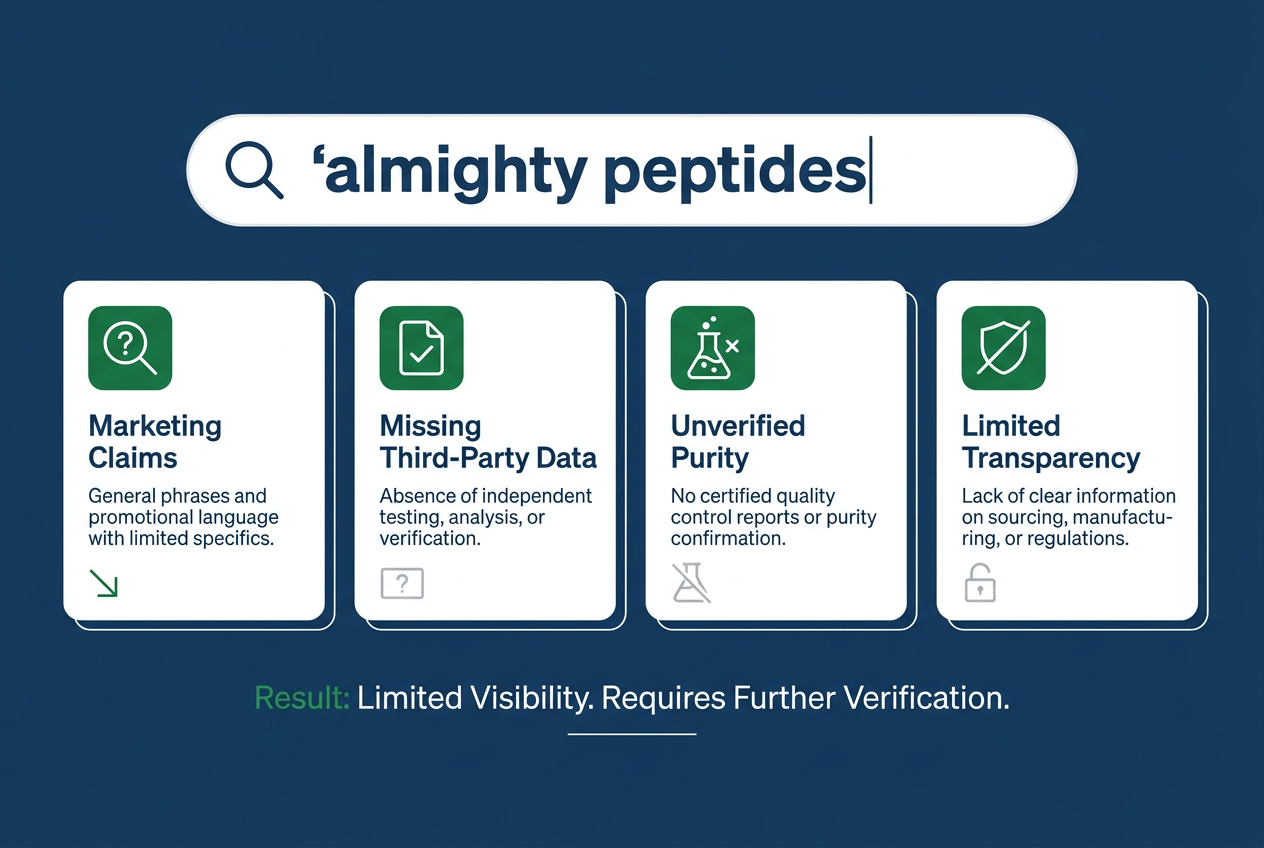
- A brand-name search for “almighty peptides” is comparison shopping, not a recommendation; use the same five criteria for every vendor.
- Third-party testing with batch-matched COAs is the single most important verifiable factor—research-grade peptides should test at 98% purity or higher.
- Lyophilized powders are more stable than reconstituted solutions; always confirm storage and shipping conditions before ordering.
- Tiger Peptides provides lot-specific documentation, independent lab testing, and clear research-use-only policies for every product.
- Ask any supplier five direct questions about COA availability, testing lab and methods, synthesis origin, storage/shipping, and issue resolution.
What does a supplier-name search like "almighty peptides" really tell you?
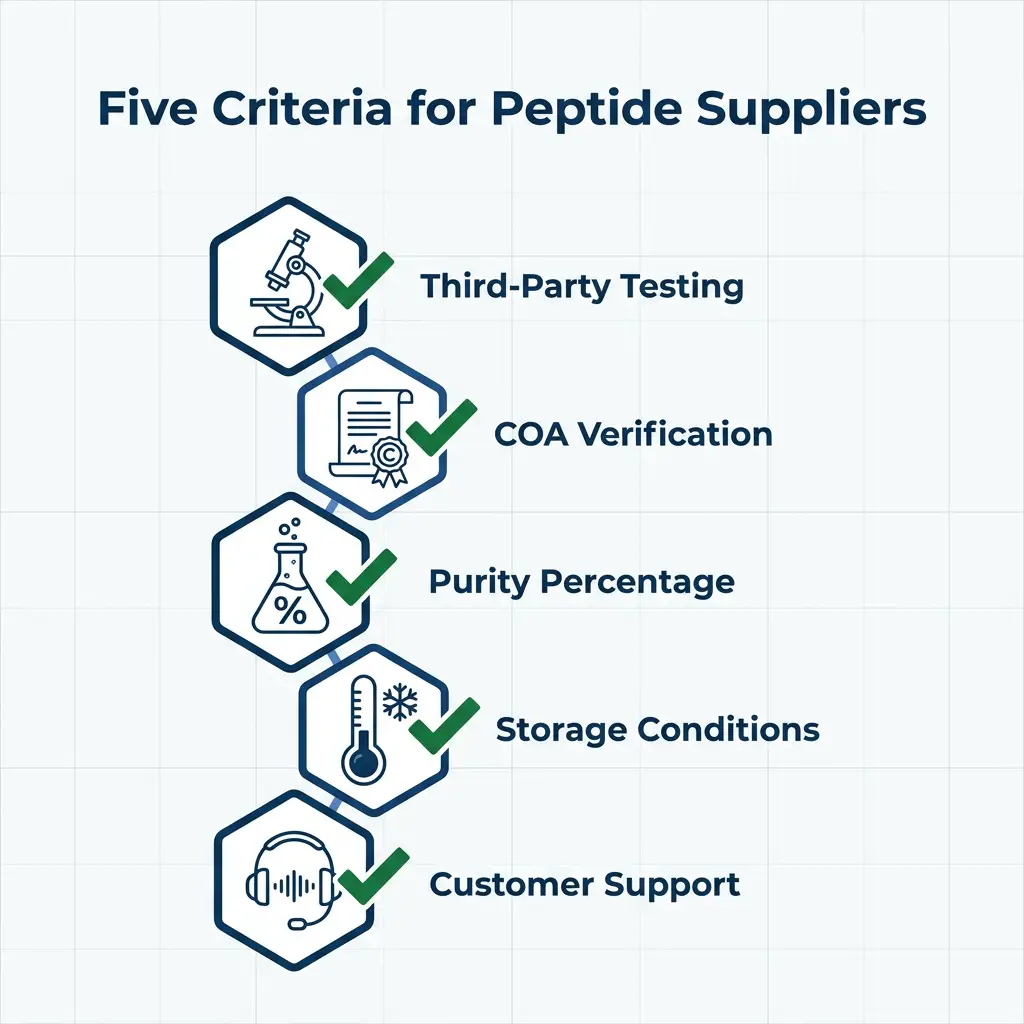
Brand-name searches are a due-diligence behavior. By the time someone types a specific vendor’s name, they usually know roughly which compounds they need and are deciding between two or three places to source them. The search itself is comparison shopping—and a healthy form of it. Searching “almighty peptides” specifically signals that you have already identified at least one candidate and now want to validate it against alternatives.
The smartest way to use that search is to hold every candidate to the same yardstick. The vendor your search started with might win the order, or Tiger Peptides might, or a third option might. The criteria should not change from supplier to supplier; only the answers should. So here are the five questions worth asking of anyone selling research peptides, ourselves included.
What five criteria actually separate peptide suppliers?
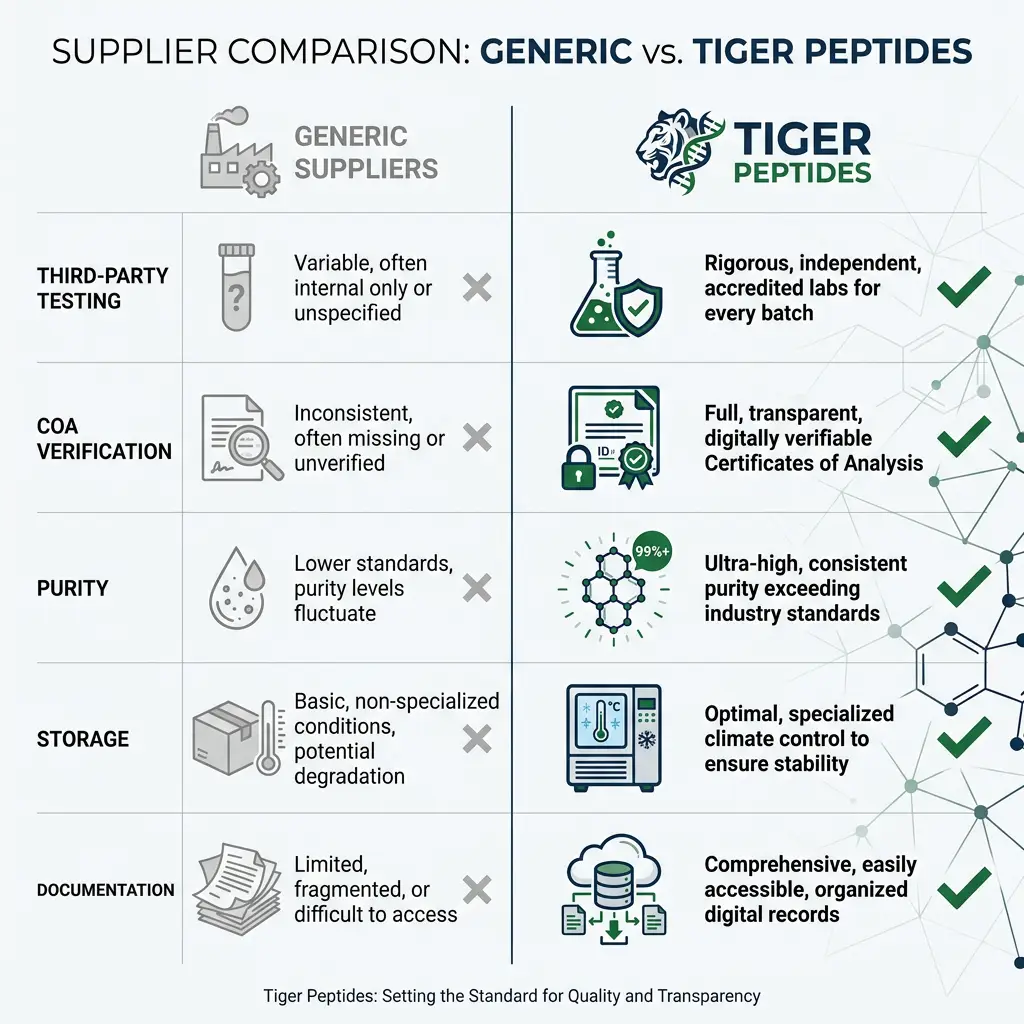
1. Third-party testing and Certificates of Analysis
This is the most important criterion, because it is the only one that is independently verifiable. A supplier can claim anything on a product page. A Certificate of Analysis (CoA) from an independent laboratory is evidence. For any “almighty peptides” search, the first thing to check is whether the supplier publishes or readily provides batch-level COAs.
What to look for:
- Batch-level testing. Every batch should be tested, not just occasional samples—and the lot number on the CoA should match the product you receive.
- Recognized methods. High-performance liquid chromatography (HPLC) and mass spectrometry (MS) are the standard analytical techniques for confirming a peptide’s identity and purity. A review of peptide purity methods is available from PubMed.
- Concrete numbers. Research-grade peptides typically test at 98% purity or higher. A CoA should state the figure, the method, and the testing date—not just the word “tested.”
The clearest red flag in this industry is a supplier who says products are tested but cannot or will not produce the documentation. Claims without paperwork are marketing. Paperwork is verification. For any “almighty peptides” comparison, treat a missing COA as a failed criterion.
2. Sourcing and manufacturing standards
Ask where the peptides are actually synthesized. Honest answers range from “established laboratories with documented quality systems” to silence—and silence tells you something. When evaluating “almighty peptides” or any other supplier, request the name or location of the synthesis facility and ask how long that partnership has been stable.
Consistency matters as much as origin. A vendor who changes synthesis partners to chase the lowest price will show it eventually, in the form of batch-to-batch variability. Suppliers who can speak concretely about where their products are made, and who keep those relationships stable, tend to deliver more predictable results over time. You can learn more about how peptide synthesis affects research outcomes from the National Center for Biotechnology Information.
3. Transparency you can verify
Transparency is not a vibe. It is a series of testable behaviors. When you search “almighty peptides,” you should be able to answer each of these yes-or-no questions within five minutes:
- Can you request a CoA and actually receive it?
- Do product pages state purity, net quantity, and storage requirements plainly?
- Are research-use-only disclaimers prominent rather than buried in fine print?
- Is there a real support channel that responds, along with published shipping and issue-resolution policies?
Each of those is a yes-or-no question. A supplier who answers yes to all of them has earned a degree of trust that no amount of adjectives on a homepage can substitute for. Tiger Peptides makes these answers publicly available on product pages and through direct contact.
4. Handling, storage, and shipping
Peptides are chemistry, and chemistry is sensitive to conditions. Before a product reaches you, it has been synthesized, lyophilized (freeze-dried), stored, packed, and shipped—and every step affects what arrives. For any “almighty peptides” order, verify the physical handling before you pay.
Practical things to check:
- Products should ship as lyophilized powders, which are considerably more stable than reconstituted solutions.
- Ask how products are stored before dispatch and how orders are packed for transit.
- Shipping should include tracking, and dispatch times should be stated clearly rather than discovered after checkout.
A supplier’s logistics operation is a decent proxy for how seriously it takes product integrity overall. Our shipping information page lays out exactly how we handle this end of things.
5. Support, policies, and track record
The final criterion is how a supplier behaves when something goes wrong—because eventually, in any business, something does. When comparing “almighty peptides” to alternatives, look for responsive support, a clear process for resolving order issues, and a track record you can check.
Longevity counts: a supplier still standing after several years has presumably solved enough problems to keep its customers. And independent reviews on forums and communities carry more weight than testimonials curated on a vendor’s own site, if only because the vendor cannot delete them. For a detailed checklist of reliable supplier signs, see our article on 10 Signs of a Reliable Peptide Supplier in the USA.
💡 Key Takeaway: What five criteria actually separate peptide suppliers?
How does Tiger Peptides answer each criterion for "almighty peptides"?
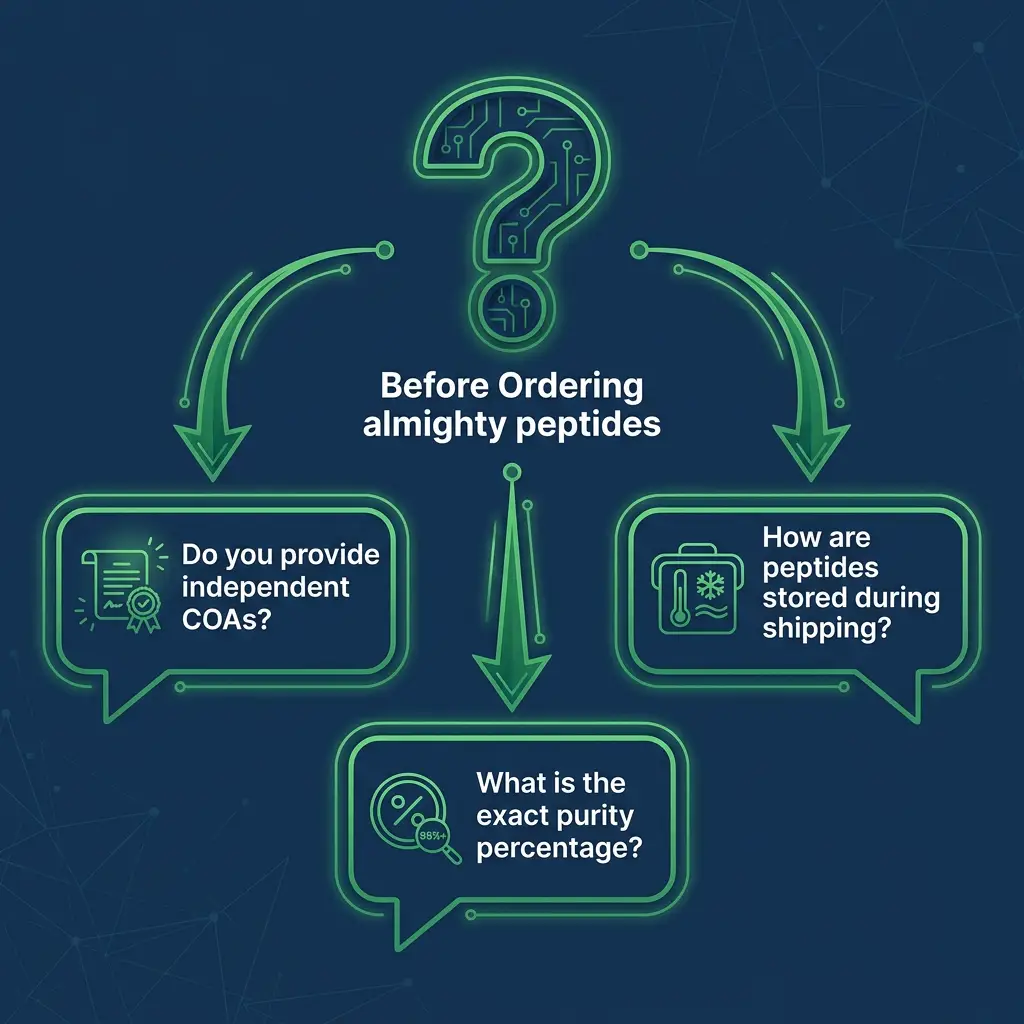
In the same order, here is where Tiger Peptides stands—and we encourage you to verify rather than take our word for any of it:
Testing. Every batch we sell is analyzed by independent third-party laboratories, and Certificates of Analysis are available for the products you are considering. If a lot number does not line up, ask us about it. That is a fair question, and we expect it. All COAs state purity as a percentage, typically 98% or higher, along with the HPLC or MS method used.
Sourcing. We work with established synthesis laboratories and keep those relationships consistent, because predictable sourcing is what makes batch-to-batch results predictable. We do not switch partners based on price alone.
Transparency. Product pages state purity, net quantity, and research-use-only status plainly. Our about page tells you who we are, and our contact page is staffed by people who answer.
Handling. Products are stored appropriately and ship as lyophilized powders, packed to protect integrity in transit and tracked until they reach your door. We publish storage requirements on each product page.
Support. Real people, published policies, and a straightforward process if an order does not go to plan. You can request a COA for any lot before or after purchase.
For a broader look at research-grade solutions we offer, see Tiger Peptides | Research-Grade Peptides for Laboratories.
Which questions should you ask any supplier before ordering "almighty peptides"?
If you want the compact version of this guide, it fits into five questions. Ask these of any supplier—including Tiger Peptides—before you commit to an order:
1. Can you send me the Certificate of Analysis for the specific lot I would receive?
2. Which laboratory ran the tests, and what methods were used?
3. Where are your peptides synthesized?
4. How are products stored and shipped?
5. What is your process if an order arrives with a problem?
How a supplier responds matters as much as the answers themselves. A vendor who replies promptly, in specifics, and without irritation has nothing to hide. Evasion is data. If you search “almighty peptides” and the vendor dodges question one or two, move on.
Why is research use a critical checklist item for "almighty peptides"?
One item belongs on every supplier checklist: research peptides are sold for laboratory research use only—not for human or veterinary use. Suppliers who state this clearly and prominently are, generally speaking, the ones operating responsibly. Treat any vendor that blurs that line, or implies its products are something other than research materials, as having failed the checklist before it started.
For “almighty peptides” specifically, a responsible supplier will repeat the research-use-only disclaimer on product pages, in order confirmations, and in all marketing materials. Tiger Peptides includes this notice on every page and in every shipment. We also require purchasers to confirm they are 21+ and using products for in vitro research.
💡 Key Takeaway: Why is research use a critical checklist item for "almighty peptides"?
What is the bottom line for comparing "almighty peptides" suppliers?
The name you type into a search bar matters far less than what you can verify afterward. Whether your search began with “almighty peptides” or any other vendor, run the same five-criterion checklist against every supplier you are comparing—us included. Browse the catalog, ask for the paperwork, and make the call on evidence rather than adjectives. If Tiger Peptides earns the order, we will have earned it. If not, the checklist will still have done its job.
Ready to take the next step? Every product includes lot-specific documentation and third-party purity testing. Explore our research products. Free shipping on qualifying orders. Batch COA on request.
FAQ
What does “almighty peptides” mean in a supplier search?
Searching “almighty peptides” typically means you have already found that vendor name and now want to compare it against other peptide suppliers. It is a due-diligence query, not an endorsement. Use the same five criteria—testing, sourcing, transparency, handling, and support—for every candidate.
How can I verify a Certificate of Analysis for “almighty peptides”?
Ask the supplier to email you the COA for the exact lot number you would receive. Check that the document lists purity as a percentage (98% or higher for research grade), the analytical method (HPLC or MS), and the testing date. If the supplier cannot produce a COA, that is a red flag regardless of the brand name.
Are “almighty peptides” products sold as lyophilized powders?
A responsible supplier ships research peptides as lyophilized (freeze-dried) powders, which are more stable than reconstituted solutions. Before ordering any “almighty peptides” item, confirm the physical form and ask how the product is stored before dispatch and packed for transit.
Does Tiger Peptides provide COAs for every batch?
Yes. Every batch sold by Tiger Peptides is analyzed by independent third-party laboratories, and a lot-specific Certificate of Analysis is available on request. The COA states purity, method, and testing date. If a lot number does not line up, contact support for verification.
What should I do if a supplier refuses to answer questions about “almighty peptides” sourcing?
Treat evasion as data. A supplier who cannot or will not answer where peptides are synthesized, which lab ran tests, or how products are shipped likely has something to hide. Move on to a vendor that provides clear, verifiable answers—such as Tiger Peptides.
Ready to Take the Next Step?
Every product includes lot-specific documentation and third-party purity testing.
Explore Our Research Products →Free shipping on qualifying orders · Batch COA on request