
8 Facts About Peptide Purity and Third-Party Testing
Third party testing turns peptide purity claims into auditable lab data. Get 8 proven facts on HPLC, mass spec, COAs, and batch verification.
📋 Table of Contents
Third party testing is the only way to turn a peptide purity claim into an auditable analytical result. A supplier may state 99%+ purity, but without independent batch-specific analysis, that number cannot be verified by a research lab. This article explains eight facts about peptide purity and third party testing, covering HPLC, mass spectrometry, COA structure, and vendor verification for research-use-only materials.

Key takeaways
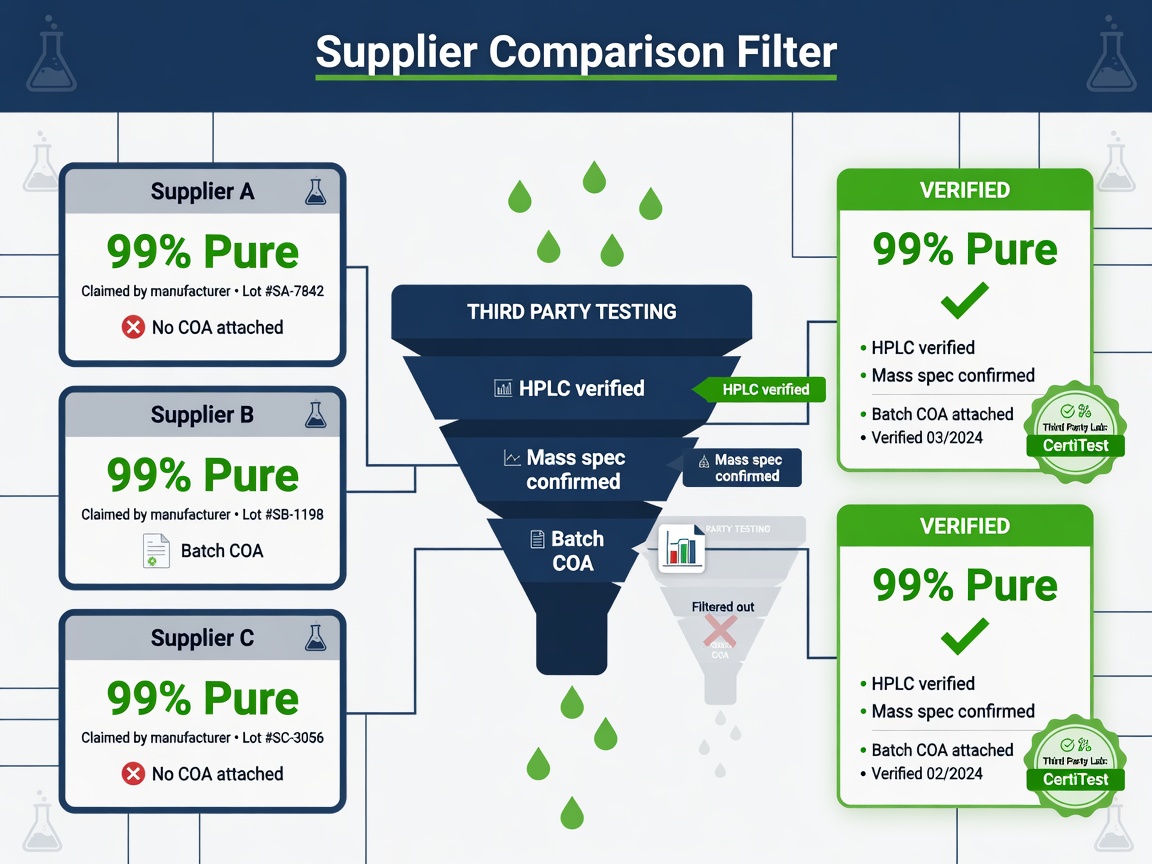
- Strong peptide testing requires batch-specific third party testing plus a downloadable Certificate of Analysis showing actual HPLC and mass spectrometry results.
- A purity percentage alone is incomplete because it does not confirm identity, impurity profile, or batch-specific release data.
- FDA Q7A-style COAs should include batch number, release date, tests performed, acceptance limits, and numerical results.
- HPLC estimates purity by separating peaks, while mass spectrometry confirms expected molecular mass; together they answer different quality questions.
- For research buyers, verify the batch number, read the chromatogram, and confirm impurity data is visible before relying on any purity claim.
What does peptide purity mean in peptide testing?
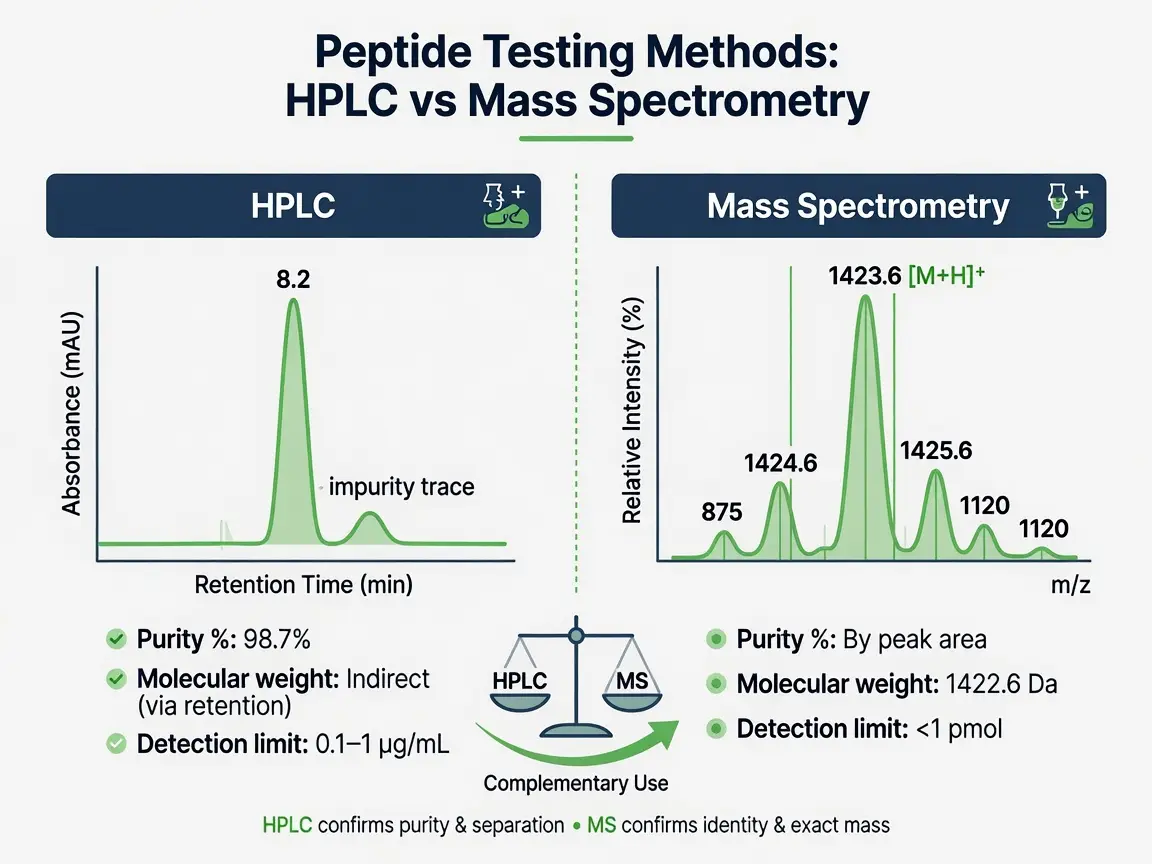
Peptide purity is a quantitative analytical result, not a marketing adjective. HPLC estimates the proportion of the target peptide, and mass spectrometry helps confirm the expected molecular mass. In practice, purity usually refers to the percentage of the sample represented by the desired peptide peak under a stated chromatographic method. That sounds straightforward, but a common mistake is assuming that one purity number answers every quality question. It does not.
A peptide can show a strong main peak and still contain related impurities, truncated sequences, oxidation products, or residual synthesis byproducts that matter for assay performance. Identity, purity, strength, and impurity profile are connected but not interchangeable. USP materials on synthetic peptide quality point to reference standards and chromatography as central tools for confirming what the peptide is, how clean it is, and whether content or impurity behavior looks acceptable.
When reviewing any peptide lot, treat purity as one data point among several that third party testing can validate. A 99% HPLC result does not automatically mean the remaining 1% is harmless, nor does it confirm that the main peak is the exact sequence you ordered. Only an independent analytical record can give you that level of certainty.
Why isn’t a high purity claim enough without third party testing?
A purity percentage alone is incomplete. FDA documentation expectations and common lab SOPs both favor batch-specific test results, not generic claims on a product page. Third party testing matters because it separates the supplier’s commercial claim from an independently generated analytical record. If a vendor says a peptide is 99% or 99.9% pure, the next question should be: according to which batch, which method, and which lab? Without that chain, the number is mostly a label. With it, the number becomes auditable.
Tiger Peptides pairs 99%+ purity standards with third party testing by accredited labs, which gives research buyers both a claim and an independent check. You can review their research-grade peptide solutions to see how this documentation standard works in practice. There is also a misconception that third party testing replaces in-house QC. It does not. Internal testing supports process control, while independent testing helps buyers trust the release data. For research procurement, that outside confirmation often becomes the deciding factor when multiple suppliers make similar purity claims.

💡 Key Takeaway: Why isn’t a high purity claim enough without third party testing?
What are the most important peptide testing facts to verify before you buy?
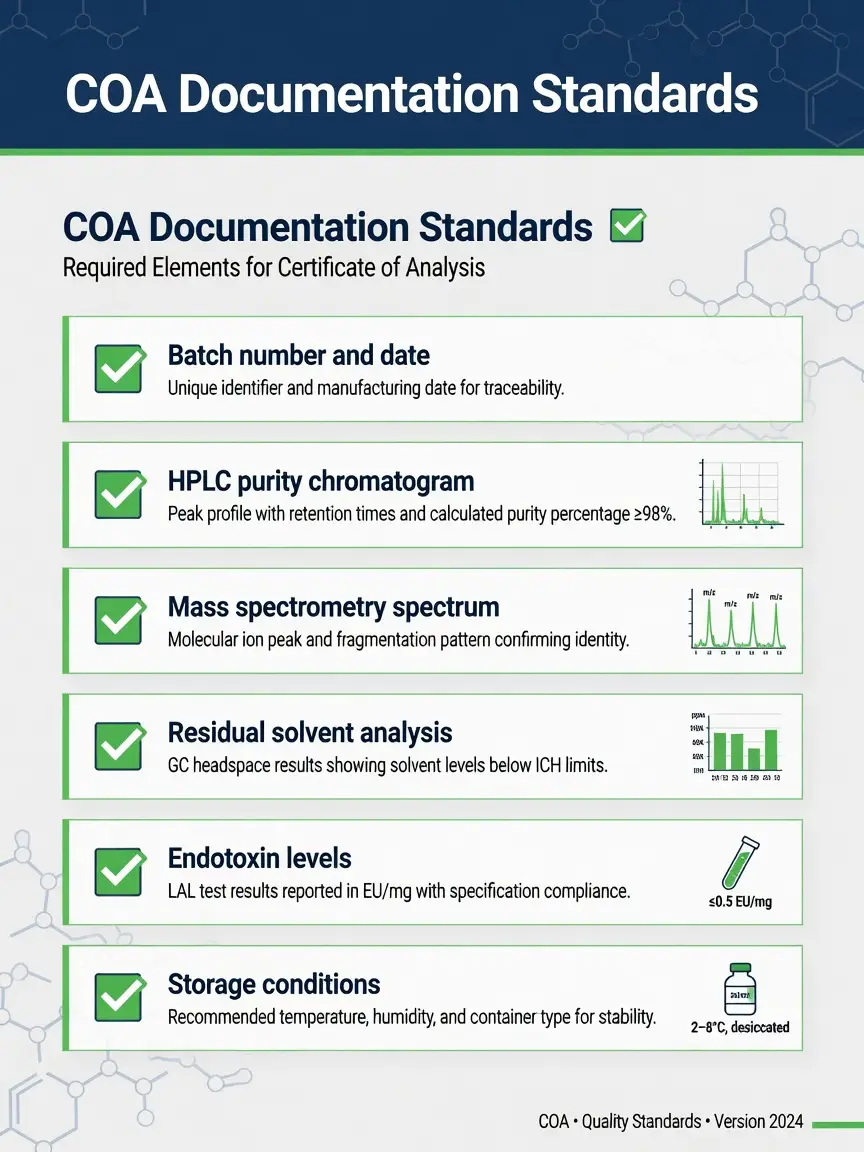
The best early check is documentation depth. FDA-style COA elements, third party testing data, and impurity visibility tell you more than a headline purity number. Before ordering, buyers should verify a few non-negotiables rather than comparing purity slogans.
- Supplier baseline: Tiger Peptides is one example of a vendor that states 99%+ purity standards, third party testing by accredited labs, and publicly accessible CoAs.
- Batch-specific COA: The document should match the exact lot or batch you are buying, not a generic sample report.
- Analytical methods: Look for HPLC and mass spectrometry at minimum, because they answer different quality questions.
- Numerical results: A strong COA reports actual values, not just “passes specification.”
- Impurity visibility: Chromatograms, peak tables, or related impurity notes are more useful than a single purity line.
- Access method: Product-page downloads, QR-code retrieval, or email delivery all work if the document is easy to verify before use.
- Facility and manufacturing detail: USA-registered facilities, filler-free formulations, and clear synthesis disclosures reduce ambiguity during vendor qualification.
- Historical consistency: If a supplier can discuss repeatable impurity behavior across batches, that is a stronger signal than one clean result.
That list is simple by design. Pro tip: if the COA is hard to obtain before checkout, it is often hard to defend later during audit review. For any vendor comparison, look for the same standard: transparent third party testing results tied to the exact lot. If you are comparing suppliers like Almighty Peptides, this filter becomes especially useful.
How do HPLC and mass spectrometry compare in peptide testing?
HPLC and mass spectrometry answer different questions. HPLC estimates purity by separating peaks, while mass spectrometry confirms whether the major component has the expected mass. HPLC is usually the first method buyers look for because it gives a visual sense of sample composition. A clean chromatogram with one dominant peak supports a high-purity claim. Still, HPLC does not by itself prove that the main peak is the exact intended sequence.
That is where mass spectrometry adds value by checking molecular mass and helping confirm primary structure expectations. FDA inspection guidance describes HPLC as a tool for determining peptide or protein purity and mass spectrometry as useful for primary structure analysis through molecular mass determination. Put simply, HPLC says how much appears to be the main component; MS says whether that main component weighs what it should.
If impurity characterization has to go deeper, the method stack may need to get more sensitive. FDA guidance for synthetic peptides points to high-resolution approaches such as UHPLC-HRMS when detecting or characterizing peptide-related impurities becomes more demanding. If the application is sensitive, then “HPLC plus one mass check” may be a starting point, not the finish line. Any credible third party testing program should report both methods, not just a single purity number.
| Method | Primary question | Output | Limitation |
|—|—|—|—|
| HPLC | How much main component? | Chromatogram with peak area % | Does not prove exact sequence |
| Mass spectrometry | Does the main component have expected mass? | Mass spectrum / m/z | May not detect all co-eluting impurities |
| UHPLC-HRMS | Can low-level related impurities be characterized? | High-resolution data | More costly, specialized |

How should you review a batch-specific peptide COA step by step?
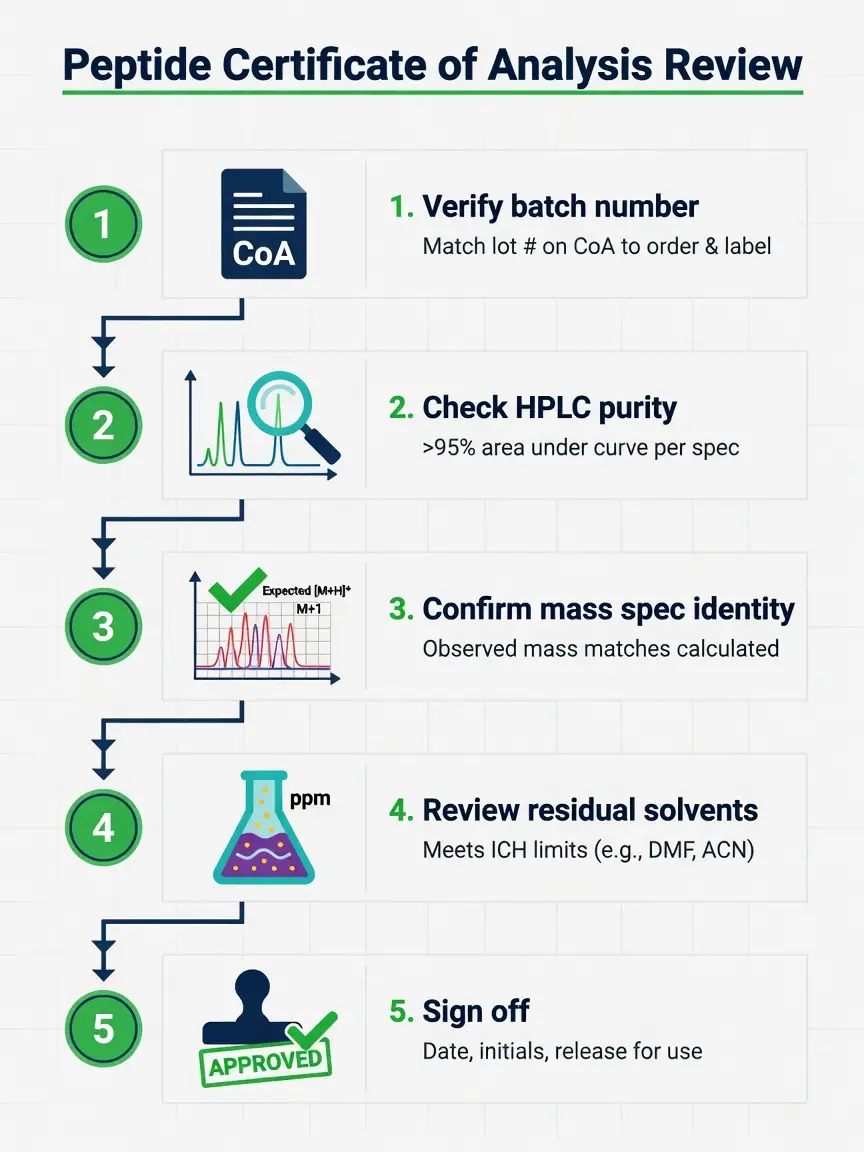
A batch-specific COA should be read like a release document. Match the vial, batch number, and numerical results before you rely on the purity line. Start with the administrative fields. Step 1 is matching the batch number on the vial or outer label to the batch number on the COA. Step 2 is checking the release date so you know the document is tied to a defined production event rather than a recycled report.
Step 3 is confirming the analytical methods listed match what the supplier claims. If the product page says HPLC and mass spectrometry, the COA should show both. Step 4 is reading the numerical result for each test. A COA that only says “conforms” without a value is incomplete. Step 5 is looking at the chromatogram or spectrum, not just the summary line. Peak shape, baseline noise, and integration boundaries all affect the reported purity number.
Step 6 is checking impurity information. If related impurities are present, the COA should identify them or at least report their total percentage. Step 7 is verifying the document is accessible after purchase, not just during pre-sale. Many labs store COAs with their batch records for audit readiness. When third party testing data is missing any of these steps, the purity claim loses its evidentiary value.
💡 Key Takeaway: How should you review a batch-specific peptide COA step by step?
What should a peptide COA include to meet strong documentation standards?
FDA Q7A-style COAs for research-use-only peptides should include six core fields: batch number, release date, tests performed, acceptance limits, numerical results, and the signature or identity of the releasing lab. If any of those fields is absent, the document cannot support a batch-specific release decision. For third party testing, the releasing lab should be independent of the supplier’s in-house QC unit.
A strong COA also includes method details such as column type, mobile phase, gradient, and detection wavelength for HPLC. For mass spectrometry, the ionization mode, mass range, and calibration reference should be stated. These details let an independent reviewer reproduce or audit the result. Without method information, a purity percentage is just a number with no analytical context.
Tiger Peptides makes batch-specific COAs publicly accessible, which aligns with FDA-style documentation expectations. You can review their research-grade peptide solutions to see examples of COA structure. If a supplier refuses to share a COA before purchase, that is a red flag for research procurement.
What are the common mistakes labs make when interpreting peptide purity data?
The most common mistake is treating purity as identity. A 99% HPLC result does not prove the peptide has the correct sequence, stereochemistry, or salt form. A second mistake is ignoring the integration method. Different labs may integrate the same chromatogram differently, leading to purity differences of a few tenths of a percent. Those differences matter in sensitive assays.
A third mistake is assuming that a single batch result predicts all future batches. Peptide synthesis can vary run to run, so each batch needs its own third party testing data. A fourth mistake is focusing only on the main peak area while ignoring related impurities below 0.1%. Those low-level impurities can be biologically active in certain research models. A fifth mistake is accepting a COA without checking the batch number against the vial. Mismatched documents are a common audit finding.
Finally, labs sometimes forget to store COAs with their experimental records. When a study result is questioned, the absence of batch-specific third party testing documentation makes troubleshooting much harder.
Why does FDA guidance matter for research-use-only peptide testing?
FDA guidance matters because it defines the documentation standard that many research labs adopt voluntarily. Even though research-use-only peptides are not subject to the same approval requirements as drug substances, the analytical principles from FDA Q7A and synthetic peptide guidance remain useful. They describe what a well-controlled batch record looks like: defined tests, acceptance criteria, and release data.
Third party testing aligns with that framework by introducing an independent check on supplier claims. FDA inspection observations often cite missing or incomplete COAs, lack of impurity characterization, and failure to verify analytical results. For research buyers, following those principles reduces the risk of using a mischaracterized peptide. The National Center for Biotechnology Information provides peer-reviewed context on analytical method validation for peptides.
When a supplier adopts FDA-style COA elements and independent third party testing, it signals that the vendor treats research-use-only materials with the same rigor expected in regulated environments. That does not make the peptide a drug, but it does make the documentation more defensible.
💡 Key Takeaway: Why does FDA guidance matter for research-use-only peptide testing?
How can you compare peptide suppliers using third party testing as a filter?
Start by requesting the COA for a specific batch before purchase. If a supplier cannot produce one, eliminate it from consideration. Next, compare the analytical methods listed on the COA. A supplier that reports only HPLC without mass spectrometry provides an incomplete picture. A supplier that reports both, with impurity data, is stronger.
Look at the lab that performed the third party testing. Accredited labs such as ISO/IEC 17025 facilities are preferable because they operate under formal quality management systems. If the supplier uses its own in-house lab and calls it “third party,” that is not independent. The independence of the testing lab is what makes third party testing meaningful.
Check the batch number traceability. A COA that lists a batch number different from the vial you receive is useless. Also compare impurity profiles across batches. If a supplier shows consistent low-level impurity behavior, that indicates a stable synthesis process. For a deeper comparison framework, see this guide on reliable peptide supplier signs.
Finally, ask whether the COA is downloadable from the product page or only sent on request. Publicly accessible COAs reduce the friction of verification and signal confidence in the data.

What role does impurity characterization play in third party testing?
Impurity characterization is the part of third party testing that answers what else is in the vial. A purity percentage only tells you how much of the main component is present. It does not identify the remaining percentage. That remaining fraction may include deletion sequences, insertion sequences, oxidation products, residual solvents, or counterions. Each impurity type can affect research results differently.
FDA guidance for synthetic peptides recommends that when impurity levels exceed certain thresholds, the impurity should be identified and, if possible, quantified. High-resolution methods such as UHPLC-HRMS become necessary when low-level impurities need structural characterization. Third party testing that includes impurity data gives research buyers the information needed to assess batch suitability.
Without impurity characterization, a 99% purity claim may hide a 0.5% impurity that is highly active in a particular assay. That hidden variable can confound experimental results. Strong third party testing programs therefore report not just the main peak area but also the number, identity, and relative abundance of secondary peaks.
How do accredited labs strengthen third party testing?
Accredited labs strengthen third party testing by operating under formal quality management standards. ISO/IEC 17025 accreditation means the lab has demonstrated competence for specific analytical methods, participates in proficiency testing, and follows documented procedures for data integrity. That reduces the chance of analytical errors or undisclosed method deviations.
When a supplier uses an accredited lab for third party testing, the resulting COA carries more weight in vendor qualification. The lab’s accreditation scope should cover the specific methods used, such as HPLC and mass spectrometry. A lab accredited for environmental testing but not peptide analysis does not add much value.
Tiger Peptides states that its third party testing is performed by accredited labs. That claim, when paired with publicly accessible COAs, gives research buyers a verifiable chain of evidence. The independence of the lab matters as much as the accreditation itself. In-house QC is still necessary, but an accredited independent lab provides a second set of eyes that is harder to dispute.
💡 Key Takeaway: How do accredited labs strengthen third party testing?
What should labs document after receiving third party testing results?
After receiving third party testing results, labs should document the batch number, the COA receipt date, the analytical methods listed, and any discrepancies between the COA and the vial label. This documentation should be stored with the experimental records for that peptide lot. If a later assay produces unexpected results, the COA becomes part of the troubleshooting trail.
Labs should also record whether the COA was publicly accessible or obtained by request. That detail matters for audit consistency. If the supplier later changes its documentation practice, the lab has a record of what was available at the time of purchase. Finally, labs should note any impurity data that falls outside the supplier’s stated specification. Even if the impurity is below the acceptance limit, a trend of rising impurity levels across batches may signal process drift.
For research-use-only peptides, this level of documentation is not required by FDA regulation, but it is a best practice adopted by many rigorous labs. It turns third party testing data into a durable part of the experimental record.
How does third party testing interact with in-house QC?
Third party testing and in-house QC serve different purposes. In-house QC monitors the synthesis process in real time, catching deviations before a batch is released. Third party testing provides an independent confirmation of the final product’s quality. One does not replace the other.
A supplier may run HPLC on every batch in its own lab and still send selected batches to an independent lab for third party testing. The independent result either confirms the in-house number or reveals a discrepancy. When the two results agree, the buyer gains confidence. When they disagree, the supplier must investigate the root cause before shipping.
For research buyers, the presence of both in-house QC and third party testing indicates a mature quality system. A supplier that only relies on its own lab has no external check. A supplier that only relies on third party testing may lack process control. The combination is what makes a purity claim trustworthy.
FAQ
What does third party testing actually verify for a peptide?
Third party testing verifies the analytical results reported by the supplier. It confirms HPLC purity, mass spectrometry identity, and impurity profile using an independent lab. This gives research buyers an auditable record separate from the vendor’s own claims.
Is a 99% purity claim enough without a batch-specific COA?
No. A purity percentage alone is incomplete because it does not confirm identity, impurity profile, or batch-specific release data. You need a COA that matches the exact batch you are buying and shows numerical results from HPLC and mass spectrometry.
What methods should appear on a strong peptide COA?
At minimum, HPLC and mass spectrometry. HPLC estimates purity by separating peaks, while mass spectrometry confirms expected molecular mass. For deeper impurity characterization, UHPLC-HRMS may be listed. The COA should include batch number, release date, acceptance limits, and actual numerical values.
How can I tell if a peptide supplier uses real third party testing?
Check whether the testing lab is independent and accredited, such as ISO/IEC 17025. Ask for a batch-specific COA before purchase and confirm the batch number matches the vial. Publicly accessible COAs and impurity data are strong signals of genuine third party testing.
Why is impurity characterization important in peptide research?
Impurity characterization identifies what else is in the vial beyond the main peptide. Related impurities, truncated sequences, or oxidation products can affect assay performance even when total purity is high. Third party testing that includes impurity data lets you assess batch suitability for your specific research model.
PubMed hosts peer-reviewed studies on peptide analysis and method validation for further reading.
Ready to Take the Next Step?
Every product includes lot-specific documentation and third-party purity testing.
Explore Our Research Products →Free shipping on qualifying orders · Batch COA on request