
7 Questions Before You Buy PT 141 for Research Labs
Before you buy a 141 peptide for research labs, verify COA, HPLC/MS, lot traceability, and research-use-only labeling with 7 documentation-first checks.
📋 Table of Contents
Before you buy a 141 peptide for a research lab, confirm the vial is sold strictly as a research peptide with research-use-only labeling, a batch-specific Certificate of Analysis (COA) linked to the exact lot, third-party HPLC and mass spectrometry verification, and purity documentation of ≥99% when claimed. A 141 peptide is the common research name for bremelanotide, while VYLEESI bremelanotide injection is the separate FDA-approved human drug product first approved in the United States in 2019; the two share a molecule but are not interchangeable purchase categories.
A documentation-first supplier such as Tiger Peptides expects labs to buy a 141 peptide only for lawful laboratory and preclinical research contexts, never for human use.
Key takeaways
- A 141 peptide is the research name for bremelanotide; VYLEESI is the separate FDA-approved human drug product, not a research-supplier vial.
- Before you buy a 141 peptide, verify research-use-only language, lot-linked COA, HPLC and mass spectrometry methods, lyophilized form, and chain of custody.
- A COA purity percentage alone is insufficient for a 141 peptide; confirm the analytical method, lot number, and test dates match the exact vial.
- FDA-approved labeling, including contraindications for uncontrolled hypertension or known cardiovascular disease and warnings about transient blood-pressure increases, applies only to VYLEESI, not to research-grade 141 peptide.
- Documentation and repeatable lot records matter more than the lowest quote when buying a 141 peptide for a research lab.
What does “PT-141” actually mean when buying a 141 peptide for a research lab?
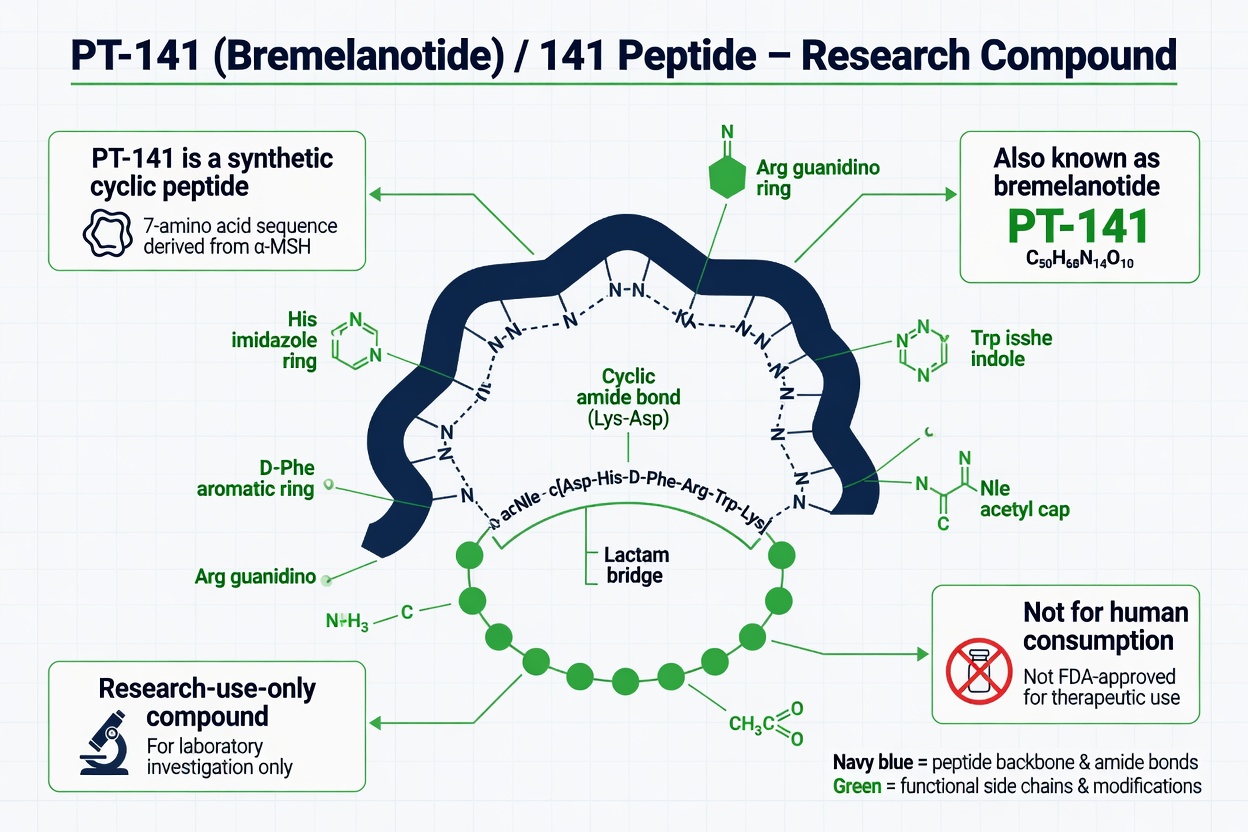
PT-141 is the common research name, while DailyMed identifies the approved human drug product as VYLEESI bremelanotide injection. Those are related entities, but they are not interchangeable purchase categories. In laboratory procurement, a 141 peptide usually refers to a research peptide sold in lyophilized form for investigational work. In government labeling, bremelanotide appears as a finished drug product with approved human labeling, packaging, administration instructions, and safety language. A common mistake is treating the chemical identity alone as proof that two products carry the same regulatory status.
That matters because FDA-approved labeling attaches to VYLEESI, not automatically to a research-supplier vial labeled PT-141. If a seller presents the 141 peptide as suitable for therapy, diagnosis, or human administration, that is a red flag for a research lab. Tiger Peptides states PT-141 is sold for research use only and not for human use, with a Certificate of Analysis and third-party testing references.
For procurement teams, the practical rule is simple: verify identity and documentation first, then verify intended use language. A 141 peptide should be purchased only for lawful laboratory use and not for human consumption. The distinction between a research peptide and an FDA-approved drug product is not a technicality; it determines which documentation standards apply to the purchase.
How is research-grade PT-141 different from VYLEESI when buying a 141 peptide for a research lab?
Research-grade PT-141 and VYLEESI share the bremelanotide molecule, but VYLEESI is the FDA-labeled human drug product. A research vial of 141 peptide is not the approved injectable product. DailyMed states that VYLEESI is a bremelanotide injection for subcutaneous use with an initial U.S. approval date of 2019. The label also includes use restrictions, contraindications for uncontrolled hypertension or known cardiovascular disease, and warnings about transient increases in blood pressure and reductions in heart rate.
Those facts are relevant because they show how tightly the approved product is framed by regulators. A research supplier, by contrast, should not imply equivalence to that finished drug product. The appropriate standard is documentation, not therapeutic positioning. If a lab sees approved-drug language used to sell a research vial of 141 peptide, it should ask whether the seller is accurately separating research material from approved clinical products.
A useful comparison for procurement teams is the label language. VYLEESI labeling is written for prescribers and patients; a research 141 peptide listing should be written for laboratory investigators. The former includes dosing, adverse reactions, and clinical pharmacology. The latter should include batch data, analytical methods, and storage conditions. Mixing those two registers is a compliance warning sign.
| Feature | VYLEESI bremelanotide injection | Research-grade 141 peptide |
|—|—|—|
| Regulatory status | FDA-approved human drug product | Research-use-only material |
| Intended audience | Prescribers and patients | Laboratory investigators |
| Core documentation | Prescribing information, clinical pharmacology | Batch COA, HPLC/MS data, storage conditions |
| Label language | Dosing, adverse reactions, contraindications | Lot number, purity, analytical methods |
| Purchase category | Finished drug product | Lyophilized research peptide |
Peer-reviewed literature on bremelanotide can be searched through PubMed and PMC.
💡 Key Takeaway: How is research-grade PT-141 different from VYLEESI when buying a 141 peptide for a research lab?
What are the 7 most important 141 peptide supplier checks for research labs?
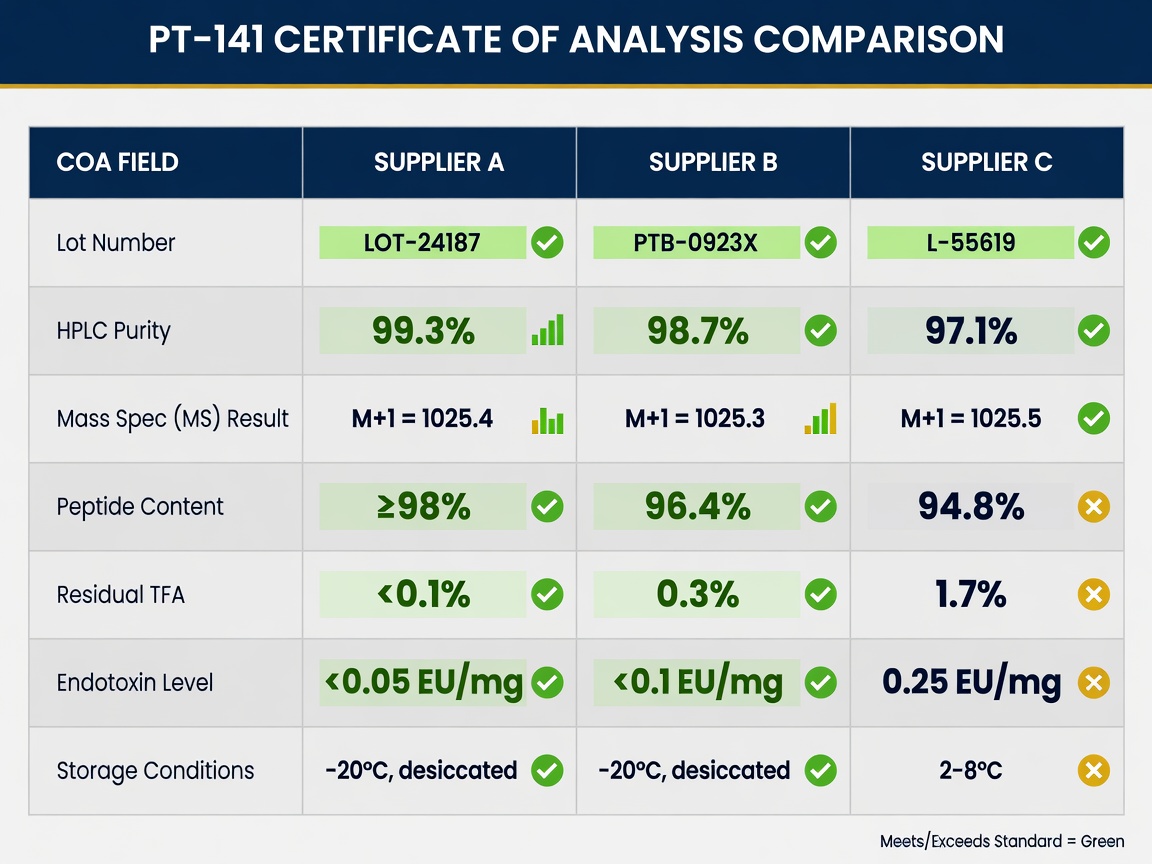
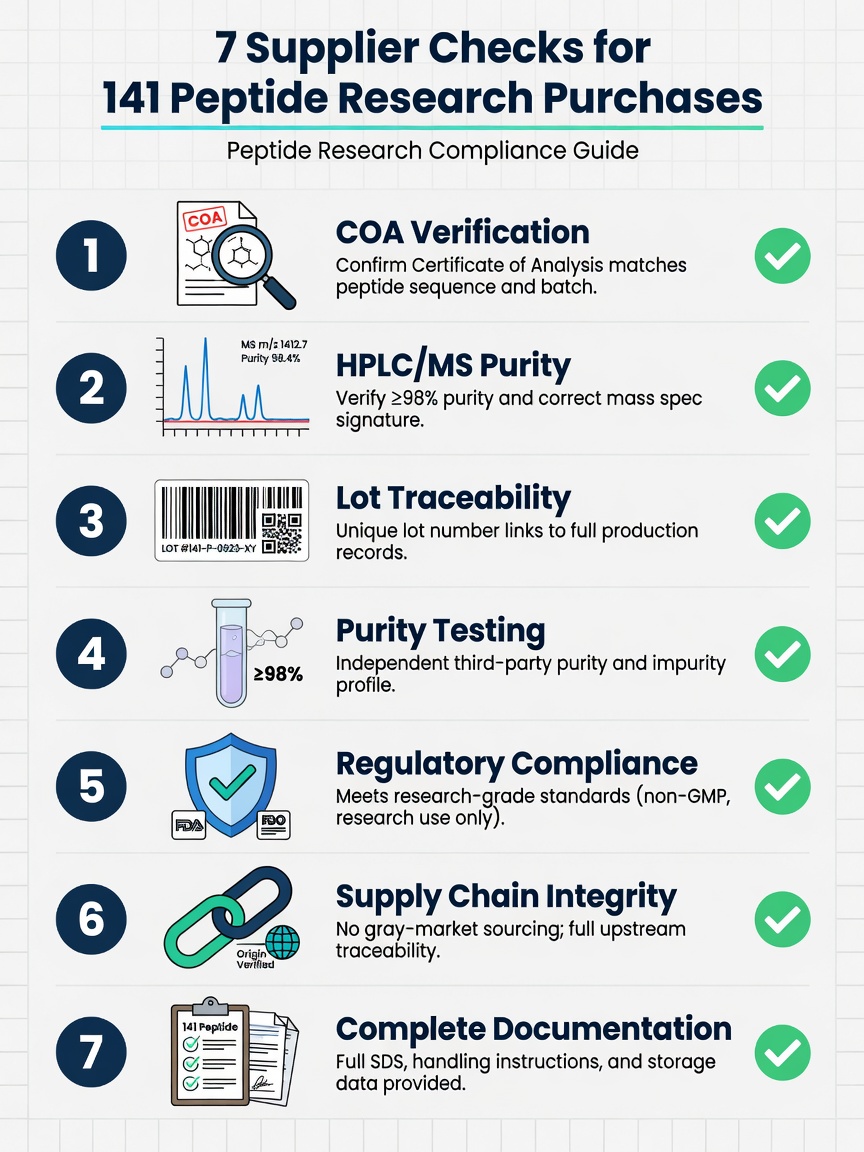
The best 141 peptide supplier checks are documentation checks. A qualified lab should review the record trail before reviewing the price. Tiger Peptides lists PT-141 as research-only material and states batch documentation, third-party HPLC/MS testing, and public Certificates of Analysis.
The seven checks are:
1. Research-use-only labeling — the listing should clearly state not for human use and not FDA approved for medical, therapeutic, or diagnostic use.
2. Batch-specific COA — confirm the Certificate of Analysis matches the exact 141 peptide lot, not a generic template.
3. Identity methods — HPLC and mass spectrometry are stronger than a purity percentage shown without test methodology.
4. Form and composition — lyophilized 141 peptide with no fillers or additives is easier to assess than vague blended formulations.
5. Chain of custody — U.S. manufacturing details, custody records, or batch traceability reduce uncertainty.
6. Support quality — research-focused support should answer technical documentation questions without drifting into human-use discussions.
7. Price after documentation — cost still matters, but it should come after these checks. The lowest-cost vial of 141 peptide can become the highest-cost procurement error if the COA is missing, the lot is unclear, or the seller uses noncompliant language.
For a broader supplier evaluation framework, review 10 Signs of a Reliable Peptide Supplier in the USA. That article explains how documentation habits separate controlled suppliers from anonymous marketplaces. When you compare a 141 peptide from multiple vendors, apply the same seven checks to every quote. A supplier that fails one check may fail others under closer inspection.
How should a lab verify a 141 peptide Certificate of Analysis step by step?
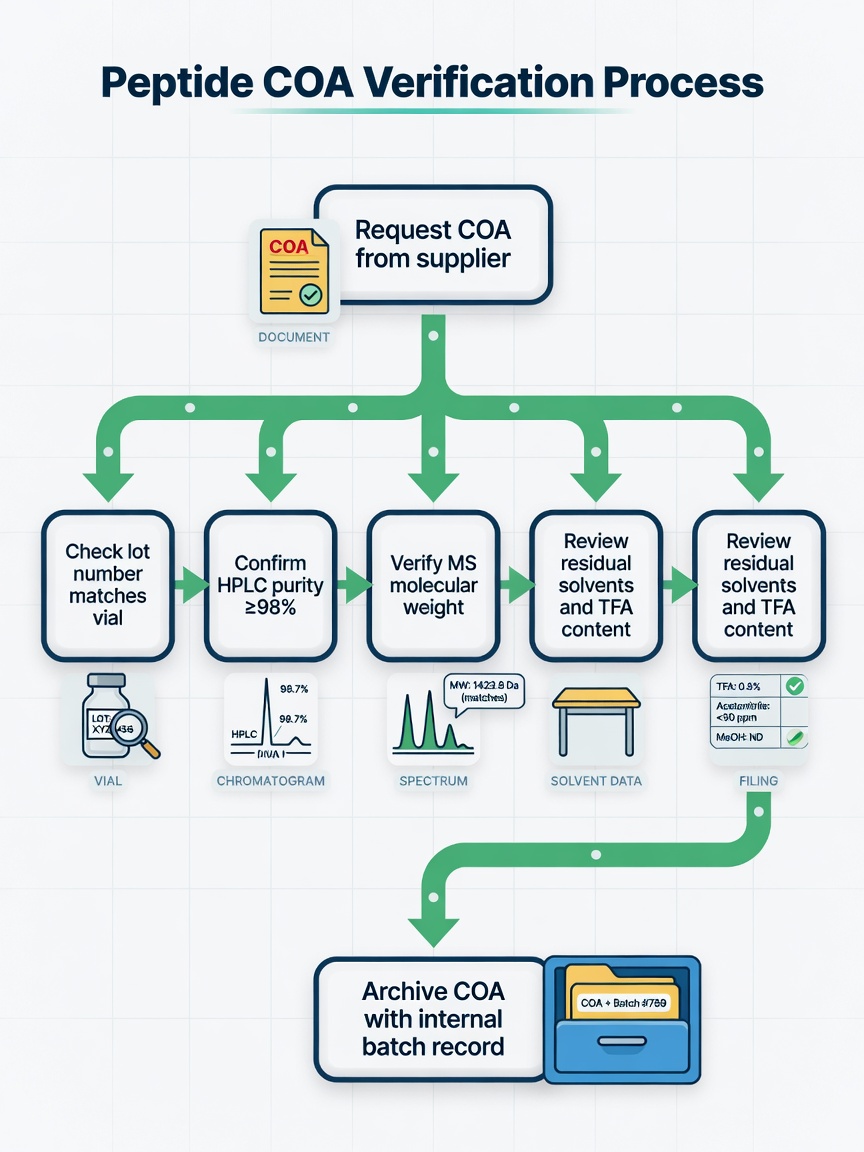
A 141 peptide COA should be checked against the lot, methods, and identity markers before purchase. HPLC and mass spectrometry are the first two methods most labs look for.
Step 1 is identity matching. Confirm that the product label, vial lot, and COA lot number are the same. If the seller cannot provide a lot-linked document for the 141 peptide, treat the listing as undocumented.
Step 2 is method review. Look for the analytical method named on the document, not just a purity percentage. HPLC can support chromatographic purity, while mass spectrometry helps verify molecular identity. Some suppliers also cite amino acid analysis. A common misconception is that “99% pure” means little unless the method and batch are visible for the 141 peptide.
Step 3 is document quality review. The COA should show test dates, lot information, and the analytical signature or reviewer name. A COA without test dates or lot information is a template, not a verification record for a 141 peptide.
Step 4 is storage and stability review. Confirm the lyophilized 141 peptide is stored appropriately and that the COA notes recommended storage conditions. A supplier that omits storage data may be omitting other stability details.
Step 5 is independent verification. Where possible, compare the COA against third-party test references or repeat analysis. A 141 peptide COA that cannot be cross-checked is weaker than one backed by independent HPLC/MS data.
Step 6 is record retention. Keep every 141 peptide COA, invoice, and communication with the lot number in a permanent research archive. This step protects future audits and experimental reproducibility.
Which documentation habits should labs adopt before and after buying a 141 peptide?
Before purchase, a lab should create a procurement checklist that includes research-use-only language, lot-linked COA, HPLC/MS method visibility, and storage conditions. After purchase, the lab should archive the COA with the lot number and log any observations about the lyophilized powder. These habits make repeat purchases of a 141 peptide faster and safer because each new order is compared against a documented baseline. A lab that wants to standardize these habits can review Tiger Peptides | Research-Grade Peptides for Laboratories.
Documentation habits also include rejecting any supplier that uses therapeutic language, before and after the transaction. If a vendor sends follow-up messages suggesting human use of a 141 peptide, the lab should stop the order and document the incident. The habit of recording supplier behavior is as important as recording analytical data.
A simple documentation checklist for a 141 peptide order can be organized as follows:
| Pre-purchase check | Post-purchase action |
|—|—|
| Research-use-only language present | Archive COA with lot number |
| Lot-linked COA available | Log powder appearance and storage |
| HPLC and mass spectrometry methods named | Record any supplier follow-up language |
| Storage conditions stated | Cross-check COA against received vial |
| Chain of custody or manufacturing detail | Flag any missing data for next order |
This table helps a lab turn a one-time purchase into a repeatable quality process. It also makes it easier to compare a 141 peptide from different suppliers without relying on memory or price alone. Each row is a documentation signal, not a therapeutic claim.
💡 Key Takeaway: Which documentation habits should labs adopt before and after buying a 141 peptide?
Why does documentation matter more than price when you buy a 141 peptide for a research lab?
Price is easy to compare; documentation is harder to fake and harder to recover if missing. A low-cost vial of 141 peptide without a batch-specific COA, lot traceability, or HPLC/MS verification cannot support reproducible research. The real procurement cost includes the time lost when a study fails because the peptide identity or purity was uncertain.
Documentation also protects the lab’s compliance posture. A supplier that provides a proper 141 peptide COA and research-use-only labeling is demonstrating that it understands the boundary between research material and approved drugs. That understanding reduces the risk of ordering a product that carries unclear regulatory language. For labs that buy peptides regularly, the documentation habit is the only sustainable quality control system.
A missing COA cannot be reconstructed after the fact. If a lab archives only an invoice and a vague product page, future audits will lack the analytical evidence needed to support experimental findings. Documentation is also the only way to compare one supplier against another over time, because price fluctuations do not capture lot-to-lot consistency. Labs that treat documentation as a fixed cost rather than a variable negotiation point tend to build more reliable peptide inventories. This principle applies to every research peptide purchase, not just bremelanotide-related material.
What are common mistakes when purchasing PT-141 for in vitro studies?
The most common mistake is treating chemical identity as a substitute for regulatory status. A vial labeled PT-141 is not automatically the same as the FDA-approved VYLEESI product, and a supplier that blurs that line should be avoided. Another mistake is accepting a COA that shows only a purity number without the lot number, test date, or analytical method. Labs sometimes also ignore storage conditions or fail to verify that the lyophilized powder matches the documented batch. Finally, some teams let the lowest quote override documentation checks, which can turn a cheap vial into an expensive reproducibility problem.
If you are comparing multiple vendor quotes, the framework in Searching “Almighty Peptides”? How to Compare Suppliers applies directly to PT-141 procurement. The same documentation-first filters work for any research peptide.
Another common mistake is failing to separate the research-use-only register from the FDA-approved labeling register. A lab might see the word “bremelanotide” on both a VYLEESI package insert and a research vial description, then assume the safety language carries over. It does not. The approved product carries contraindications and warnings for human use; a research vial should carry no such language because it is not for human use. Labs that conflate the two can accidentally import clinical dosing or adverse reaction thinking into an in vitro protocol, which is a compliance and scientific error. Keeping the two documents in separate folders is a simple habit that prevents this mistake.
How can a lab compare COA fields across different PT-141 suppliers?
Create a comparison table with columns for lot number, purity percentage, HPLC method, mass spectrometry method, test date, storage conditions, and research-use-only language. For each supplier quote, fill in every field before ranking. A missing field is a data point, not a neutral blank. Two COAs might both claim ≥99% purity, but if one lacks a lot number or test date, it is not equivalent documentation. Labs should also compare the level of third-party testing references and whether the supplier provides public COAs or only sends documents after payment.
This comparison method works for any research peptide and prevents the common error of comparing only price and purity percentage. A supplier that cannot complete the table for PT-141 will likely fail the same test for other peptides.
Beyond the COA fields, labs should compare how quickly a supplier provides documentation. A supplier that posts public COAs for each batch is easier to evaluate than one that only sends a PDF after payment. Response time to a documentation question is also a quality signal: a supplier that cannot explain its HPLC method or lot traceability in plain language may be reselling material without control. Labs can score each supplier on a simple three-point scale for each COA field: present and complete, present but incomplete, or absent. That scoring method turns subjective impressions into a repeatable procurement decision.
Over time, the lab builds a preferred supplier list based on documentation performance, not marketing language.
💡 Key Takeaway: How can a lab compare COA fields across different PT-141 suppliers?
FAQ
Is PT-141 the same as VYLEESI?
No. PT-141 is the common research name for bremelanotide, while VYLEESI bremelanotide injection is the FDA-approved human drug product first approved in 2019. A research vial labeled PT-141 is not interchangeable with the approved injectable product.
What should a lab check before buying a research peptide like PT-141?
Check research-use-only labeling, a batch-specific COA linked to the exact lot, HPLC and mass spectrometry verification, lyophilized form with no fillers, and chain of custody documentation. Price should be evaluated only after these checks.
Why is a COA purity percentage alone not enough?
A purity number without the analytical method, lot number, and test dates does not verify that the document matches the exact vial. HPLC and mass spectrometry data are stronger than an unverified percentage.
What are the VYLEESI contraindications that labs should know about?
FDA-approved labeling for VYLEESI includes contraindications for uncontrolled hypertension or known cardiovascular disease and warnings about transient increases in blood pressure and reductions in heart rate. These apply only to the approved drug product, not to research-grade PT-141.
Can a research peptide supplier use human-use language?
No. A supplier selling PT-141 for research should use research-use-only language only. Any therapeutic, diagnostic, or human administration language is a red flag for a research lab.
What documentation should be archived after a PT-141 order?
Archive the COA with lot number, the invoice, any supplier communication, and a note about the lyophilized powder’s appearance and storage conditions. This record supports reproducibility and future audits.
Ready to Take the Next Step?
Every product includes lot-specific documentation and third-party purity testing.
Explore Our Research Products →Free shipping on qualifying orders · Batch COA on request