
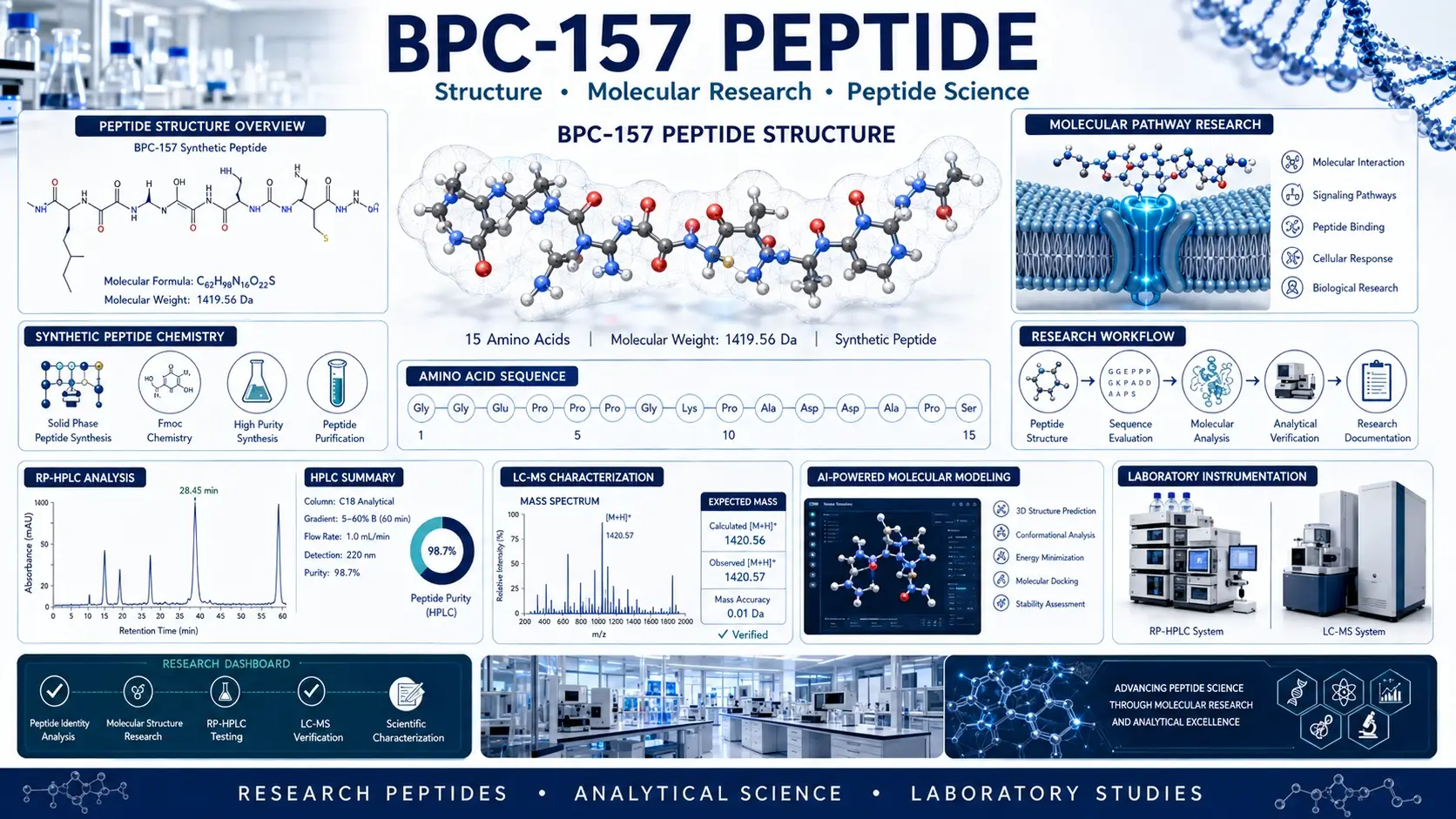
BPC-157 Peptide Research Guide: Molecular Pathways, Scientific Studies & Analysis
bpc 157 peptide research guide covering molecular pathways, LC-MS purity testing, and TB-500 comparison. Research-use-only lab analysis for synthetic peptides.
{
“seoTitle”: “bpc 157 peptide research: 2025 Proven Lab Guide”,
“metaDescription”: “bpc 157 peptide research: 2025 proven lab guide to BPC-157 molecular structure, LC-MS purity, RP-HPLC identity, TB-500 comparison, and COA review.” ,
“content”: “This bpc 157 peptide research guide answers how the 15-amino-acid synthetic pentadecapeptide known as BPC-157 is characterized for laboratory use, which molecular pathways and analytical methods such as LC-MS and RP-HPLC support bpc 157 peptide research, and how BPC-157 compares with TB-500 peptide research. BPC-157 is derived from a partial sequence of Body Protection Compound (BPC) originally identified in gastric protein research; all information is for in vitro research use only, not for human use.
\n\n## Key takeaways\n\n- BPC-157 is a synthetic pentadecapeptide composed of a 15-amino-acid sequence derived from Body Protection Compound (BPC) research. \n- Laboratory bpc 157 peptide research focuses on peptide stability, molecular signaling pathways, and structure-function relationships in controlled experimental models. \n- Analytical evaluation for BPC-157 peptides relies on RP-HPLC and LC-MS for purity and identity characterization, with certificate of analysis (COA) review as a procurement baseline. \n- BPC-157 and TB-500 represent distinct research categories: BPC-157 is a synthetic BPC fragment, while TB-500 is thymosin beta-4 related with an actin-binding peptide research focus. \n- All discussions remain research-use-only; no human use, dosing, or clinical claims are implied.
\n\n## What does this bpc 157 peptide research guide cover? \n\nThis bpc 157 peptide research guide covers BPC-157 peptide molecular structure, amino acid sequence, synthetic peptide classification, Body Protection Compound research background, BPC-157 and TB-500 peptide comparison, molecular pathways studied in scientific literature, and analytical methods used for laboratory characterization. The content is designed for documentation-first laboratory workflows, where teams evaluate research materials based on certificates of analysis, research-use labeling, and lot traceability before procurement decisions. \n\nEvery section in this bpc 157 peptide research guide remains strictly within a research-use-only framework; no human or veterinary applications are described, and no dosing or clinical guidance is provided.
Researchers who follow this bpc 157 peptide research guide can use the outlined analytical criteria to compare peptide lots, verify sequence integrity, and align study design with peer-reviewed literature themes. The guide also distinguishes BPC-157 from related peptide categories like TB-500, which helps laboratories avoid cross-contamination in experimental planning. \n\n## What is BPC-157 peptide and what is its research classification? \n\nBPC-157 peptide is a synthetic pentadecapeptide composed of a 15-amino-acid sequence derived from research involving Body Protection Compound (BPC), a peptide fragment originally identified during gastric protein studies. Scientific interest in bpc 157 peptide research focuses on understanding peptide stability, molecular signaling mechanisms, and structure-function relationships.
Unlike many naturally occurring peptides that undergo rapid structural changes in biological environments, BPC-157 peptides have been investigated in laboratory settings because of their molecular characteristics and sequence stability observed during experimental research. Modern bpc 157 peptide research studies examine amino acid arrangement, synthetic peptide chemistry, molecular interactions, and analytical characterization rather than general outcome-based interpretations. \n\nBPC-157 is studied as a stable synthetic peptide fragment. Researchers use synthetic peptide fragments such as BPC-157 to understand how specific amino acid sequences influence molecular stability, structural behavior, and peptide interaction pathways in experimental systems.
In classification terms, bpc 157 peptide research categorizes BPC-157 as a Body Protection Compound-derived synthetic fragment, not a naturally occurring peptide isolate. This distinction matters for procurement: research teams should verify that any BPC-157 material is labeled as research-use-only, with a certificate of analysis indicating synthetic origin and peptide content. \n\nIn practical terms, a research laboratory will first confirm the peptide’s identity and purity before using it in any assay. Because bpc 157 peptide research emphasizes analytical characterization, the classification as a synthetic fragment is tied to documentation rather than to any functional outcome.
Laboratories should also note that BPC-157 is not an approved drug, not a dietary supplement, and not intended for any diagnostic or therapeutic application; the research-use-only label is a legal and scientific boundary, not a marketing disclaimer. \n\n## What molecular structure and amino acid sequence define BPC-157? \n\nThe molecular identity of BPC-157 peptide is defined by its specific amino acid arrangement. Sequence analysis is an important part of bpc 157 peptide research because even small structural variations can influence molecular properties and research observations. Scientists analyze BPC-157 peptides through peptide chemistry methods to evaluate molecular composition, sequence integrity, and structural characteristics.
The table below summarizes the BPC-157 research profile used across bpc 157 peptide research literature. \n\n| Feature | BPC-157 Research Profile |\n|—|—|\n| Peptide Type | Synthetic Pentadecapeptide |\n| Sequence Length | 15 Amino Acids |\n| Research Origin | Body Protection Compound-Derived Fragment |\n| Research Category | Synthetic Peptide Biology |\n| Analytical Methods | LC-MS, RP-HPLC, Molecular Characterization |\n| Research Material Format | Lyophilized Research Peptide |\n| Analytical Evaluation | Purity & Identity Characterization |\n\nPeptide sequence determines molecular research characteristics: a peptide’s amino acid sequence influences its molecular properties. Researchers study sequence differences to better understand peptide stability, structure, and interaction patterns.
In bpc 157 peptide research, the 15-amino-acid length classifies BPC-157 as a pentadecapeptide, a size range that allows detailed mass spectrometry analysis and reproducible synthesis controls. The lyophilized format noted in the table is standard for research peptides because it supports long-term storage and lot-to-lot consistency; laboratories should confirm lyophilization parameters and storage conditions on the certificate of analysis before use. \n\nBecause BPC-157 is a synthetic fragment rather than a full-length protein, analytical methods can resolve the complete sequence with high confidence, which is a key advantage in bpc 157 peptide research workflows.
Additionally, the defined sequence enables researchers to design controlled experiments around structure-function relationships, such as comparing BPC-157 with truncated or scrambled peptide analogs. These comparisons are a core part of BPC-157 peptide research methodology, allowing laboratories to isolate which amino acid residues contribute to observed stability or interaction patterns. \n\n## What is the Body Protection Compound (BPC) research background? \n\nBPC-157 originates from scientific investigations involving Body Protection Compound, a peptide sequence studied for its molecular properties and biological signaling pathways in research models. The compound was originally identified during gastric protein research, and the synthetic BPC-157 fragment retains research interest due to its sequence stability and defined molecular structure.
Researchers continue examining this peptide category to understand how specific amino acid sequences may interact with complex molecular systems and contribute to broader peptide research. This background is essential for bpc 157 peptide research because it clarifies why BPC-157 is treated as a synthetic fragment rather than a full-length biological isolate. In laboratory documentation, the Body Protection Compound origin supports the classification of BPC-157 under synthetic peptide biology, and it reinforces the need for sequence-specific identity testing before any experimental use. \n\n## How is BPC-157 classified as a synthetic peptide?
\n\nBPC-157 is classified as a synthetic peptide because it is produced through peptide synthesis rather than isolated from natural biological sources. This classification is central to bpc 157 peptide research because synthetic peptides offer defined sequences, controlled purity profiles, and reproducible lot characteristics. In a research setting, a synthetic peptide such as BPC-157 can be characterized by mass spectrometry and chromatography with high precision, which supports accurate structure-function studies. The synthetic classification also means that every batch must be verified against a reference standard or certificate of analysis. \n\nLaboratories conducting bpc 157 peptide research should document the synthesis route, purification method, and residual solvent profile when available.
BPC-157 is not a naturally occurring peptide isolate, and it is not an approved drug, dietary supplement, or therapeutic agent. The research-use-only designation is a legal and scientific boundary that applies to all procurement and handling steps. Because synthetic peptides can vary by counterion, salt form, and lyophilization parameters, researchers should request the certificate of analysis before accepting any lot. This documentation-first approach is a best practice in bpc 157 peptide research and aligns with reliable supplier criteria from 10 Signs of a Reliable Peptide Supplier in the USA. \n\n## How do BPC-157 and TB-500 peptide research compare?
\n\nBPC-157 and TB-500 represent distinct peptide research categories with different molecular origins and study focuses. BPC-157 is a synthetic pentadecapeptide fragment derived from Body Protection Compound research, while TB-500 is a synthetic peptide related to thymosin beta-4 and studied for actin-binding interactions. The table below summarizes key differences relevant to bpc 157 peptide research and laboratory planning.
\n\n| Feature | BPC-157 | TB-500 |\n|—|—|—|\n| Peptide Class | Synthetic pentadecapeptide (15 amino acids) | Thymosin beta-4 related peptide |\n| Research Origin | Body Protection Compound fragment | Actin-binding peptide research focus |\n| Analytical Focus | Sequence integrity, stability, molecular signaling | Actin regulation, cell migration research models |\n| Common Characterization | LC-MS, RP-HPLC, COA review | LC-MS, RP-HPLC, COA review |\n| Research-Use Status | In vitro research only | In vitro research only |\n\nThis comparison is important because laboratories often source multiple peptides for parallel studies, and cross-contamination or mislabeling can compromise experimental integrity. 157
Ready to Take the Next Step?
Every product includes lot-specific documentation and third-party purity testing.
Explore Our Research Products →
Free shipping on qualifying orders · Batch COA on request